
We read your photo as:
Describe the life cycle of Wuchereria bancrofti, a cause of lymphatic filariasis.
ScanSolve AI Answer
Step-by-step solution
4 stepsAnswer Question 1.
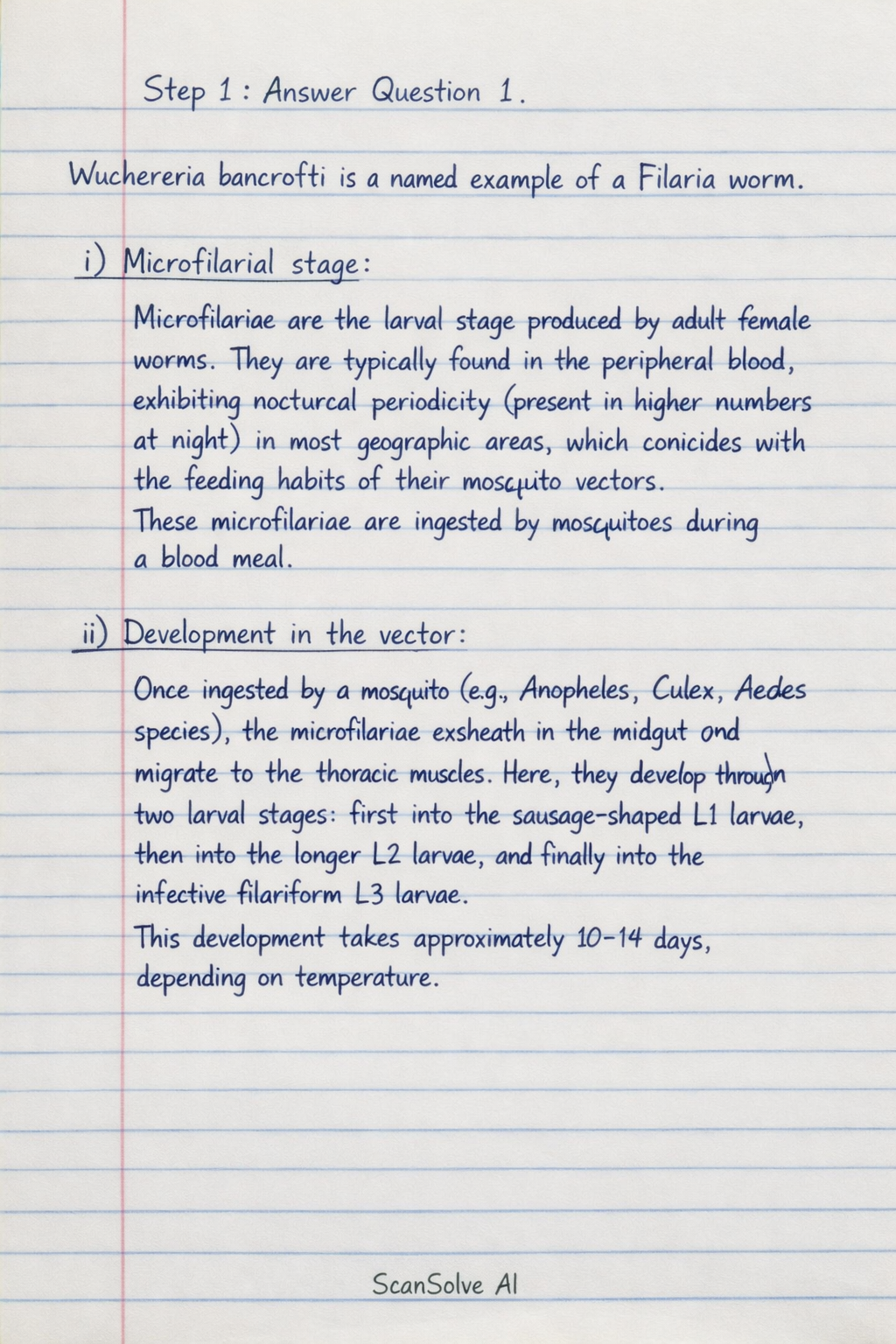
Wuchereria bancrofti is a named example of a Filaria worm.
-
i) Microfilarial stage: Microfilariae are the larval stage produced by adult female worms. They are typically found in the peripheral blood, exhibiting nocturnal periodicity (present in higher numbers at night) in most geographic areas, which coincides with the feeding habits of their mosquito vectors. These microfilariae are ingested by mosquitoes during a blood meal.
-
ii) Development in the vector: Once ingested by a mosquito (e.g., Anopheles, Culex, Aedes species), the microfilariae exsheath in the midgut and migrate to the thoracic muscles. Here, they develop through two larval stages: first into the sausage-shaped L1 larvae, then into the longer L2 larvae, and finally into the infective filariform L3 larvae. This development takes approximately 10-14 days, depending on temperature.
-
iii) Transmission to host: The infective L3 larvae migrate from the mosquito's thoracic muscles to its proboscis. When the infected mosquito takes another blood meal on a human host, the L3 larvae emerge from the proboscis onto the skin and actively penetrate the skin through the bite wound.
-
iv) Maturation in the host: After penetrating the skin, the L3 larvae migrate to the lymphatic vessels and lymph nodes. Over several months (typically 6-12 months), they mature into adult male and female worms. The adult worms reside in the lymphatic system, where they mate, and the females produce millions of microfilariae, completing the cycle.
-
Answer Question 2.
-
i) Lifecycle of a named Plasmodium species (Plasmodium falciparum) with an annotated description: The lifecycle of Plasmodium falciparum involves two hosts: humans (asexual reproduction) and Anopheles mosquitoes (sexual reproduction).
-
Human Host (Asexual Cycle):
- Infection: An infected Anopheles mosquito injects sporozoites into the human bloodstream during a blood meal.
- Liver Stage (Exoerythrocytic Cycle): Sporozoites rapidly travel to the liver and invade hepatocytes. Inside liver cells, they develop into schizonts, which undergo asexual reproduction (schizogony) to produce thousands of merozoites. This stage is asymptomatic.
- Erythrocytic Stage: Merozoites are released from the liver cells and invade red blood cells (RBCs). Inside RBCs, they develop into ring forms, then trophozoites, and finally schizonts. These schizonts rupture the RBCs, releasing more merozoites to infect new RBCs, leading to cycles of fever and chills.
- Gametocyte Formation: Some merozoites differentiate into male and female gametocytes within RBCs. These are the sexual stages.
-
Mosquito Host (Sexual Cycle):
- Infection: An uninfected Anopheles mosquito ingests gametocytes during a blood meal from an infected human.
- Gametogenesis and Fertilization: In the mosquito's midgut, gametocytes mature into gametes. Male and female gametes fuse to form a zygote.
- Oocyst Development: The zygote develops into a motile ookinete, which penetrates the midgut wall and forms an oocyst on the outer surface.
- Sporozoite Formation: Inside the oocyst, thousands of sporozoites develop.
- Transmission: The oocyst ruptures, releasing sporozoites that migrate to the mosquito's salivary glands, ready to infect another human host.
-
-
ii) Five Plasmodium species:
- Plasmodium falciparum
- Plasmodium vivax
- Plasmodium ovale
- Plasmodium malariae
- Plasmodium knowlesi
-
iii) Laboratory diagnosis: The primary method is microscopic examination of Giemsa-stained thick and thin blood smears to identify parasites, species, and quantify parasite density. Rapid Diagnostic Tests (RDTs) detect parasite antigens. Molecular methods like PCR are used for species identification and drug resistance detection.
-
iv) Clinical manifestation: Malaria typically presents with fever, chills, headache, muscle aches, and fatigue. Other symptoms include nausea, vomiting, diarrhea, and abdominal pain. Severe malaria, particularly with P. falciparum, can lead to cerebral malaria, severe anemia, acute kidney injury, respiratory distress, and metabolic acidosis.
-
v) Prevention and control: Prevention strategies include vector control (e.g., insecticide-treated bed nets (ITNs), indoor residual spraying (IRS), larval source management) and chemoprophylaxis for travelers. Control measures involve prompt diagnosis and effective treatment of infected individuals, and vaccine development (e.g., RTS,S vaccine).
-
Answer Question 3.
-
a. Define the term Ancylostomiasis: Ancylostomiasis is a parasitic infection of the small intestine caused by hookworms of the genus Ancylostoma. It is characterized by blood loss, leading to iron deficiency anemia.
-
b. Mention the two species of Ancylostoma that affect humans:
- Ancylostoma duodenale
- Ancylostoma ceylanicum
-
c. Succinctly discuss their pathophysiology: Adult hookworms attach to the intestinal mucosa using their buccal capsules and feed on blood and tissue fluids. They secrete anticoagulants and proteolytic enzymes, causing continuous blood loss from the attachment sites. Chronic blood loss leads to iron deficiency anemia, hypoproteinemia, and malnutrition, especially in children and pregnant women.
-
d. Laboratory diagnosis: The definitive diagnosis is made by microscopic examination of stool samples to detect the characteristic oval-shaped eggs. The Kato-Katz technique can be used to quantify egg burden.
-
e. Prevention and control: Prevention and control measures include improving sanitation (proper disposal of human feces), wearing shoes in endemic areas to prevent skin penetration by larvae, and mass drug administration with anthelmintics (e.g., albendazole or mebendazole) in high-prevalence communities.
-
Answer Question 5.
-
a. Causative agent: The causative agent of Enterobiasis is Enterobius vermicularis, commonly known as the pinworm or threadworm.
-
b. Pathophysiology: Adult Enterobius vermicularis worms reside in the cecum and adjacent parts of the large intestine. Gravid female worms migrate nocturnally to the perianal and perineal regions to lay eggs on the skin. This migration and egg-laying cause intense pruritus ani (anal itching), which is the most common symptom. Scratching can lead to secondary bacterial infections and autoinfection.
-
c. Laboratory diagnosis: Diagnosis is primarily made by the scotch tape test (also known as the perianal swab or Graham sticky tape method). This involves pressing a piece of transparent adhesive tape to the perianal skin, preferably in the morning before bathing or defecation, to collect eggs. The tape is then examined microscopically for the characteristic D-shaped eggs.
-
d. Prevention and control: Prevention and control focus on good personal hygiene, especially frequent hand washing (particularly after using the toilet and before eating), trimming fingernails short, and discouraging nail-biting. Regular changing and washing of underwear and bed linens in hot water can help reduce environmental contamination. Mass treatment of all household members is often recommended to prevent reinfection.
-
Still stuck on this one?
Ask a follow-up, and the answer starts from this question.
More Biology Questions
Handwritten Step-by-Step Solution
Get this as a handwritten image on WhatsApp — like a tutor wrote it for you.
Try on WhatsApp