
We read your photo as:
List 4 common laboratory preservatives and differentiate between bilateral and radial symmetry with one example each. Also tabulate 8 differences between monocots and dicots.
ScanSolve AI Answer
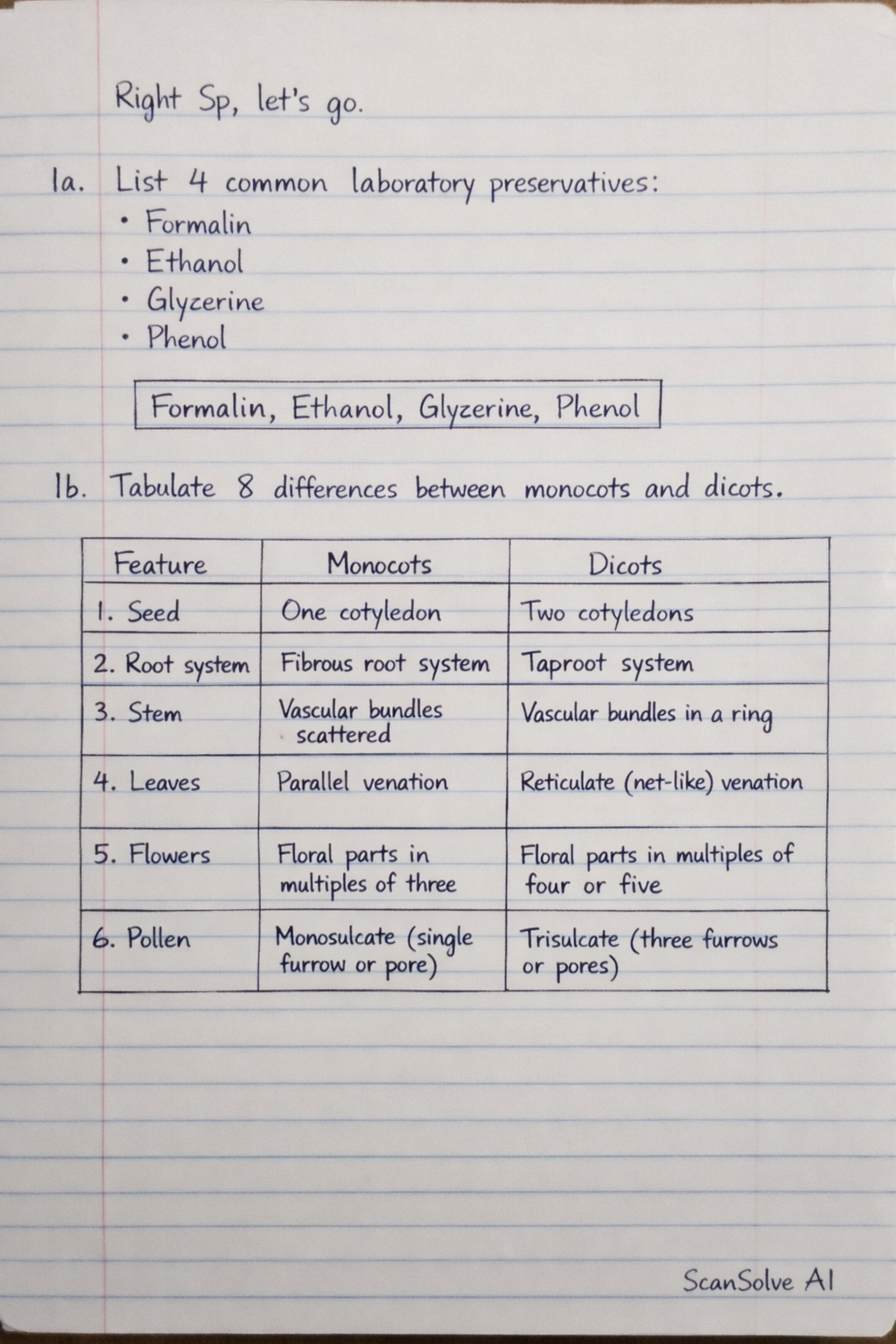
1a. List 4 common laboratory preservatives.
- Formalin
- Ethanol
- Glycerine
- Phenol
1b. Tabulate 8 differences between monocots and dicots.
| Feature | Monocots | Dicots |
|---|---|---|
| 1. Seed | One cotyledon | Two cotyledons |
| 2. Root system | Fibrous root system | Taproot system |
| 3. Stem | Vascular bundles scattered | Vascular bundles in a ring |
| 4. Leaves | Parallel venation | Reticulate (net-like) venation |
| 5. Flowers | Floral parts in multiples of three | Floral parts in multiples of four or five |
| 6. Pollen | Monosulcate (single furrow or pore) | Trisulcate (three furrows or pores) |
| 7. Secondary growth | Usually absent | Often present |
| 8. Cambium | Absent | Present |
2a. With one example each differentiate between bilateral and radial symmetry.
- Bilateral symmetry means an organism can be divided into two mirror-image halves along only one plane. An example is a human.
- Radial symmetry means an organism can be divided into similar halves by any plane passing through its central axis. An example is a starfish.
2b. List the main levels of the taxonomic hierarchy.
The main levels of the taxonomic hierarchy, from broadest to most specific, are:
- Domain
- Kingdom
- Phylum
- Class
- Order
- Family
- Genus
- Species
2c. What is a herbarium?
A herbarium is a collection of preserved plant specimens, typically dried and mounted on sheets, along with associated data such as collection date, location, and collector's name. It serves as a reference for botanical research and identification.
3a. What is natural selection? Outline the mechanism guiding it.
Natural selection is the process by which organisms better adapted to their environment tend to survive and produce more offspring.
The mechanism guiding natural selection involves:
- Variation: Individuals within a population show variations in their traits.
- Inheritance: Many of these variations are heritable, meaning they can be passed from parents to offspring.
- Overproduction: Organisms produce more offspring than the environment can support, leading to competition for resources.
- Differential Survival and Reproduction: Individuals with advantageous heritable traits are more likely to survive, reproduce, and pass those traits to their offspring, increasing the frequency of these traits in the population over generations.
3b. List the qualities of a name.
The qualities of a scientific name (binomial nomenclature) include:
- Unique: Each species has a distinct name.
- Universal: Used globally, transcending language barriers.
- Stable: Names are generally consistent and do not change frequently.
- Latinized: Names are typically in Latin or Latinized.
- Binomial: Composed of two parts: genus and species epithet.
4a. Briefly explain the concept of alternation of generation.
Alternation of generations is a life cycle found in plants and some algae, characterized by two distinct multicellular stages: a haploid gametophyte and a diploid sporophyte. The sporophyte produces spores via meiosis, which grow into gametophytes. The gametophyte then produces gametes via mitosis, which fuse during fertilization to form a zygote that develops into a new sporophyte.
4b. List and discuss the 3 theories of animal distribution.
The three main theories of animal distribution (biogeography) are:
- Theory of Continental Drift (Plate Tectonics): This theory explains that the movement of Earth's tectonic plates over geological time has caused continents to drift apart, isolating populations and leading to independent evolution and unique distributions of species.
- Theory of Dispersal: This theory describes how species spread from their original geographic range to new areas. Dispersal can occur through active migration (e.g., animals moving) or passive transport (e.g., seeds carried by wind, animals rafting on debris).
- Theory of Vicariance: This theory explains that a species' range can be split by the formation of a new geographical barrier (e.g., a mountain range, river, or ocean). This barrier isolates populations, preventing gene flow and leading to their genetic divergence and potential speciation.
5a. Outline exhaustively the major phyla of the animal kingdom.
The major phyla of the animal kingdom include:
- Porifera: Sponges; simplest multicellular animals, lack true tissues.
- Cnidaria: Jellyfish, corals, sea anemones; possess radial symmetry and stinging cells (cnidocytes).
- Platyhelminthes: Flatworms; bilaterally symmetrical, unsegmented, and acoelomate.
- Nematoda: Roundworms; bilaterally symmetrical, unsegmented, and pseudocoelomate.
- Mollusca: Snails, clams, octopuses; soft-bodied invertebrates, often with a shell.
- Annelida: Segmented worms (e.g., earthworms, leeches); bodies are divided into segments.
- Arthropoda: Insects, spiders, crustaceans; characterized by an exoskeleton, segmented bodies, and jointed appendages. This is the largest animal phylum.
- **
Still stuck on this one?
Ask a follow-up, and the answer starts from this question.
More Biology Questions
Handwritten Step-by-Step Solution
Get this as a handwritten image on WhatsApp — like a tutor wrote it for you.
Try on WhatsApp