
We read your photo as:
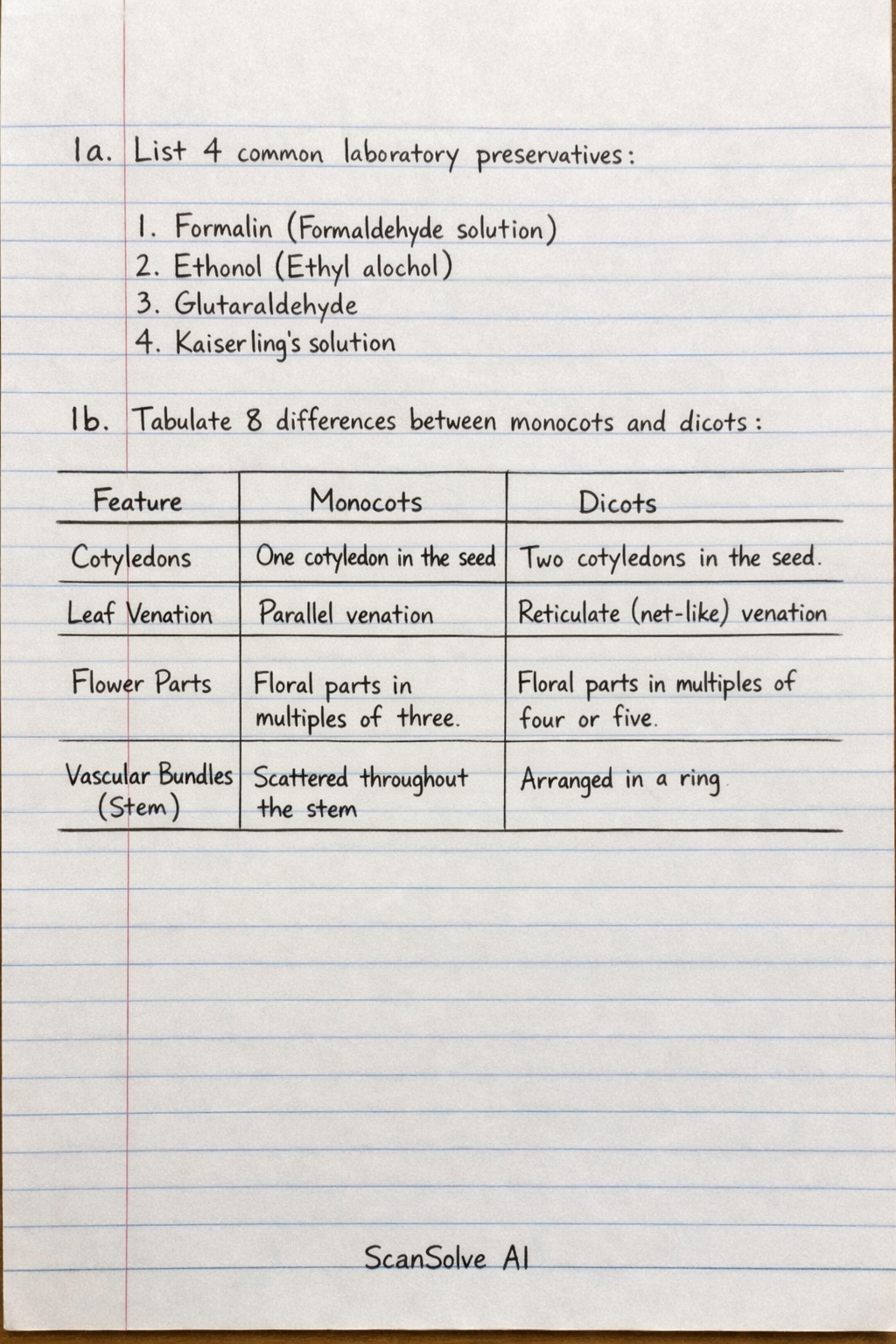
List 4 common laboratory preservatives and tabulate 8 differences between monocots and dicots.
ScanSolve AI Answer
I'll provide the answers for all the questions from the image.
1a. List 4 common laboratory preservatives.
- Formalin (Formaldehyde solution)
- Ethanol (Ethyl alcohol)
- Glutaraldehyde
- Kaiserling's solution
1b. Tabulate 8 differences between monocots and dicots.
| Feature | Monocots | Dicots |
|---|---|---|
| Cotyledons | One cotyledon in the seed | Two cotyledons in the seed |
| Leaf Venation | Parallel venation | Reticulate (net-like) venation |
| Flower Parts | Floral parts in multiples of three | Floral parts in multiples of four or five |
| Vascular Bundles (Stem) | Scattered throughout the stem | Arranged in a ring |
| Root System | Fibrous root system | Taproot system |
| Pollen Grains | Monosulcate (single furrow or pore) | Trisulcate (three furrows or pores) |
| Secondary Growth | Typically absent (no true wood) | Often present (produces true wood) |
| Stomata | Often arranged in rows | Randomly scattered |
2a. With one example each differentiate between bilateral and radial symmetry.
- Bilateral Symmetry: The body can be divided into two mirror-image halves along a single plane (sagittal plane). This typically results in distinct anterior (head) and posterior (tail) ends, and dorsal (back) and ventral (belly) surfaces.
- Example: Humans (or most vertebrates like a fish)
- Radial Symmetry: The body parts are arranged around a central axis, and any plane passing through the central axis divides the organism into two roughly equal halves. These organisms typically lack distinct anterior/posterior ends.
- Example: Starfish (or Jellyfish)
2b. List the main levels of the taxonomic hierarchy.
The main levels of the taxonomic hierarchy, from broadest to most specific, are:
- Domain
- Kingdom
- Phylum
- Class
- Order
- Family
- Genus
- Species
2c. What is a herbarium?
A herbarium is a collection of preserved plant specimens, typically dried and mounted on sheets, along with associated data such as collection date, location, collector's name, and ecological information. These collections are systematically arranged and housed in a facility for study, reference, and research.
3a. What is natural selection? Outline the mechanism guiding it.
- Natural selection is the process by which organisms better adapted to their environment tend to survive and produce more offspring. It is a fundamental mechanism of evolution.
- Mechanism guiding it:
- Variation: Individuals within a population exhibit variation in their traits.
- Heritability: Some of this variation is heritable, meaning it can be passed from parents to offspring.
- Overproduction: Organisms produce more offspring than can survive, leading to competition for resources.
- Differential Survival and Reproduction: Individuals with traits that are advantageous in a particular environment are more likely to survive, reproduce, and pass on those advantageous traits to their offspring. Over time, these advantageous traits become more common in the population.
3b. List the qualities of a name.
In biological nomenclature, a scientific name should possess the following qualities:
- Uniqueness: Each species should have only one correct scientific name.
- Universality: Scientific names are recognized and used globally, transcending language barriers.
- Stability: Names, once established, should ideally remain unchanged to avoid confusion.
- Brevity: Names should be relatively short and easy to pronounce.
- Latinized: Names are typically derived from Latin or Greek, or Latinized if from other languages.
- Binomial: For species, the name consists of two parts: genus and specific epithet.
4a. Briefly explain the concept of alternation of generation.
Alternation of generation is a life cycle pattern observed in plants and some algae, characterized by the presence of two distinct multicellular forms: a haploid gametophyte and a diploid sporophyte. The gametophyte produces gametes, which fuse to form a zygote that grows into a sporophyte. The sporophyte then produces spores through meiosis, which germinate to form new gametophytes, thus completing the cycle.
4b. List and discuss the 3 theories of animal distribution.
The three main theories explaining animal distribution (biogeography) are:
- Theory of Continental Drift (Plate Tectonics): This theory proposes that the Earth's continents have moved over geological time, causing landmasses to separate, collide, and change positions. This movement has directly influenced the distribution of animal species by creating new barriers, connecting previously isolated areas, and altering climates, leading to vicariance (separation of populations by a barrier) and dispersal events.
- Theory of Dispersal: This theory suggests that animals spread from their centers of origin to new areas. Dispersal can occur through various means, such as active migration (e.g., birds flying), passive transport (e.g., seeds floating, small animals hitchhiking), or jump dispersal (colonization of a distant area across a barrier). Barriers like oceans or mountains can limit dispersal, leading to distinct faunal regions.
- Theory of Vicariance: This theory posits that the distribution patterns of many species are best explained by the fragmentation of a once-continuous population by the formation of a geographical barrier (e.g., mountain range uplift, sea-level rise, continental separation). The barrier then leads to the evolutionary divergence of the separated populations, resulting in new species with related but distinct distributions.
5a. Outline exhaustively the major phyla of the animal kingdom.
The major phyla of the animal kingdom (Kingdom Animalia) include:
- Porifera: Sponges (simplest multicellular animals, sessile, filter feeders).
- Cnidaria: Jellyfish, corals, sea anemones (radially symmetrical, stinging cells).
- Platyhelminthes: Flatworms (acoelomate, bilateral symmetry, many parasitic).
- Nematoda: Roundworms (pseudocoelomate, unsegmented, many parasitic).
- Mollusca: Snails, clams, octopuses (soft-bodied, often with a shell, muscular foot).
- Annelida: Segmented worms (earthworms, leeches; segmented body, coelomate).
- Arthropoda: Insects, spiders, crustaceans (exoskeleton, jointed appendages, segmented body; largest phylum).
- Echinodermata: Starfish, sea urchins, sea cucumbers (radially symmetrical adults, spiny skin, water vascular system).
- Chordata: Vertebrates (fish, amphibians, reptiles, birds, mammals) and some invertebrates (tunicates, lancelets); possess a notochord, dorsal hollow nerve cord, pharyngeal slits, and post-anal tail at some stage.
Other significant phyla include Rotifera, Bryozoa, Brachiopoda, Phoronida, Nemertea, etc., but the list above covers the most commonly recognized "major" phyla.
5b. List and discuss the 4 sources of variation.
The four primary sources of variation in a population are:
- Mutation: A permanent change in the DNA sequence of an organism. Mutations can introduce new alleles (forms of a gene) into a population, which can be beneficial, harmful, or neutral. They are the ultimate source of all new genetic variation.
- Gene Flow (Migration): The movement of genes between populations, typically through the migration of individuals or gametes. When individuals from one population move to another and interbreed, they introduce new alleles or change the frequencies of existing alleles in the recipient population, increasing its genetic variation.
- Genetic Recombination (Sexual Reproduction): The shuffling of existing alleles during sexual reproduction. This occurs through independent assortment of chromosomes during meiosis and crossing over between homologous chromosomes. Recombination creates new combinations of alleles in offspring, leading to novel genotypes and phenotypes without necessarily creating new alleles.
- Random Fertilization: The chance encounter and fusion of any one sperm with any one egg during sexual reproduction. Given the vast number of possible gametes produced by each parent, the specific combination that forms a zygote is largely random, further contributing to the unique genetic makeup of each offspring.
6a. What are the uses of a herbarium?
Herbaria serve multiple crucial uses:
- Reference Collection: They provide a permanent, verifiable record of plant diversity, serving as a reference for identifying unknown plant specimens.
- Research: Used by botanists, ecologists, and taxonomists for studies on plant taxonomy, systematics, biogeography, evolution, and conservation.
- Documentation of Flora: They document the plant species present in a particular region or globally, including their distribution and changes over time.
- Educational Tool: Used for teaching botany, plant identification, and ecological principles.
- Conservation: Provide data on rare, endangered, or extinct species, and track changes in plant populations due to environmental shifts or human impact.
- Historical Records: Offer insights into past vegetation, climate, and human uses of plants.
6b. Define a species.
A species is generally defined as a group of organisms that can naturally interbreed and produce fertile offspring. They are reproductively isolated from other such groups. This is known as the biological species concept. Other concepts exist, such as morphological (based on physical traits) or phylogenetic (based on evolutionary history).
6c. Explain the 4 basic postulates in the definition.
Assuming this refers to the Biological Species Concept (the most common definition of species):
- Interbreeding: Individuals within a species have the potential to interbreed with one another.
- Natural Conditions: This interbreeding occurs under natural conditions, not just in a laboratory setting.
- Fertile Offspring: The interbreeding must produce offspring that are themselves fertile, meaning they can also reproduce.
- Reproductive Isolation: Members of different species are reproductively isolated from each other, meaning they cannot naturally interbreed to produce fertile offspring.
7a. List the 5 aims of the international code for biological nomenclature.
The International Code of Nomenclature (e.g., ICZN for zoology, ICN for botany) aims to:
- Provide a stable system of names: Ensure that each taxonomic group has a unique and universally accepted scientific name.
- Promote clarity and precision: Avoid ambiguity and confusion in scientific communication about organisms.
- Ensure universality: Establish rules that are applicable across all biological disciplines and languages.
- Facilitate communication: Enable scientists worldwide to refer to the same organism by the same name.
- Serve as a reference: Provide a framework for resolving conflicts and inconsistencies in naming.
7b. What would consider as the importance of taxonomic studies?
Taxonomic studies are fundamentally important for several reasons:
- Understanding Biodiversity: They provide a framework for identifying, naming, and classifying all living organisms, which is essential for understanding the vast diversity of life on Earth.
- Conservation Efforts: By identifying species and their relationships, taxonomy helps in recognizing endangered species, assessing biodiversity loss, and developing effective conservation strategies.
- Ecological Research: Accurate species identification is crucial for ecological studies, allowing scientists to understand species interactions, food webs, ecosystem functions, and the impact of environmental changes.
- Agriculture and Medicine: Taxonomy helps in identifying pests, pathogens, beneficial organisms, and sources of new drugs or food crops, which is vital for agriculture, pest control, and pharmaceutical development.
- Evolutionary Biology: Taxonomic classifications reflect evolutionary relationships, providing insights into the history of life, speciation processes, and the tree of life.
- Communication: It provides a universal language for biologists worldwide, ensuring that when a specific organism is discussed, everyone understands which organism is being referred to.
Still stuck on this one?
Ask a follow-up, and the answer starts from this question.
More Biology Questions
Handwritten Step-by-Step Solution
Get this as a handwritten image on WhatsApp — like a tutor wrote it for you.
Try on WhatsApp