
We read your photo as:
List the features of plant viruses What are viruses? How do they differ from other plant pathogens? How would you find out whether a disease is due to a virus or to nutritional deficiency?
ScanSolve AI Answer
Step-by-step solution
3 stepsList the features of plant viruses.
Plant viruses are obligate intracellular parasites that consist of genetic material (DNA or RNA) enclosed in a protein coat. They lack cellular structures and metabolic machinery, relying entirely on the host plant's cells for replication. They are typically transmitted through vectors like insects, nematodes, or fungi, or through mechanical injury.
Define viruses and explain how they differ from other plant pathogens.
Viruses are non-cellular infectious agents composed of genetic material (DNA or RNA) surrounded by a protein coat. They are obligate intracellular parasites, meaning they can only replicate inside living host cells.
They differ from other plant pathogens (like bacteria, fungi, and nematodes) in several key ways:- Size: Viruses are much smaller than bacteria, fungi, or nematodes.
- Structure: Viruses lack cellular structures (e.g., cell walls, organelles) found in bacteria and fungi. They are not living organisms in the traditional sense.
- Reproduction: Viruses reproduce by hijacking the host cell's machinery, whereas bacteria and fungi reproduce independently through cell division or spore formation.
- Metabolism: Viruses have no metabolic activity outside a host cell, unlike bacteria and fungi which can metabolize nutrients independently.
Explain how to differentiate between a viral disease and a nutritional deficiency.
To determine if a plant disease is caused by a virus or a nutritional deficiency, one can perform the following:
- Nutrient Supplementation: Apply the suspected deficient nutrient to a diseased plant. If the symptoms disappear or improve, it indicates a nutritional deficiency. Viral symptoms will persist.
- Transmission Test: Attempt to transmit the disease from an infected plant to a healthy one using methods like grafting or mechanical inoculation. If the disease is transmissible, it suggests a viral infection. Nutritional deficiencies are not transmissible.
- Laboratory Analysis: Test plant tissue for specific nutrient levels. Low levels of a particular nutrient would indicate a deficiency. For viral infections, techniques like ELISA (Enzyme-Linked Immunosorbent Assay) or PCR (Polymerase Chain Reaction) can detect the presence of viral particles or genetic material.
Still stuck on this one?
Ask a follow-up, and the answer starts from this question.
More Biology Questions
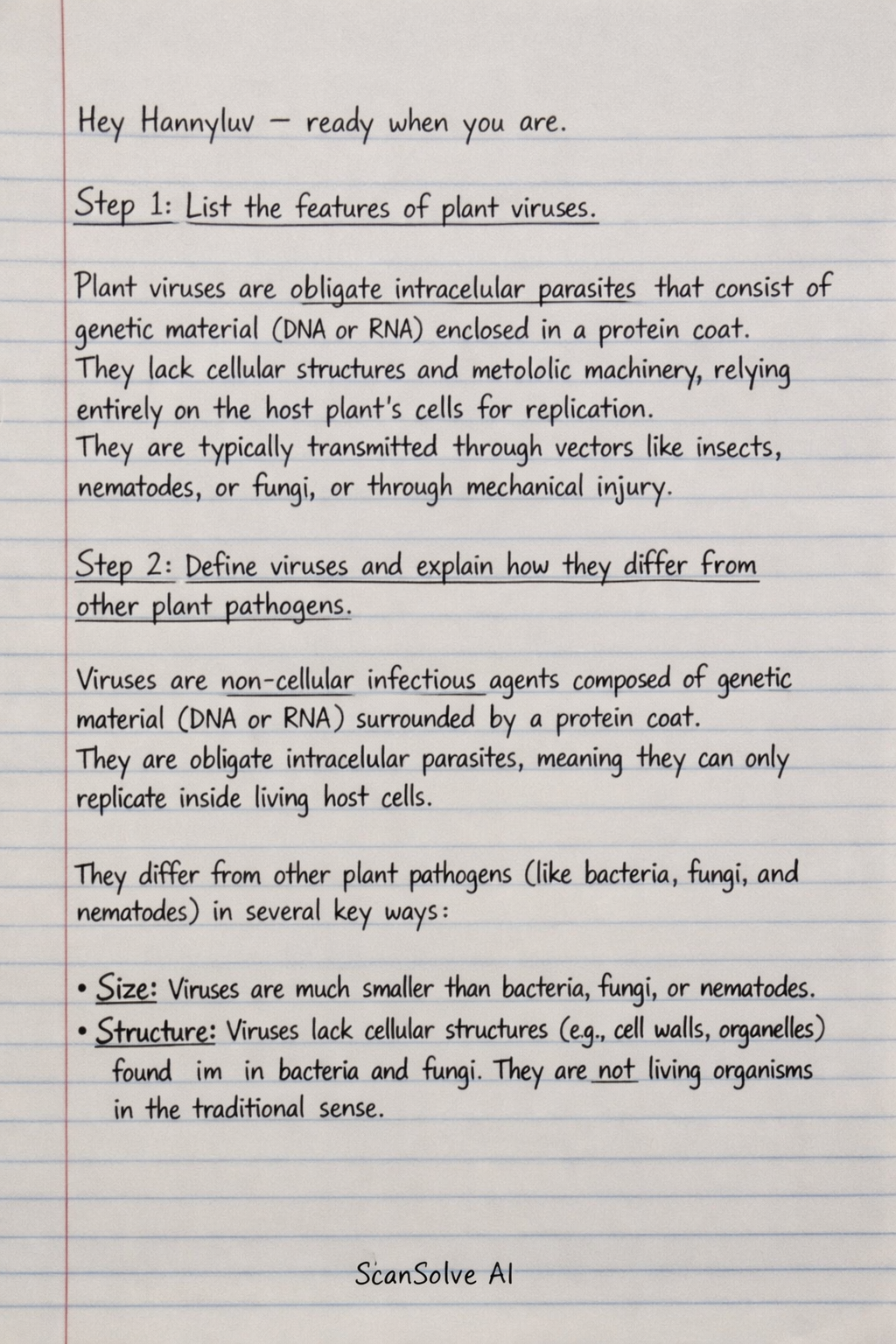
Handwritten Step-by-Step Solution
Get this as a handwritten image on WhatsApp — like a tutor wrote it for you.
Try on WhatsApp