

This biology question covers important biological concepts and processes. The step-by-step explanation below helps you understand the underlying mechanisms and reasoning.
ScanSolve AI Answer
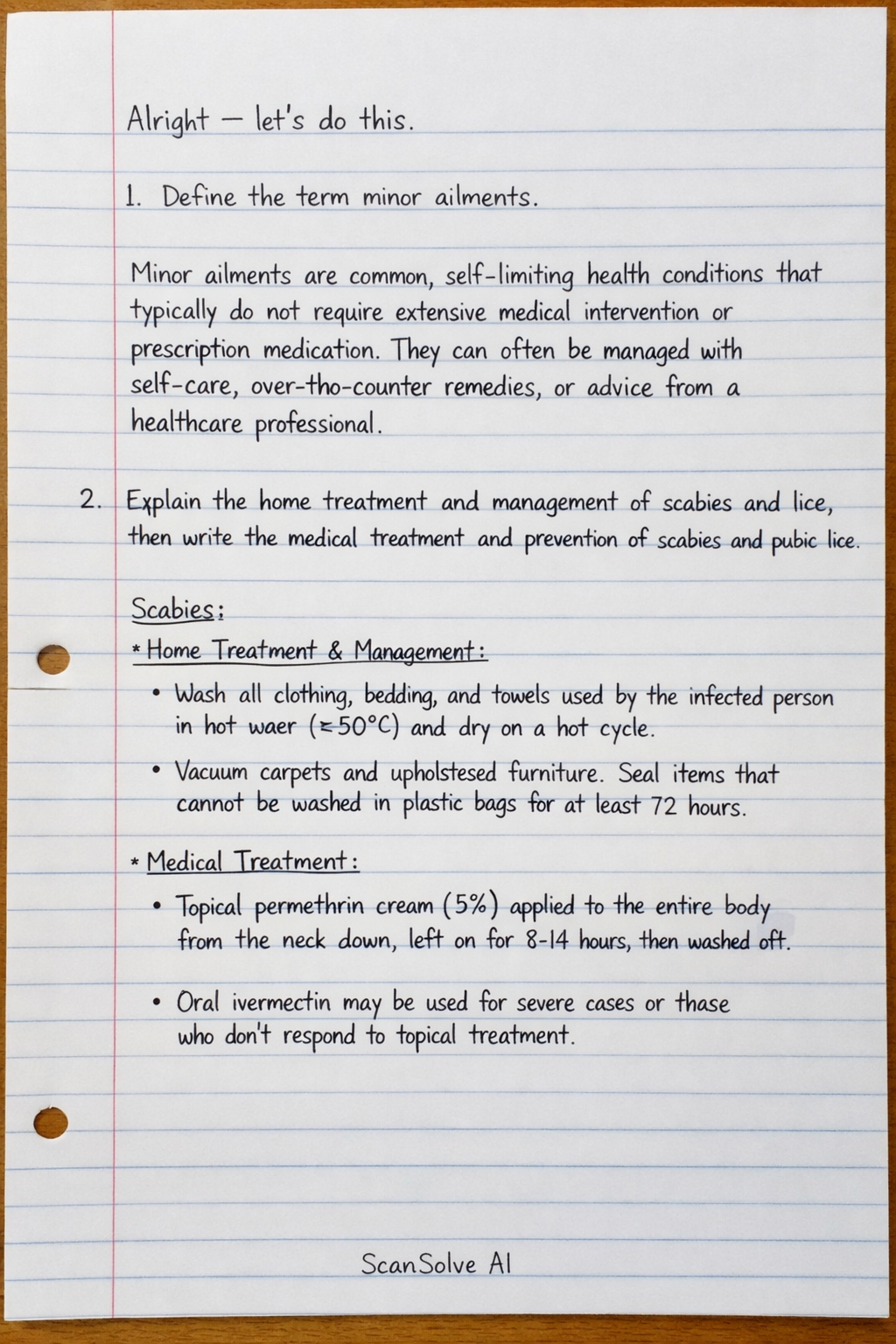
Alright — let's do this. 1. Define the term minor ailments. Minor ailments are common, self-limiting health conditions that typically do not require extensive medical intervention or prescription medication. They can often be managed with self-care, over-the-counter remedies, or advice from a healthcare professional. 2. Explain the home treatment and management of scabies and lice, then write the medical treatment and prevention of scabies and pubic lice. Scabies: Home Treatment & Management:* Wash all clothing, bedding, and towels used by the infected person in hot water (>50^) and dry on a hot cycle. Vacuum carpets and upholstered furniture. Seal items that cannot be washed in plastic bags for at least 72 hours. Medical Treatment:* Topical permethrin cream (5%) applied to the entire body from the neck down, left on for 8-14 hours, then washed off. Oral ivermectin may be used for severe cases or those who don't respond to topical treatment. Prevention:* Avoid direct skin-to-skin contact with an infected person. Treat all household members and close contacts simultaneously. Lice (Head Lice): Home Treatment & Management:* Use a fine-toothed nit comb on wet hair to remove lice and nits. Wash bedding, clothing, and towels in hot water. Medical Treatment:* Over-the-counter permethrin lotion (1%) or pyrethrins with piperonyl butoxide. Prescription options include malathion lotion, spinosad, or ivermectin lotion. Prevention:* Avoid head-to-head contact. Do not share combs, brushes, hats, or scarves. Pubic Lice (Crabs): Medical Treatment:* Over-the-counter permethrin lotion (1%) or pyrethrins with piperonyl butoxide. Prescription options include malathion lotion or oral ivermectin. Prevention:* Avoid sexual contact with an infected person until treatment is complete and effective. Inform sexual partners for treatment. 3. Define universal precautions and describe the ways of preventing cross infection in health facilities based on patient care and handling of linen and other medical procedures. Universal Precautions:* These are a set of infection control practices designed to prevent transmission of bloodborne and other pathogens. They involve treating all human blood and certain body fluids as if they are known to be infectious for HIV, HBV, and other bloodborne pathogens. Preventing Cross-Infection:* Patient Care: Implement strict hand hygiene before and after every patient contact. Use appropriate Personal Protective Equipment (PPE) such as gloves, gowns, masks, and eye protection based on the anticipated exposure. Practice respiratory hygiene/cough etiquette* by covering coughs and sneezes. Handling of Linen:* Handle soiled linen with minimal agitation to prevent aerosolization of microorganisms. Place soiled linen in designated leak-proof bags at the point of use. Do not sort or rinse soiled linen in patient care areas. Other Medical Procedures: Maintain aseptic technique for invasive procedures. Ensure proper sterilization or high-level disinfection* of reusable medical equipment. Safely dispose of sharps in puncture-resistant containers. Follow environmental cleaning protocols for surfaces and equipment. 4. List the 5 types of disinfectants used in medical facilities. 1. Alcohols (e.g., ethanol, isopropanol) 2. Chlorine compounds (e.g., sodium hypochlorite/bleach) 3. Aldehydes (e.g., glutaraldehyde, formaldehyde) 4. Phenolics (e.g., Lysol) 5. Quaternary Ammonium Compounds (Quats) 5. Write 3 procedures where aseptic technique is applied. 1. Insertion of urinary catheters 2. Surgical procedures (e.g., incision and drainage, suturing) 3. Dressing changes for open wounds 6. Attach the hand washing steps picture/diagram and explain 5 importance of hand washing. Which instances should you always wash hands? Hand Washing Steps (Description):* 1. Wet hands with water. 2. Apply enough soap to cover all hand surfaces. 3. Rub hands palm to palm. 4. Rub back of left hand with right palm with interlaced fingers, and vice versa. 5. Rub palm to palm with fingers interlaced. 6. Rub backs of fingers to opposing palms with fingers interlocked. 7. Rotational rubbing of left thumb clasped in right palm, and vice versa. 8. Rotational rubbing, backwards and forwards with clasped fingers of right hand in left palm, and vice versa. 9. Rinse hands with water. 10. Dry thoroughly with a single-use towel. 11. Use towel to turn off faucet. 5 Importance of Hand Washing:* 1. Prevents the spread of infections (e.g., common cold, flu, gastroenteritis). 2. Removes harmful bacteria, viruses, and other microorganisms from hands. 3. Protects vulnerable individuals (e.g., infants, elderly, immunocompromised) from illness. 4. Reduces the risk of healthcare-associated infections in clinical settings. 5. Promotes overall public health and hygiene. Instances to Always Wash Hands:* Before, during, and after preparing food. Before eating. Before and after caring for someone who is sick. Before and after treating a cut or wound. After using the toilet. After changing diapers or cleaning up a child who has used the toilet. After blowing your nose, coughing, or sneezing. After touching an animal, animal feed, or animal waste. After handling pet food or pet treats. After touching garbage. 7. Explain water purification methods used to prevent diarrhoea and other diseases. Water purification methods are crucial for removing contaminants that cause waterborne diseases like diarrhea, cholera, and typhoid. Common methods include: Boiling:* Heating water to a rolling boil for at least one minute kills most bacteria, viruses, and parasites. Filtration:* Using physical filters (e.g., ceramic filters, sand filters) to remove suspended particles, protozoa, and some bacteria. Advanced filters can remove viruses. Chlorination:* Adding chlorine (e.g., bleach, chlorine tablets) to water to kill bacteria and viruses. It leaves a residual disinfectant to prevent recontamination. Solar Disinfection (SODIS):* Exposing water in clear plastic bottles to direct sunlight for several hours. UV-A radiation and heat from the sun destroy pathogenic microorganisms. 8. Explain the hydration assessment of children (skin turgor) and state reasons why its done. Skin Turgor Assessment:* This involves gently pinching a fold of skin, usually on the abdomen or inner thigh, and observing how quickly it returns to its normal position. In a well-hydrated child, the skin snaps back immediately. In a dehydrated child, the skin fold remains elevated for a few seconds, a phenomenon known as "tenting." Reasons for Assessment:* To assess the degree of dehydration*, which is a critical indicator of fluid loss, especially in children with vomiting, diarrhea, or fever. To guide fluid management* decisions, determining if oral rehydration therapy or intravenous fluids are needed. To monitor the effectiveness of rehydration* treatment. 9. Explain the procedure used to determine malnutrition or checking oedema of the feet. Determining Malnutrition:* Anthropometric Measurements: This involves taking physical measurements such as weight-for-age, height-for-age, and weight-for-height to compare a child's growth to standard reference charts. Mid-Upper Arm Circumference (MUAC)* is also commonly measured using a colored tape, especially in emergency settings, to quickly identify severe acute malnutrition. Clinical Signs:* Observing for signs like wasting (severe thinness), stunted growth, hair changes, or skin lesions. Checking Oedema of the Feet (Pitting Oedema Test):* Gently press a thumb firmly for at least 3 seconds on the top of both feet, behind the ankle bone. Remove the thumb and observe if an indentation (pit) remains. If a pit remains, it indicates pitting oedema*, which can be a sign of severe malnutrition (kwashiorkor) or other conditions like heart failure or kidney disease. 10. Explain why urine is tested, which abnormalities can be detected including diseases? Urine is tested through a urinalysis to assess kidney function, detect urinary tract infections, and screen for various metabolic and systemic diseases. It provides valuable insights into a person's overall health. Abnormalities and Diseases Detected:* Urinary Tract Infections (UTIs):* Presence of bacteria, white blood cells (leukocytes), and nitrites. Diabetes:* High levels of glucose (sugar) in the urine, and sometimes ketones. Kidney Disease:* Presence of protein (proteinuria), red blood cells (hematuria), or casts. Liver Disease:* Bilirubin in the urine, indicating liver dysfunction or bile duct obstruction. Dehydration:* Highly concentrated urine. Certain Metabolic Disorders:* Abnormal levels of specific substances. 11. What is the normal smell and colour of urine? The normal smell of urine is typically mildly aromatic or odorless. The normal color of urine is pale yellow to amber, depending on hydration levels. 12. What is the importance of intake and output on a patient and why should you record accurately on the temperature chart? Importance of Intake and Output (I&O): Monitoring I&O is crucial for assessing a patient's fluid balance*. It helps healthcare providers determine if a patient is adequately hydrated, overhydrated, or dehydrated. This information is vital for managing conditions like kidney failure, heart failure, severe burns, and patients receiving intravenous fluids or diuretics. It guides treatment decisions to prevent fluid imbalances that can lead to serious complications. Why Record Accurately:* Accurate recording of I&O (and other vital signs like temperature) on a patient's chart (often a fluid balance chart, but sometimes integrated into a general observation chart) is essential for: Accurate Assessment:* Provides a precise picture of the patient's physiological status over time. Early Detection:* Allows for early identification of trends or sudden changes in fluid balance, enabling timely intervention. Treatment Planning:* Informs medical decisions regarding fluid administration, medication dosages, and overall care plan adjustments. Continuity of Care:* Ensures all healthcare team members have consistent and reliable data for patient management. Legal Documentation:* Serves as a legal record of care provided and observations made. Drop the next question! 📸