
We read your photo as:
Define and explain the differences between the following terms as used in food and nutrition: Metabolism, Balanced diet, Malnutrition, Macro-nutrients, Cutlery, Catabolism and Anabolism.
ScanSolve AI Answer
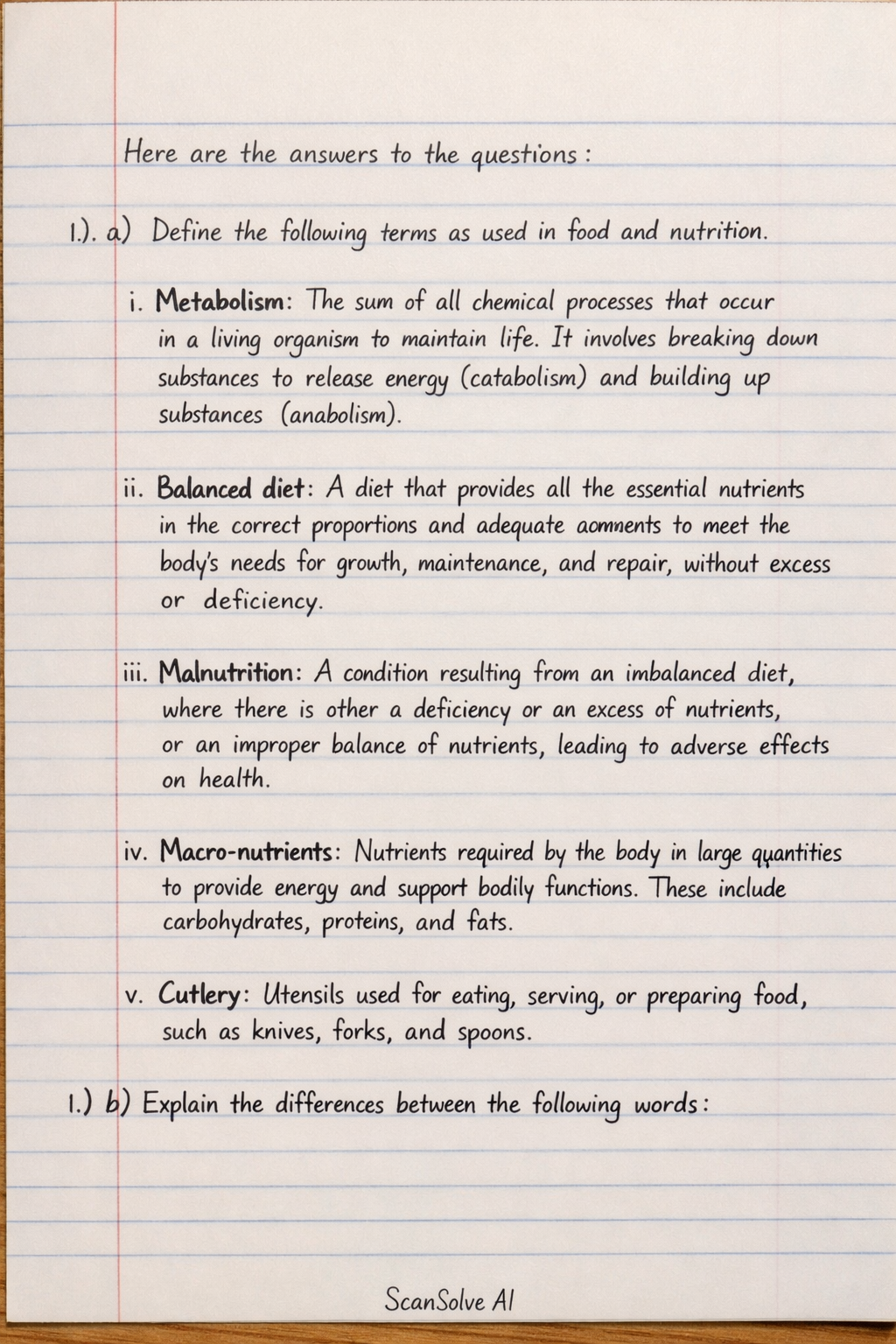
Here are the answers to the questions:
1. a) Define the following terms as used in food and nutrition
- i. Metabolism: The sum of all chemical processes that occur in a living organism to maintain life. It involves breaking down substances to release energy (catabolism) and building up substances (anabolism).
- ii. Balanced diet: A diet that provides all the essential nutrients in the correct proportions and adequate amounts to meet the body's needs for growth, maintenance, and repair, without excess or deficiency.
- iii. Malnutrition: A condition resulting from an imbalanced diet, where there is either a deficiency or an excess of nutrients, or an improper balance of nutrients, leading to adverse effects on health.
- iv. Macro-nutrients: Nutrients required by the body in large quantities to provide energy and support bodily functions. These include carbohydrates, proteins, and fats.
- v. Cutlery: Utensils used for eating, serving, or preparing food, such as knives, forks, and spoons.
1. b) Explain the differences between the following words
- i. Catabolism and Anabolism:
- Catabolism is the metabolic process of breaking down complex molecules into simpler ones, releasing energy. For example, the breakdown of glucose for energy.
- Anabolism is the metabolic process of building complex molecules from simpler ones, requiring energy. For example, the synthesis of proteins from amino acids.
- ii. Over-nutrition and Under-nutrition:
- Over-nutrition is a form of malnutrition resulting from excessive intake of nutrients, particularly calories, leading to obesity and related health problems.
- Under-nutrition is a form of malnutrition resulting from insufficient intake of nutrients or calories, leading to weight loss, nutrient deficiencies, and impaired growth and development.
1. c) List three (3) functions of protein to the body.
- Building and repairing tissues.
- Producing enzymes, hormones, and other body chemicals.
- Providing energy when carbohydrates and fats are insufficient.
1. d) State deficiency diseases related to the following nutrients
- i. Vitamin D: Rickets (in children), Osteomalacia (in adults).
- ii. Vitamin B1: Beriberi.
- iv. Vitamin C: Scurvy.
2. a) i) Define peristalsis
- i. Peristalsis: The rhythmic, wave-like contractions and relaxations of the smooth muscles in the walls of the digestive tract that propel food along the alimentary canal.
2. a) ii) Outline four adaptations of the ileum in performing the role of absorption.
- Long length: Provides a large surface area for absorption.
- Folded inner surface: Contains numerous folds (plicae circulares) that increase the surface area.
- Villi: Finger-like projections on the folds, further increasing the surface area for absorption.
- Microvilli: Tiny projections on the epithelial cells of the villi, forming a "brush border" that maximizes surface area and contains digestive enzymes.
- Rich blood supply: Each villus contains a capillary network to efficiently transport absorbed nutrients away.
- Thin walls: The epithelial lining is only one cell thick, allowing for rapid diffusion of nutrients.
2. a) iii) State three functions of hydrochloric acid in digestion.
- Kills most bacteria ingested with food, preventing infections.
- Provides an acidic environment (pH 1.5-3.5) necessary for the optimal activity of the enzyme pepsin.
- Denatures proteins, unfolding them to make them more accessible to enzymatic digestion.
2. b) State two first aid measures each for the following accidents;
- i) Bleeding
- Apply direct pressure to the wound using a clean cloth or bandage.
- Elevate the injured part above the level of the heart if possible.
- ii) Burns and scalds
- Cool the burn immediately with cool or lukewarm running water for at least 10-20 minutes.
- Remove any clothing or jewelry near the burned area, unless it's stuck to the skin.
- iii) Poisoning
- Call emergency services immediately (e.g., poison control center or ambulance).
- Do not induce vomiting unless instructed by medical professionals.
2. c) State five important points to consider when buying a refrigerator.
- Energy efficiency: Look for an Energy Star rating to save on electricity bills.
- Size and capacity: Ensure it fits the available space and meets the household's storage needs.
- Type and features: Consider freezer-on-top, bottom-freezer, side-by-side, or French door models, and features like ice makers or water dispensers.
- Budget: Determine an affordable price range.
- Brand reputation and warranty: Choose a reliable brand with good customer service and a comprehensive warranty.
2. d) Enumerate five ways of incorporating mechanical raising agents in mixtures.
- Whisking: Incorporating air into liquids (e.g., egg whites for meringue).
- Beating: Vigorously mixing ingredients to trap air (e.g., creaming butter and sugar).
- Sifting: Aerating flour and other dry ingredients.
- Folding: Gently incorporating whipped ingredients into a heavier mixture to retain air.
- Kneading: Developing gluten in dough, which traps gases produced by yeast or other leavening agents.
3. a) list six cooking skills you can demonstrate in a food and nutrition practical lesson, with an example of a food type in each skill
- Chopping: Cutting vegetables (e.g., onions for a stir-fry).
- Sautéing: Quickly frying food in a small amount of fat (e.g., mushrooms).
- Baking: Cooking food with dry heat, typically in an oven (e.g., bread).
- Boiling: Cooking food in rapidly bubbling hot water (e.g., pasta).
- Whisking: Incorporating air into liquids (e.g., eggs for an omelette).
- Kneading: Developing gluten in dough (e.g., pizza dough).
3. b) List four types of knives used by the cook in the kitchen
- Chef's knife: All-purpose knife for chopping, slicing, and dicing.
- Paring knife: Small knife for intricate tasks like peeling and trimming.
- Bread knife: Serrated knife for slicing bread without crushing it.
- Slicing knife: Long, thin blade for slicing cooked meats.
3. c) Name and explain the uses of four labour serving devices or equipment
- Food processor: Used for chopping, slicing, shredding, pureeing, and mixing ingredients quickly, reducing manual effort.
- Electric mixer: Used for beating, whisking, and kneading, especially for batters, doughs, and creams, saving time and effort compared to hand mixing.
- Microwave oven: Used for rapid heating, defrosting, and cooking of food, significantly reducing cooking time.
- Dishwasher: Used for automated cleaning of dishes, cutlery, and cookware, eliminating manual washing.
3. d) i)Explain the following terms;
- -Meal: An occasion when food is eaten, typically at a regular time, or the food eaten on such an occasion.
- -Breakfast: The first meal of the day, typically eaten in the morning.
- -A course: A distinct part of a meal, served separately from the others (e.g., appetizer course, main course, dessert course).
3. d) ii) Enumerate three informal food services
- Cafeteria service: Customers select food from a counter and carry it to their tables.
- Buffet service: Food is displayed on a table, and guests serve themselves.
- Takeaway/Fast food service: Food is prepared quickly and packaged for customers to eat elsewhere.
3. d) iii) State five guidelines to follow when drafting an invitation
- Clearly state the purpose of the event.
- Include the date and time of the event.
- Specify the location or venue.
- Provide RSVP information (contact person, deadline, and method).
- Mention any dress code or special instructions.
Still stuck on this one?
Ask a follow-up, and the answer starts from this question.
More Biology Questions
Handwritten Step-by-Step Solution
Get this as a handwritten image on WhatsApp — like a tutor wrote it for you.
Try on WhatsApp