
We read your photo as:
Describe and explain the observations made when yeast and glucose are incubated and the gas produced is bubbled through calcium hydroxide.
ScanSolve AI Answer
Step-by-step solution
4 stepsPart a· 2 steps
State the observations made. (2mks)
Observe the boiling tube with glucose and yeast suspension.
Yeast undergoes anaerobic respiration, producing gas.
Observe the calcium hydroxide solution.
The gas produced in the boiling tube is bubbled into the calcium hydroxide solution.
The observations made are:
- In the boiling tube, bubbles are seen, and the yeast suspension becomes cloudy.
- In the beaker, the calcium hydroxide solution turns cloudy/milky and bubbles are observed.
Part b· 2 steps
Account for the observations made in a) above. (2mks)
Explain the activity in the boiling tube.
The yeast in the glucose solution carries out anaerobic respiration (fermentation) due to the absence of oxygen (paraffin layer). This process breaks down glucose to produce carbon dioxide gas, causing the bubbles, and ethanol. The yeast cells also multiply, making the suspension cloudy.
Explain the reaction in the calcium hydroxide solution.
The carbon dioxide gas produced by the yeast is bubbled into the calcium hydroxide solution. Carbon dioxide reacts with calcium hydroxide to form insoluble calcium carbonate, which is a white precipitate, causing the solution to turn cloudy or milky.
The chemical reaction is:
Part c
Why was paraffin layer added to the suspension? (1mk)
The paraffin layer was added to prevent atmospheric oxygen from dissolving into the glucose and yeast suspension. This ensures anaerobic conditions, forcing the yeast to carry out anaerobic respiration (fermentation).
Still stuck on this one?
Ask a follow-up, and the answer starts from this question.
More Biology Questions
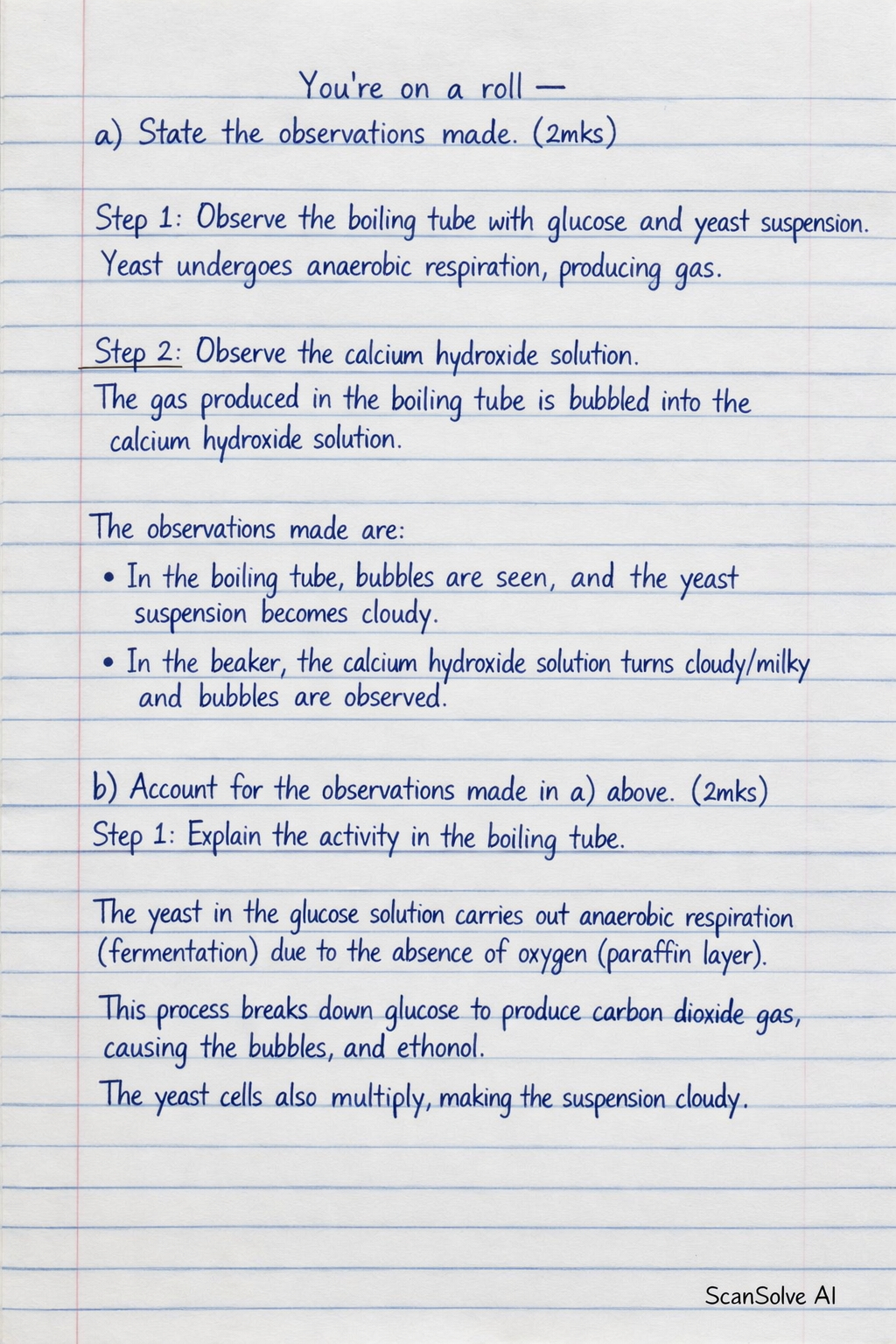
Handwritten Step-by-Step Solution
Get this as a handwritten image on WhatsApp — like a tutor wrote it for you.
Try on WhatsApp