
We read your photo as:
Describe nerve impulses, the all-or-nothing law, the role of synapses in nerve impulse transmission, and define tropic and nastic responses with examples.
ScanSolve AI Answer
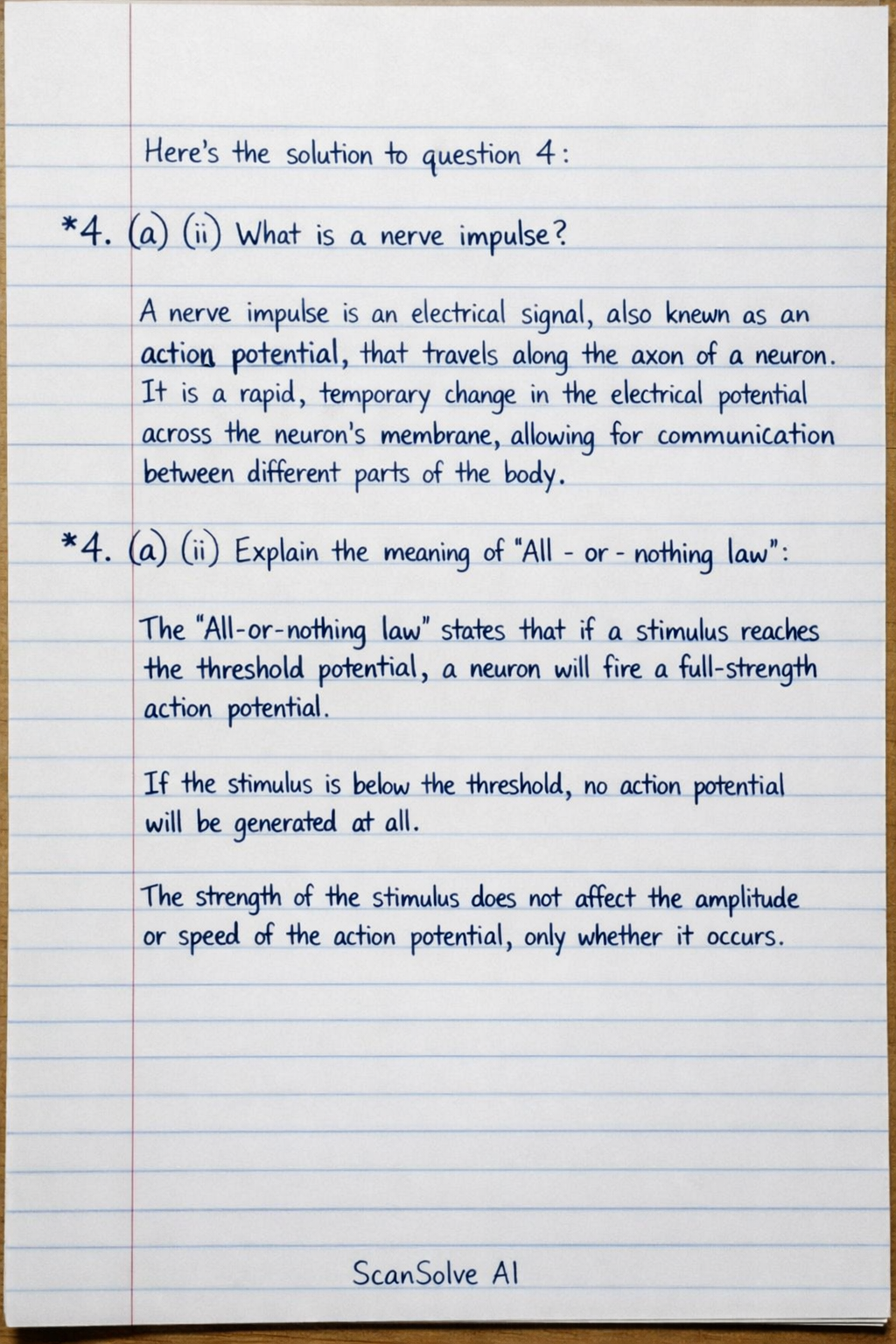
Here's the solution to question 4:
4. (a) (i) What is a nerve impulse?
A nerve impulse is an electrical signal, also known as an action potential, that travels along the axon of a neuron. It is a rapid, temporary change in the electrical potential across the neuron's membrane, allowing for communication between different parts of the body.
4. (a) (ii) Explain the meaning of 'All - or - nothing law'.
The 'All-or-nothing law' states that if a stimulus reaches the threshold potential, a neuron will fire a full-strength action potential. If the stimulus is below the threshold, no action potential will be generated at all. The strength of the stimulus does not affect the amplitude or speed of the action potential, only whether it occurs.
4. (b) How are synapses important in the transmission of nerve impulses in mammals?
Synapses are crucial for nerve impulse transmission because they are the junctions where neurons communicate with each other or with effector cells. They allow for the unidirectional flow of information, ensuring impulses travel in the correct direction. Synapses also enable integration and modulation of signals, as multiple impulses can converge or diverge, and neurotransmitters can either excite or inhibit the postsynaptic neuron, allowing for complex processing of information.
4. (c) Define tropic and nastic responses stating one example in each case.
- A tropic response is a growth movement in plants that is directional, meaning the plant grows either towards or away from a stimulus.
- Example: Phototropism, where a plant stem grows towards a light source.
- A nastic response is a plant movement that is non-directional, meaning the direction of the response is independent of the direction of the stimulus.
- Example: Thigmonasty, the folding of leaves in a Mimosa pudica plant when touched.
4. (d) Describe the effects of photoperiods on plants.
Photoperiods, the relative lengths of day and night, significantly affect various physiological processes in plants. The most notable effect is on flowering, where plants are classified as short-day, long-day, or day-neutral based on their photoperiodic requirements for flower induction. Photoperiods also influence seed germination, bud dormancy (e.g., in temperate trees preparing for winter), and the development of storage organs like tubers and bulbs.
Still stuck on this one?
Ask a follow-up, and the answer starts from this question.
More Biology Questions
Handwritten Step-by-Step Solution
Get this as a handwritten image on WhatsApp — like a tutor wrote it for you.
Try on WhatsApp