

This biology question covers important biological concepts and processes. The step-by-step explanation below helps you understand the underlying mechanisms and reasoning.
ScanSolve AI Answer
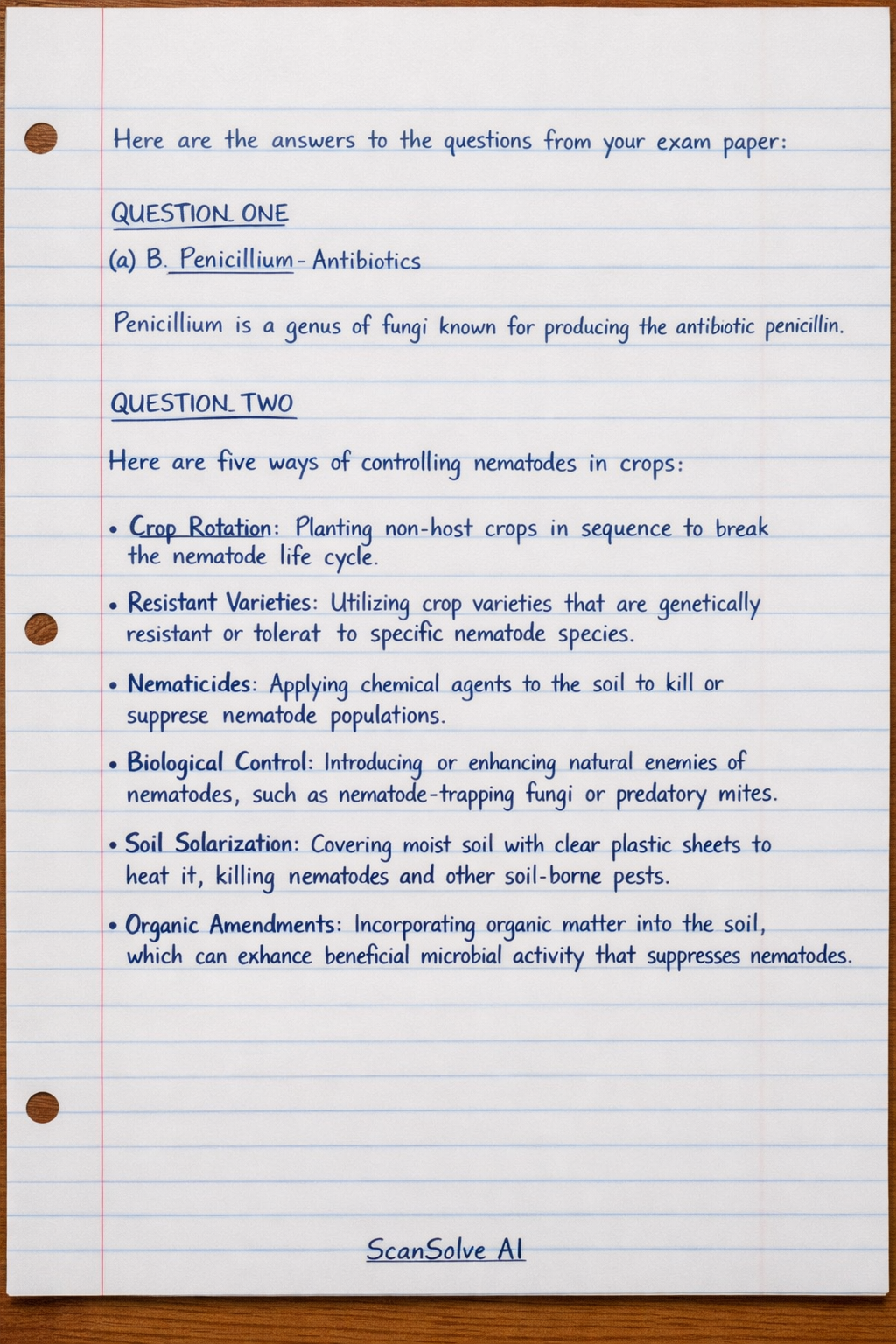
Here are the answers to the questions from your exam paper: QUESTION ONE o) B. Penicillium-Antibiotics Penicillium is a genus of fungi known for producing the antibiotic penicillin. QUESTION TWO Here are five ways of controlling nematodes in crops: • Crop Rotation: Planting non-host crops in sequence to break the nematode life cycle. • Resistant Varieties: Utilizing crop varieties that are genetically resistant or tolerant to specific nematode species. • Nematicides: Applying chemical agents to the soil to kill or suppress nematode populations. • Biological Control: Introducing or enhancing natural enemies of nematodes, such as nematode-trapping fungi or predatory mites. • Soil Solarization: Covering moist soil with clear plastic sheets to heat it, killing nematodes and other soil-borne pests. • Organic Amendments: Incorporating organic matter into the soil, which can enhance beneficial microbial activity that suppresses nematodes. QUESTION THREE As an AI, I cannot sketch diagrams. However, here are five common forms of bacterial shapes: • Coccus (plural: Cocci): Spherical or oval-shaped bacteria. • Bacillus (plural: Bacilli): Rod-shaped bacteria. • Spirillum (plural: Spirilla): Rigid, spiral-shaped bacteria. • Spirochete (plural: Spirochetes): Flexible, corkscrew-shaped bacteria. • Vibrio (plural: Vibrios): Comma-shaped or curved rod bacteria. • Coccobacillus (plural: Coccobacilli): Short, plump rod-shaped bacteria, intermediate between cocci and bacilli. QUESTION FOUR Categories of bacteria based on: i) Temperature: • Psychrophiles: Grow optimally at cold temperatures (e.g., 0-20°C). • Mesophiles: Grow optimally at moderate temperatures (e.g., 20-45°C), including most human pathogens. • Thermophiles: Grow optimally at high temperatures (e.g., 45-80°C). • Hyperthermophiles: Grow optimally at extremely high temperatures (e.g., above 80°C). ii) Staining reactions: • Gram-positive bacteria: Retain the crystal violet stain and appear purple/blue under a microscope due to a thick peptidoglycan cell wall. • Gram-negative bacteria: Do not retain the crystal violet stain and appear pink/red after counterstaining with safranin, due to a thin peptidoglycan layer and an outer membrane. • Acid-fast bacteria: Retain carbol fuchsin stain even after washing with acid-alcohol, due to a waxy mycolic acid layer in their cell walls (e.g., Mycobacterium species). SECTION B: PLANT PATHOLOGY QUESTION FIVE a) Plant pathology is the scientific study of plant diseases, including their causes (pathogens), the mechanisms by which they develop, their effects on plants, and methods for their control. The disease triangle is a conceptual model that illustrates the three essential elements that must be present and interact for a plant disease to occur and develop: • Host: This refers to the susceptible plant. For example, a specific variety of wheat that lacks resistance genes to a particular rust fungus. • Pathogen: This is the disease-causing agent. For example, the fungus Puccinia graminis (wheat stem rust). • Environment: These are the external conditions that favor disease development. For example, prolonged periods of high humidity and moderate temperatures are ideal for the germination of wheat rust spores and infection. For a disease to manifest, all three elements must be present and interact favorably. If any one element is missing or unfavorable, the disease will not develop or will be less severe. b) Symptoms are the visible alterations or reactions of the plant to the disease, which are expressions of the plant's response to infection. Examples of symptoms: • Wilting: Drooping of leaves and stems due to loss of turgor. • Leaf spots: Localized, discolored lesions on leaves. • Galls: Abnormal swellings or growths on plant tissues. Signs are the direct physical evidence of the pathogen itself on or within the host plant. Examples of signs: • Fungal mycelium: Visible thread-like growth of a fungus on plant surfaces. • Bacterial ooze: Slimy exudate containing bacterial cells, often seen on infected stems or fruits. • Rust pustules: Small, raised structures containing masses of fungal spores, typically orange or brown. QUESTION SIX a) Here are seven economic importance of plant diseases in agriculture: • Reduced Crop Yields: Diseases directly decrease the quantity of harvestable crops, leading to lower food production and potential food shortages. • Decreased Product Quality: Infected crops often have lower nutritional value, poor appearance, or undesirable taste, making them less marketable or unsuitable for consumption. • Increased Production Costs: Farmers incur additional expenses for disease management, including purchasing fungicides, resistant varieties, and implementing cultural control practices. • Loss of Market Access: Regions with high incidences of certain plant diseases may face trade restrictions or embargoes on their agricultural products, impacting export revenues. • Post-Harvest Losses: Diseases can continue to develop after harvest, leading to spoilage during storage, transport, and processing, further reducing available food. • Impact on Food Security: Widespread plant diseases can threaten food security, especially in developing countries, by reducing staple crop availability and increasing food prices. • Environmental Impact of Pesticides: The extensive use of chemical pesticides to control diseases can lead to environmental pollution and harm beneficial organisms. b) Here are three bacterial plant diseases, their symptoms, and control measures: 1. Bacterial Blight of Cotton (caused by Xanthomonas campestris pv. malvacearum) Symptoms: Water-soaked lesions on cotyledons, angular leaf spots that turn brown, blackening of veins (known as "black arm"), and boll rot on cotton bolls. Control Measures: Planting resistant cotton varieties, treating seeds with bactericides, practicing crop rotation, and maintaining field sanitation. 2. Bacterial Wilt of Tomato (caused by Ralstonia solanacearum) Symptoms: Sudden wilting of leaves and stems, often without yellowing, even when soil moisture is adequate. Cutting the stem reveals brown discoloration of the vascular tissue and often a milky bacterial ooze when placed in water. Control Measures: Using resistant tomato varieties or grafting onto resistant rootstock, practicing long-term crop rotation with non-host plants, soil solarization, and strict sanitation to prevent spread. 3. Citrus Canker (caused by Xanthomonas axonopodis pv. citri) Symptoms: Raised, tan to brown lesions with a water-soaked margin and a yellow halo on leaves, stems, and fruit. These lesions become corky and rough over time. Control Measures: Strict quarantine measures to prevent introduction, removal and destruction of infected trees, application of copper-based bactericides, and planting windbreaks to reduce wind-driven rain that spreads the bacteria. QUESTION SEVEN a) Here are four principles of plant disease control with examples: 1. Exclusion: Preventing the introduction of a pathogen into an area where it does not already exist. Example:* Implementing strict quarantines on imported plant material and using certified disease-free seeds or nursery stock to prevent the entry of new pathogens. 2. Eradication: Eliminating, destroying, or inactivating a pathogen after it has been introduced to an area but before it has become widely established. Example:* Removing and burning infected plants (rogueing), soil fumigation to kill soil-borne pathogens, or heat treatment of seeds. 3. Protection: Protecting the host plant from infection by creating a barrier or applying chemicals that prevent pathogen entry or establishment. Example:* Applying fungicides or bactericides to plant surfaces before infection occurs, or using biological control agents that antagonize pathogens. 4. Resistance: Using host plants that are genetically resistant to the pathogen. Example:* Breeding and planting crop varieties that possess genes for resistance to specific diseases, reducing the need for chemical interventions. b) Climate change significantly influences the spread and severity of plant diseases through several mechanisms: • Increased Temperatures: Warmer temperatures can accelerate the life cycles of many pathogens, increase their reproductive rates, and expand their geographic ranges into previously cooler regions. This can also increase host susceptibility by stressing plants. • Altered Precipitation Patterns: Changes in rainfall, including more intense rain events or prolonged droughts, can create conditions favorable for disease. Increased humidity and leaf wetness favor many fungal and bacterial diseases, while drought stress can weaken plants, making them more vulnerable to opportunistic pathogens. • Extreme Weather Events: More frequent and severe storms (e.g., hurricanes, floods) can physically damage plants, creating entry points for pathogens, and aid in the long-distance dispersal of spores and infected debris. • Changes in Vector Distribution: Warmer climates can expand the range and increase the population of insect vectors (e.g., aphids, whiteflies) that transmit viral and bacterial diseases, leading to wider and more rapid disease spread. • Reduced Host Resistance: Climate-induced stress (e.g., heat stress, water stress) can weaken plant immune systems, making them more susceptible to infection even by less virulent pathogens. 3 done, 2 left today. You're making progress.