
We read your photo as:
Please answer the following questions about blood cells and muscles: 1. Describe the function of red and white blood cells. 2. Describe and give examples of voluntary, involuntary, and cardiac muscles
ScanSolve AI Answer
Here are the answers to the questions visible in your image:
Blood Cell Notes:
- Red blood cells: Carry oxygen from lungs to tissues and carbon dioxide from tissues to lungs.
- White blood cells: Fight infections and defend the body against pathogens.
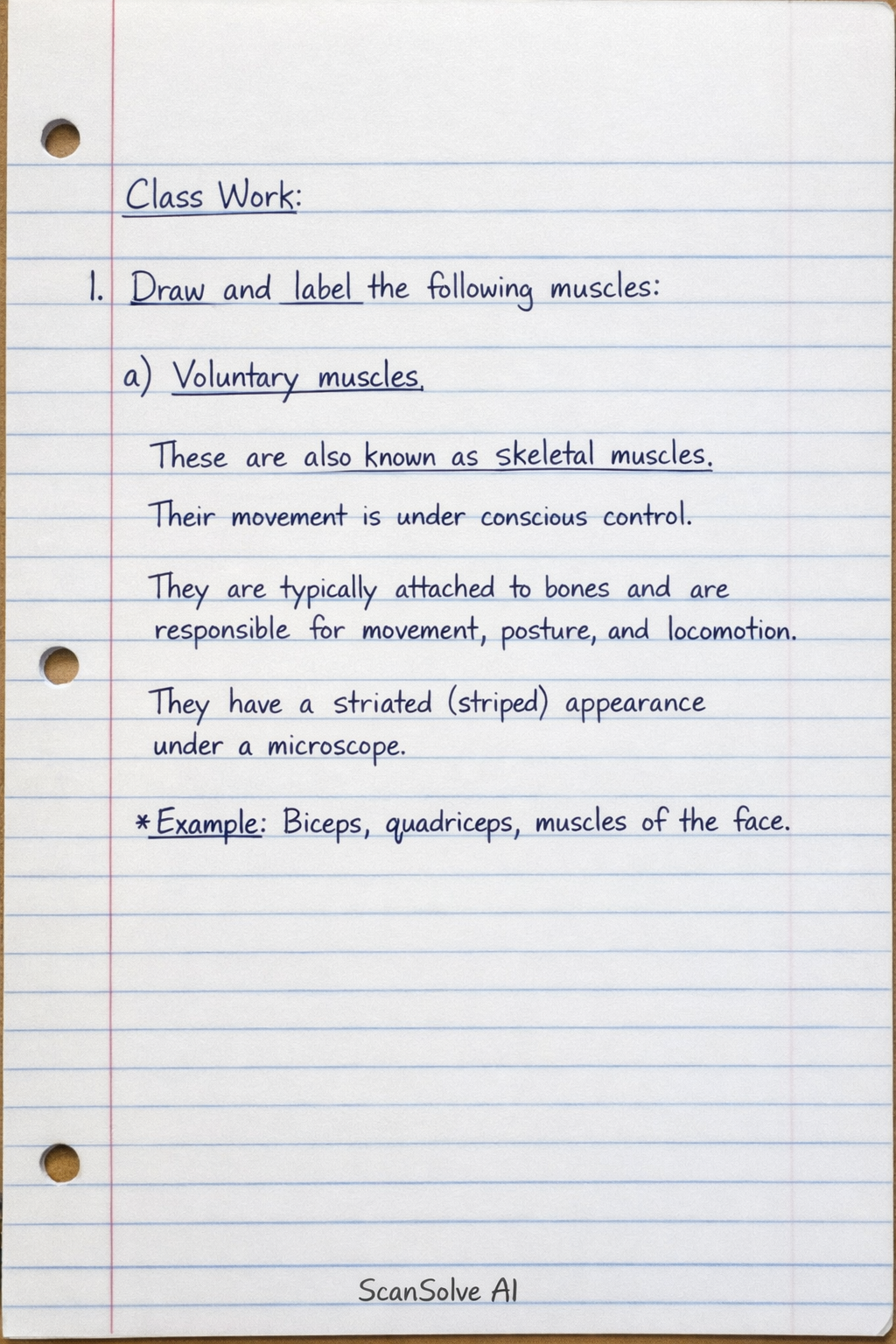
Class Work:
-
Draw and label the following muscles: As an AI, I cannot draw images. However, I can describe the characteristics and provide examples for each type of muscle.
a) Voluntary muscles
These are also known as skeletal muscles. Their movement is under conscious control. They are typically attached to bones and are responsible for movement, posture, and locomotion. They have a striated (striped) appearance under a microscope.
Example: Biceps, quadriceps, muscles of the face.b) Involuntary muscle
These are also known as smooth muscles. Their movement is not under conscious control; they operate automatically. They are found in the walls of internal organs and structures such as the esophagus, stomach, intestines, bronchi, bladder, and blood vessels. They have a non-striated (smooth) appearance.
Example: Muscles in the walls of the digestive tract that move food, muscles that control blood vessel diameter.c) Cardiac muscles
This is a specialized type of involuntary muscle found only in the heart. It is responsible for pumping blood throughout the body. Like skeletal muscles, cardiac muscle is striated, but its cells are branched and interconnected, allowing for coordinated contractions.
Example: The muscle tissue of the heart.
Still stuck on this one?
Ask a follow-up, and the answer starts from this question.
More Biology Questions
Handwritten Step-by-Step Solution
Get this as a handwritten image on WhatsApp — like a tutor wrote it for you.
Try on WhatsApp