
We read your photo as:
Write on bone formation. Add short note on its anomalies
ScanSolve AI Answer
here is the answer to question 2 from the image.
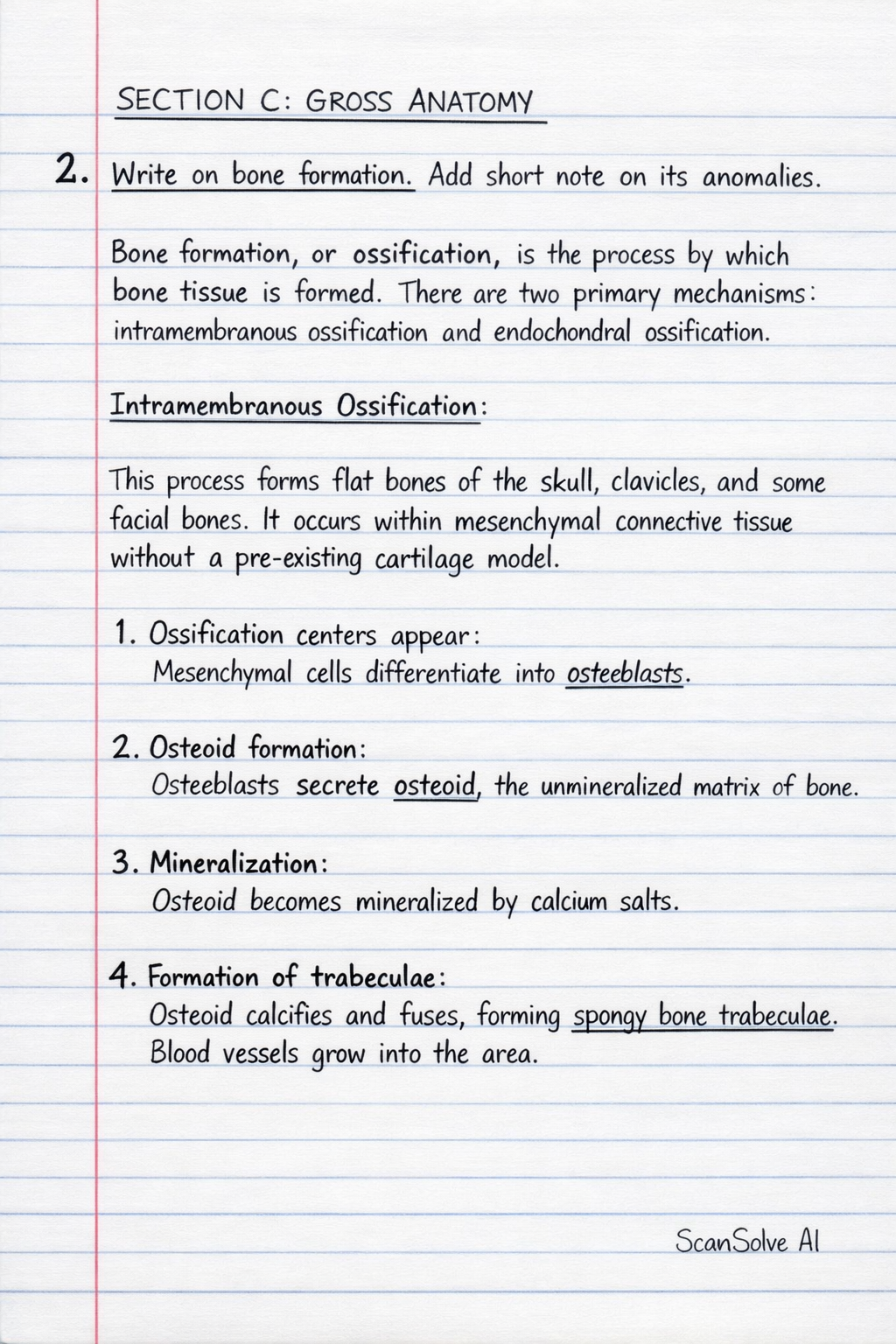
SECTION C: GROSS ANATOMY
2. Write on bone formation. Add short note on its anomalies
Bone formation, or ossification, is the process by which bone tissue is formed. There are two primary mechanisms: intramembranous ossification and endochondral ossification.
Intramembranous Ossification:
This process forms flat bones of the skull, the clavicles, and some facial bones. It occurs directly within mesenchymal connective tissue without a pre-existing cartilage model.
- Step 1: Ossification centers appear: Mesenchymal cells differentiate into osteoblasts.
- Step 2: Osteoid formation: Osteoblasts secrete osteoid, the unmineralized matrix of bone.
- Step 3: Mineralization: Osteoid becomes mineralized by calcium salts.
- Step 4: Formation of trabeculae: Osteoid calcifies and fuses, forming spongy bone trabeculae. Blood vessels grow into the area.
- Step 5: Formation of compact bone: Mesenchyme on the outer surface condenses to form the periosteum. Osteoblasts beneath the periosteum lay down bone matrix, forming compact bone on the outer surface. The spongy bone in the center remains.
Endochondral Ossification:
This process forms most bones of the skeleton, including long bones, vertebrae, and ribs. It involves the replacement of a hyaline cartilage model with bone.
- Step 1: Cartilage model formation: Mesenchymal cells differentiate into chondrocytes, forming a hyaline cartilage model surrounded by a perichondrium.
- Step 2: Cartilage calcification: The cartilage matrix begins to calcify, and chondrocytes die, forming cavities. A periosteal bud (containing blood vessels, osteoblasts, and osteoclasts) invades the calcified cartilage.
- Step 3: Primary ossification center formation: Osteoblasts deposit osteoid around the calcified cartilage remnants, forming spongy bone trabeculae in the diaphysis (shaft).
- Step 4: Medullary cavity formation: Osteoclasts break down some spongy bone in the diaphysis, creating the medullary cavity.
- Step 5: Secondary ossification centers formation: Ossification occurs in the epiphyses (ends) of the long bone.
- Step 6: Epiphyseal plate formation: Hyaline cartilage remains as articular cartilage and the epiphyseal plate (growth plate), allowing for longitudinal bone growth.
Clinical Abnormalities of Bone Formation:
Abnormalities can result from genetic factors, nutritional deficiencies, or hormonal imbalances.
- Osteogenesis Imperfecta (OI): A genetic disorder causing defective collagen, leading to brittle bones that fracture easily.
- Rickets (children) / Osteomalacia (adults): Caused by vitamin D deficiency, impairing calcium and phosphate absorption, leading to soft, poorly mineralized bones.
- Osteoporosis: Characterized by decreased bone density, making bones fragile and susceptible to fractures, often due to aging or hormonal changes.
- Achondroplasia: A genetic condition affecting endochondral ossification, resulting in dwarfism with short limbs.
- Fractures: While a break, abnormal healing can lead to nonunion (failure to heal) or malunion (healing in an incorrect position).
Still stuck on this one?
Ask a follow-up, and the answer starts from this question.
More Biology Questions
Handwritten Step-by-Step Solution
Get this as a handwritten image on WhatsApp — like a tutor wrote it for you.
Try on WhatsApp