
We read your photo as:
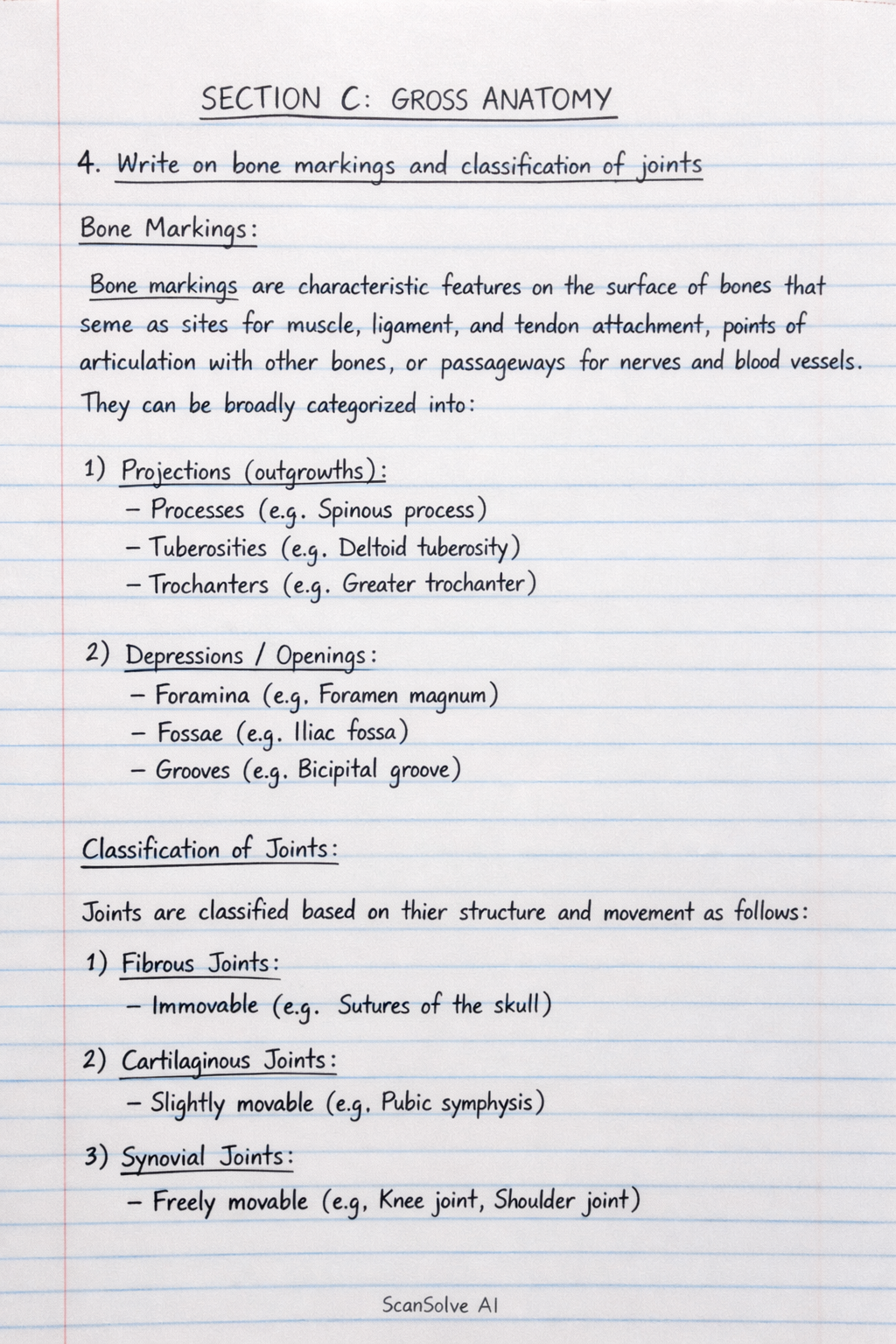
Write on bone markings and classification of joints
ScanSolve AI Answer
here is the answer to question 4 from the image.
SECTION C: GROSS ANATOMY
4. Write on bone markings and classification of joints
Bone Markings:
Bone markings are characteristic features on the surface of bones that serve as sites for muscle, ligament, and tendon attachment, points of articulation with other bones, or passageways for nerves and blood vessels. They can be broadly categorized into projections (outgrowths) and depressions/openings.
A. Projections (Processes): These are areas that protrude from the bone surface.
- Head: A prominent, rounded epiphysis (end) of a bone, often articulating with another bone. Example: Head of the femur.
- Condyle: A rounded articular projection. Example: Medial and lateral condyles of the femur.
- Epicondyle: A projection superior to a condyle. Example: Medial and lateral epicondyles of the humerus.
- Facet: A smooth, nearly flat articular surface. Example: Articular facets on vertebrae.
- Ramus: An arm-like bar of bone. Example: Ramus of the mandible.
- Spine: A sharp, slender, often pointed projection. Example: Spinous process of a vertebra.
- Crest: A narrow ridge of bone, usually prominent. Example: Iliac crest.
- Line: A narrow ridge of bone, less prominent than a crest. Example: Linea aspera of the femur.
- Trochanter: A very large, blunt, irregularly shaped process (only on the femur). Example: Greater and lesser trochanters of the femur.
- Tubercle: A small, rounded projection. Example: Greater and lesser tubercles of the humerus.
- Tuberosity: A large, rounded, or roughened projection. Example: Ischial tuberosity.
B. Depressions and Openings: These are indentations or holes in the bone.
- Fossa: A shallow, basin-like depression, often serving as an articular surface. Example: Olecranon fossa of the humerus.
- Groove (Sulcus): A furrow. Example: Intertubercular groove of the humerus.
- Fissure: A narrow, slit-like opening. Example: Superior orbital fissure.
- Foramen: A round or oval opening through a bone. Example: Foramen magnum of the occipital bone.
- Meatus: A canal-like passageway. Example: External acoustic meatus.
- Sinus: A cavity within a bone, filled with air and lined with mucous membrane. Example: Frontal sinus.
Classification of Joints:
Joints (articulations) are sites where two or more bones meet. They are classified both structurally (based on the type of material binding the bones and whether a joint cavity is present) and functionally (based on the amount of movement allowed).
A. Structural Classification:
-
Fibrous Joints:
- Bones are joined by fibrous connective tissue.
- No joint cavity.
- Most are immovable (synarthrotic) or slightly movable (amphiarthrotic).
- Types:
- Sutures: Immovable joints found only between bones of the skull. Example: Coronal suture.
- Syndesmoses: Bones connected by a ligament or interosseous membrane. Slightly movable. Example: Joint between tibia and fibula (distal tibiofibular joint).
- Gomphoses: Peg-in-socket fibrous joint. Immovable. Example: Tooth in its alveolar socket.
-
Cartilaginous Joints:
- Bones are united by cartilage.
- No joint cavity.
- Can be immovable or slightly movable.
- Types:
- Synchondroses: Bones united by hyaline cartilage. Immovable. Example: Epiphyseal plates (growth plates) in long bones, joint between the first rib and sternum.
- Symphyses: Bones united by fibrocartilage. Slightly movable. Example: Pubic symphysis, intervertebral discs.
-
Synovial Joints:
- Bones are separated by a fluid-filled joint cavity.
- Most common type of joint in the body.
- All are freely movable (diarthrotic).
- Key features: Articular cartilage, joint cavity, articular capsule, synovial fluid, reinforcing ligaments.
- Examples: Knee, hip, shoulder, elbow joints.
- Subtypes based on shape of articular surfaces: Plane, Hinge, Pivot, Condylar, Saddle, Ball-and-socket.
B. Functional Classification:
-
Synarthroses:
- Immovable joints.
- Examples: Sutures of the skull, gomphoses.
-
Amphiarthroses:
- Slightly movable joints.
- Examples: Pubic symphysis, intervertebral discs, distal tibiofibular joint.
-
Diarthroses:
- Freely movable joints.
- All synovial joints are diarthroses.
- Examples: Shoulder joint, knee joint, hip joint.
Still stuck on this one?
Ask a follow-up, and the answer starts from this question.
More Biology Questions
Handwritten Step-by-Step Solution
Get this as a handwritten image on WhatsApp — like a tutor wrote it for you.
Try on WhatsApp