
We read your photo as:
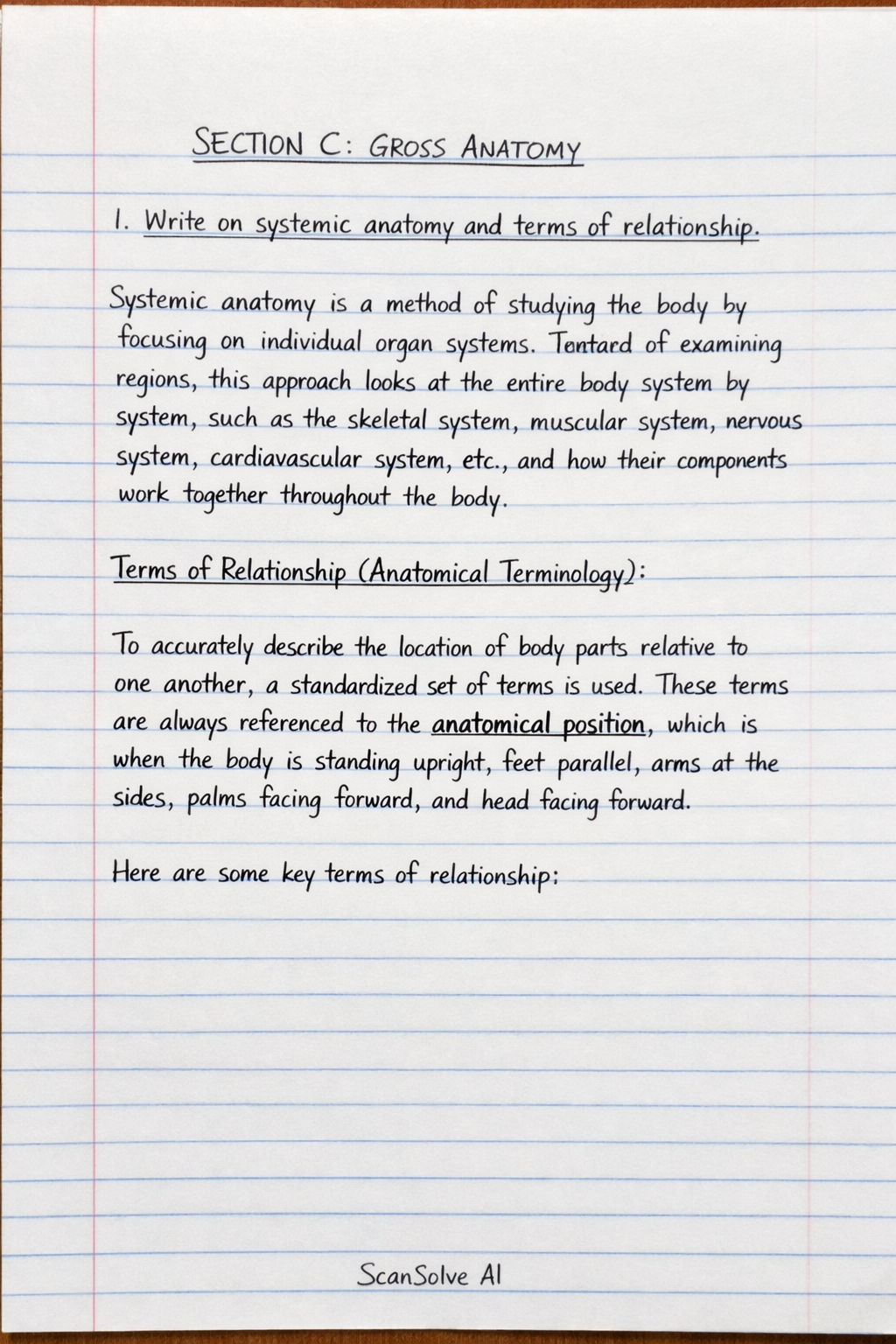
Write on systemic anatomy and terms of relationship.
ScanSolve AI Answer
here is the answer to question 1 from the image.
SECTION C: GROSS ANATOMY
1. Write on systemic anatomy and terms of relationship
Systemic anatomy is a method of studying the body by focusing on individual organ systems. Instead of examining regions, this approach looks at the entire body system by system, such as the skeletal system, muscular system, nervous system, cardiovascular system, etc., and how their components work together throughout the body.
Terms of Relationship (Anatomical Terminology):
To accurately describe the location of body parts relative to one another, a standardized set of terms is used. These terms are always referenced to the anatomical position, which is when the body is standing upright, feet parallel, arms at the sides, palms facing forward, and head facing forward.
Here are some key terms of relationship:
- Superior (cranial): Towards the head end or upper part of a structure or the body; above.
- Example: The head is superior to the neck.
- Inferior (caudal): Away from the head end or toward the lower part of a structure or the body; below.
- Example: The feet are inferior to the knees.
- Anterior (ventral): Towards or at the front of the body; in front of.
- Example: The sternum is anterior to the heart.
- Posterior (dorsal): Towards or at the back of the body; behind.
- Example: The vertebral column is posterior to the sternum.
- Medial: Towards or at the midline of the body; on the inner side of.
- Example: The nose is medial to the ears.
- Lateral: Away from the midline of the body; on the outer side of.
- Example: The arms are lateral to the chest.
- Proximal: Closer to the origin of the body part or the point of attachment of a limb to the body trunk.
- Example: The elbow is proximal to the wrist.
- Distal: Farther from the origin of a body part or the point of attachment of a limb to the body trunk.
- Example: The fingers are distal to the elbow.
- Superficial (external): Towards or at the body surface.
- Example: The skin is superficial to the muscles.
- Deep (internal): Away from the body surface; more internal.
- Example: The bones are deep to the muscles.
- Ipsilateral: On the same side of the body.
- Example: The right arm and right leg are ipsilateral.
- Contralateral: On opposite sides of the body.
- Example: The right arm and left leg are contralateral.
Still stuck on this one?
Ask a follow-up, and the answer starts from this question.
More Biology Questions
Handwritten Step-by-Step Solution
Get this as a handwritten image on WhatsApp — like a tutor wrote it for you.
Try on WhatsApp