
We read your photo as:
Part (b) The genotype of offspring number 1 is. Part (c) The probability of having a hemophiliac son is.
ScanSolve AI Answer
Answers
3 partsStep-by-step solution
7 stepsPart b· 3 steps
Identify the parents of offspring 1.
Offspring 1 is a male. His parents are the first generation male (normal) and female (carrier).
Determine the genotypes of the parents.
Hemophilia is X-linked recessive. Let be the allele for normal clotting and be the allele for hemophilia.
The normal male parent has genotype .
The carrier female parent has genotype .Determine the genotype of offspring 1.
Offspring 1 is a normal male. Males inherit from their father and an X chromosome from their mother. Since the father is , he passes . The mother is . For the son to be normal, he must inherit from his mother.
Therefore, the genotype of offspring 1 is .The genotype of offspring number 1 is .
Part c
Determine the genotypes of the couple.
A carrier woman has genotype .
A hemophiliac man has genotype .Set up a Punnett square to determine the possible genotypes of their offspring.
Gametes from woman: ,
Gametes from man: ,Identify the genotypes of sons and hemophiliac sons.
The possible genotypes for sons are (normal male) and (hemophiliac male).
Calculate the probability of having a son who is hemophiliac.
Out of the four possible offspring genotypes, one is , which represents a hemophiliac son.
The probability is .The probability that the couple will have a son who is hemophiliac is .
Part d
One defect of non-disjunction chromosomal mutation is Down syndrome (Trisomy 21).
Name one defect of non-disjunction chromosomal mutation: .
Try one yourself
A new problem that tests the same skill.
Still stuck on this one?
Ask a follow-up, and the answer starts from this question.
More Biology Questions
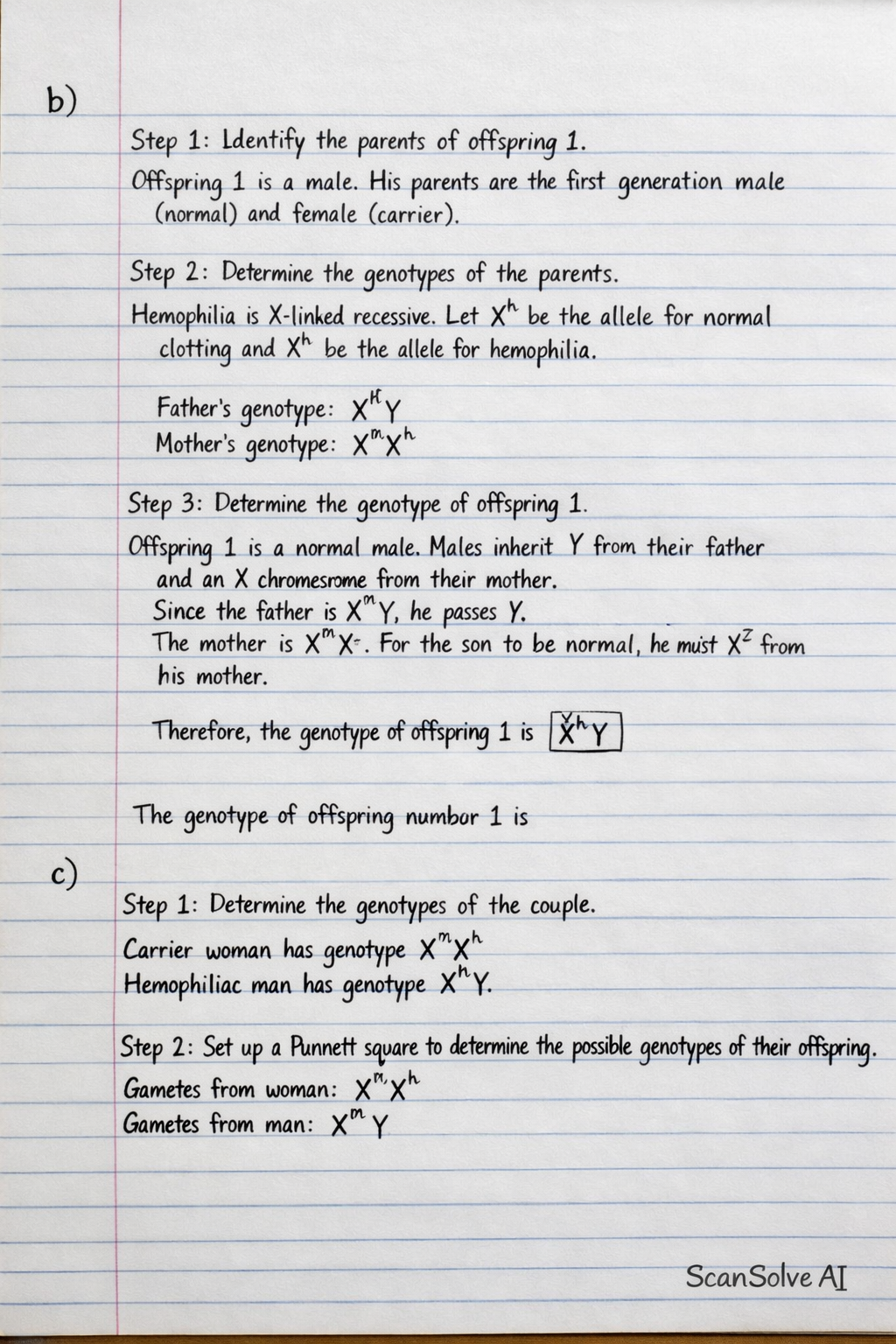
Handwritten Step-by-Step Solution
Get this as a handwritten image on WhatsApp — like a tutor wrote it for you.
Try on WhatsApp