
We read your photo as:
Which of the following molecules cannot pass through the plasma membrane?
ScanSolve AI Answer
Answer
Here are the solutions to the questions from the image you sent.
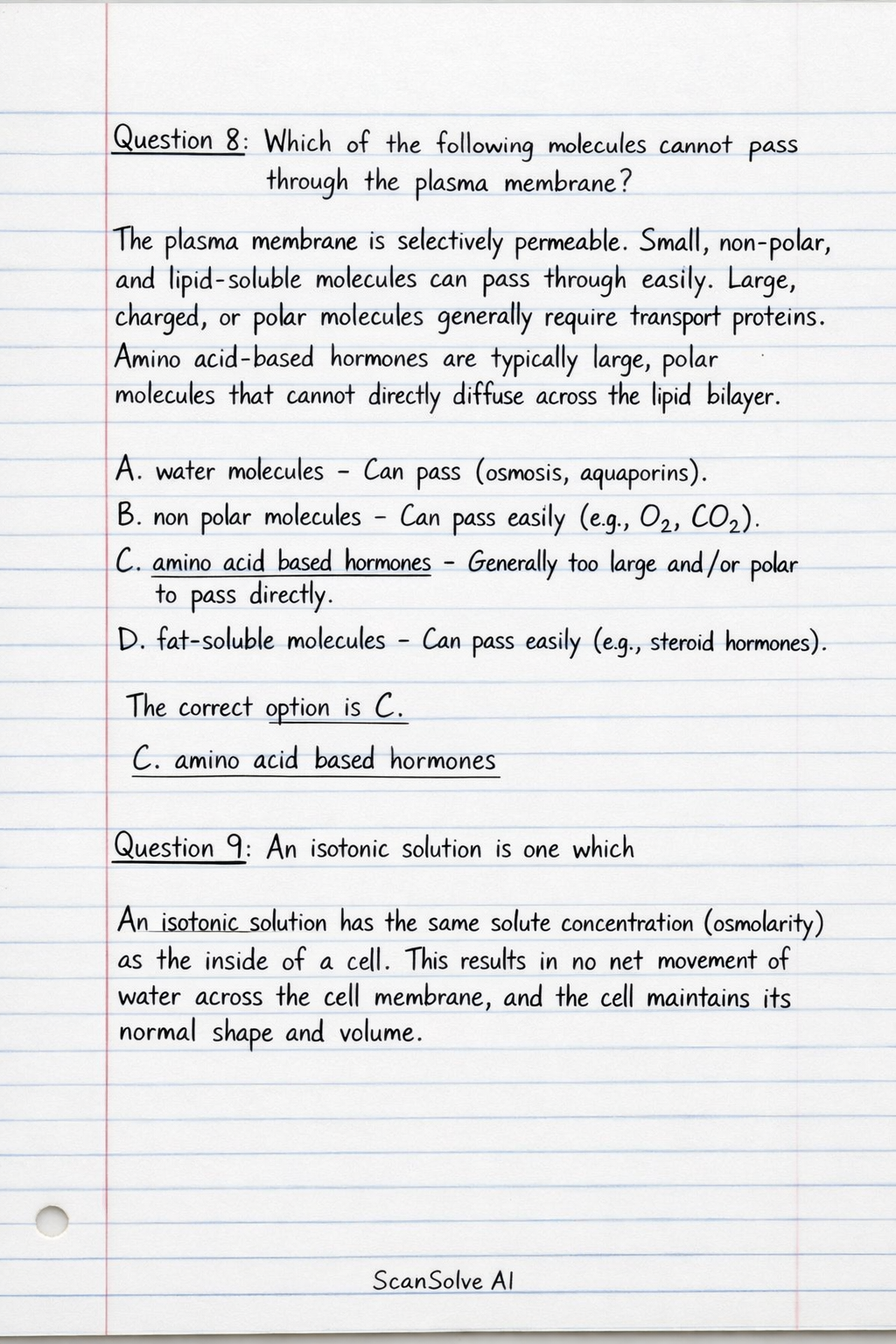
Question 8: Which of the following molecules cannot pass through the plasma membrane?
The plasma membrane is selectively permeable. Small, non-polar, and lipid-soluble molecules can pass through easily. Large, charged, or polar molecules generally require transport proteins. Amino acid-based hormones are typically large, polar molecules that cannot directly diffuse across the lipid bilayer.
- A. water molecules - Can pass (osmosis, aquaporins).
- B. non polar molecules - Can pass easily (e.g., O, CO).
- C. amino acid based hormones - Generally too large and/or polar to pass directly.
- D. fat-soluble molecules - Can pass easily (e.g., steroid hormones).
The correct option is C.
- C. amino acid based hormones
Question 9: An isotonic solution is one which
An isotonic solution has the same solute concentration (osmolarity) as the inside of a cell. This results in no net movement of water across the cell membrane, and the cell maintains its normal shape and volume.
- A. has an osmotic pressure that is different to red blood cells - Incorrect.
- B. has an osmolarity less than that of red blood cells - Incorrect (hypotonic).
- C. causes no net movement of water between the solution and red blood cells - Correct.
- D. has an osmolarity greater than that of red blood cells - Incorrect (hypertonic).
The correct option is C.
- C. causes no net movement of water between the solution and red blood cells
Question 10: One of the buffer systems in the blood is the carbonic acid/bicarbonate buffer. It helps to maintain the body's acid-base balance by destroying any excess:
The carbonic acid/bicarbonate buffer system neutralizes both excess acids (hydrogen ions) and excess bases (hydroxide ions) to maintain a stable pH.
- A. Hydrogen ions in the blood - Neutralizes excess H.
- B. acid or base in the blood - This is a comprehensive description of a buffer's function.
- C. Hydroxide ions formed in the blood - Neutralizes excess OH.
- D. bicarbonate ions formed in the blood - Bicarbonate ions are part of the buffer, not what it destroys.
The most complete and accurate answer describing what the buffer system destroys is B.
- B. acid or base in the blood
Question 11: The primary somatosensory cortex is located in the:
The primary somatosensory cortex processes sensory information and is located in the postcentral gyrus of the parietal lobe.
- A. Precentral gyrus - Primary motor cortex.
- B. Postcentral gyrus - Primary somatosensory cortex.
- C. Frontal pole - Part of the frontal lobe.
- D. Temporal cortex - Auditory processing.
The correct option is B.
- B. Postcentral gyrus
Question 12: Which of the following statements about the role of the kidneys or lungs in the maintenance of acid-base balance in the body is FALSE?
Let's evaluate each statement:
- A. The kidneys are able to affect several buffer systems but the lungs affect only one. (True: Lungs affect carbonic acid; kidneys affect carbonic acid, phosphate, ammonia.)
- B. The lungs exert their influence on the carbonic acid/bicarbonate buffer system. (True: By regulating CO.)
- C. Neither the lungs nor the kidneys have much influence over the protein buffer. (False: They influence overall pH, which affects all buffer systems, including protein buffers.)
- D. The kidneys are able to respond more rapidly than the lungs to changes in acid-base balance. (False: Lungs respond rapidly (minutes), kidneys respond slowly (hours to days).)
Both C and D are false statements. However, the speed of response (D) is a fundamental and distinct difference between renal and respiratory compensation, making it unequivocally false.
The correct option is D.
- D. The kidneys are able to respond more rapidly than the lungs to changes in acid-base balance.
Question 13: Choose one answer below that completes the sentence so that it makes a true statement: Positive feedback:
Positive feedback mechanisms amplify an initial stimulus, moving the system further away from the set point. Homeostasis is primarily maintained by negative feedback.
- A. is the way the body maintains homeostasis - This is false; negative feedback maintains homeostasis.
- B. is a response that opposes a stimulus - This is false; this describes negative feedback.
The options C and D are not visible in the provided image. Therefore, I cannot fully answer this question.
Try one yourself
A new problem that tests the same skill.
Still stuck on this one?
Ask a follow-up, and the answer starts from this question.
More Biology Questions
Handwritten Step-by-Step Solution
Get this as a handwritten image on WhatsApp — like a tutor wrote it for you.
Try on WhatsApp