

This chemistry question involves key chemical concepts and calculations. The detailed solution below walks through each step, from identifying the reaction type to computing the final answer.
ScanSolve AI Answer
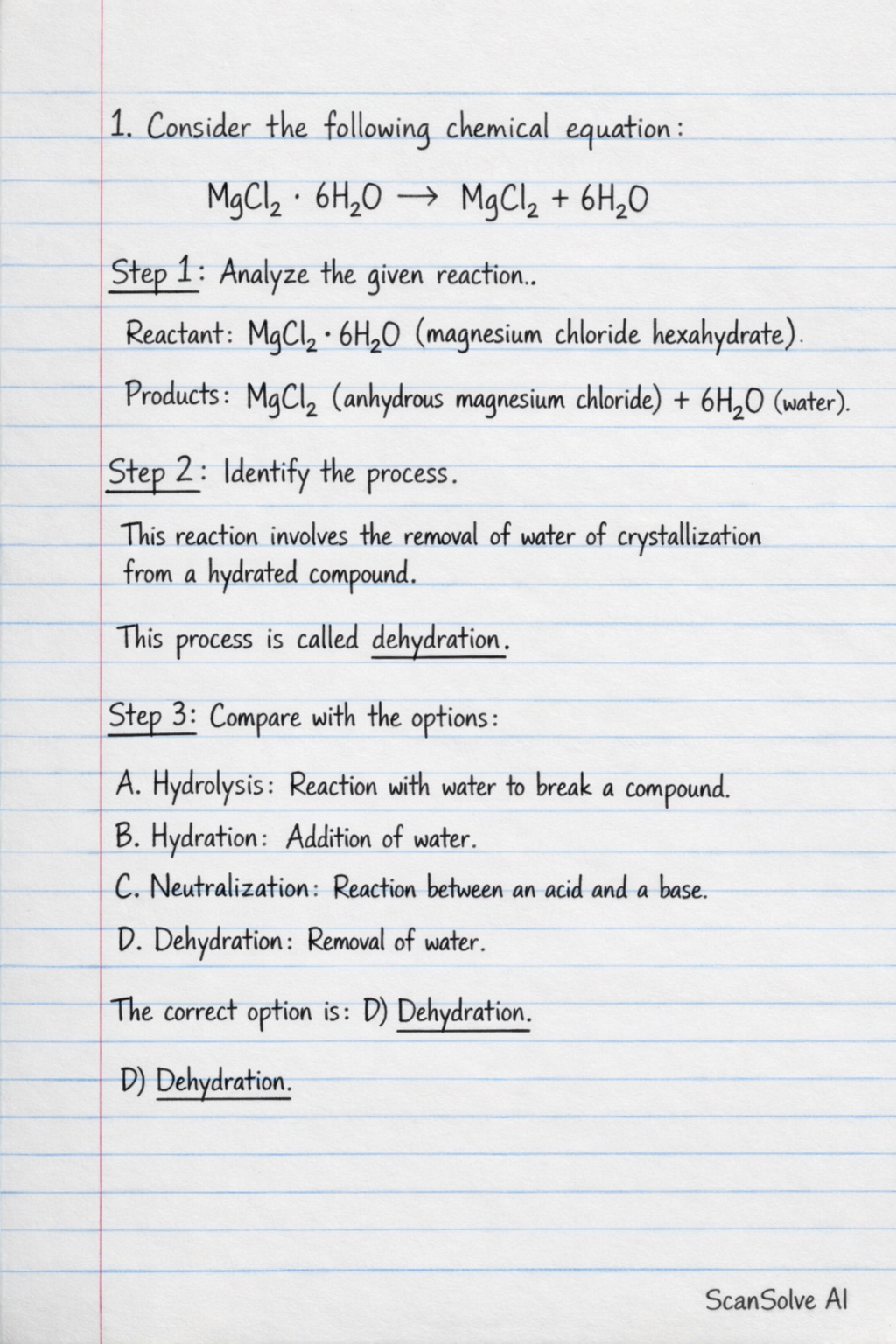
Here are the solutions to the questions from the image: 1. Consider the following chemical equation: MgCl_2 · 6H_2O MgCl_2 + 6H_2O The reaction represented by the equation is Step 1: Analyze the given reaction. The reactant is a hydrated salt, magnesium chloride hexahydrate (MgCl_2 · 6H_2O). The products are anhydrous magnesium chloride (MgCl_2) and water (H_2O). Step 2: Identify the process. The reaction shows the removal of water of crystallization from a hydrated compound. This process is known as dehydration. Step 3: Compare with the given options. A. Hydrolysis: Reaction with water to break a compound. B. Hydration: Addition of water. C. Neutralization: Reaction between an acid and a base. D. Dehydration: Removal of water. The correct option is D. D) dehydration 2. The preparation of carbon(II) oxide is done in a fume cupboard because the gas is Step 1: Identify carbon(II) oxide. Carbon(II) oxide is the chemical name for carbon monoxide (CO). Step 2: Recall the properties of carbon monoxide. Carbon monoxide is a colorless, odorless, and highly poisonous gas. Step 3: Determine why a fume cupboard is necessary. Due to its poisonous nature, carbon monoxide must be handled in a fume cupboard to prevent inhalation and ensure safety. The correct option is B. B) poisonous 3. Which of the following substances is not a mixture? Step 1: Define a mixture. A mixture is a substance containing two or more different substances that are not chemically bonded together. Step 2: Evaluate each option: A. Iron rod: An iron rod is primarily composed of the element iron. While commercial iron might contain impurities or be an alloy (which is a mixture), in the context of these options, pure iron is an element, not a mixture. B. Urine: A complex biological fluid containing water, urea, salts, and other dissolved substances, making it a mixture. C. Sea water: A solution of various salts (like sodium chloride) dissolved in water, making it a mixture. D. Brine: A concentrated solution of salt (usually sodium chloride) in water, making it a mixture. Step 3: Conclude which is not a mixture. Among the given options, an iron rod (representing the element iron) is the only one that is not inherently a mixture. The correct option is A. A) Iron rod 4. Carbon(IV) oxide could be produced from glucose by Step 1: Identify carbon(IV) oxide. Carbon(IV) oxide is carbon dioxide (CO_2). Step 2: Consider the processes that produce CO_2 from glucose (C_6H_12O_6). Fermentation: This is an anaerobic process where microorganisms convert glucose into ethanol and carbon dioxide (e.g., alcoholic fermentation: C_6H_12O_6 2C_2H_5OH + 2CO_2). Oxidation (Cellular Respiration): Glucose is oxidized to CO_2 and water in the presence of oxygen. Decarboxylation: A specific reaction where a carboxyl group is removed, releasing CO_2. This is a step within broader processes like fermentation or respiration. Step 3: Choose the most appropriate option. While oxidation and decarboxylation are involved, fermentation is a direct and common biological process specifically known for producing CO_2 from glucose. The correct option is C. C) fermentation 5. If carbon forms CX_4 and CY_2 with elements X and Y respectively, the formula of the compound that would be formed between elements X and Y is Step 1: Determine the valency of element X. In CX_4, carbon (valency 4) combines with four atoms of X. This means X has a valency of 1. Step 2: Determine the valency of element Y. In CY_2, carbon (valency 4) combines with two atoms of Y. This means Y has a valency of 2. Step 3: Determine the formula of the compound formed between X (valency 1) and Y (valency 2). Using the criss-cross method, the valency of X (1) becomes the subscript for Y, and the valency of Y (2) becomes the subscript for X. Step 4: Write the formula. The compound formed would be X_2Y. The correct option is D. D) X_2Y 6. When the pressure on 200 cm^3 of a gas is doubled, and its absolute temperature is halved, its volume would become Step 1: State the combined gas law formula. (P_1V_1)/(T_1) = (P_2V_2)/(T_2) where P is pressure, V is volume, and T is absolute temperature. Step 2: Identify the initial conditions (P_1, V_1, T_1) and final conditions (P_2, V_2, T_2). Initial volume V_1 = 200 cm^3. Let initial pressure P_1 = P. Let initial absolute temperature T_1 = T. Final pressure P_2 = 2P (pressure is doubled). Final absolute temperature T_2 = (T)/(2) (absolute temperature is halved). We need to find the final volume V_2. Step 3: Substitute the values into the combined gas law equation. (P · 200)/(T) = ((2P) · V_2)/((T/2)) Step 4: Simplify the equation to solve for V_2. (200P)/(T) = (4P · V_2)/(T) Multiply both sides by T: 200P = 4P · V_2 Divide both sides by P: 200 = 4V_2 V_2 = (200)/(4) V_2 = 50 cm^3 The correct option is C. C) 50 cm^3 What's next? Send 'em!