
We read your photo as:
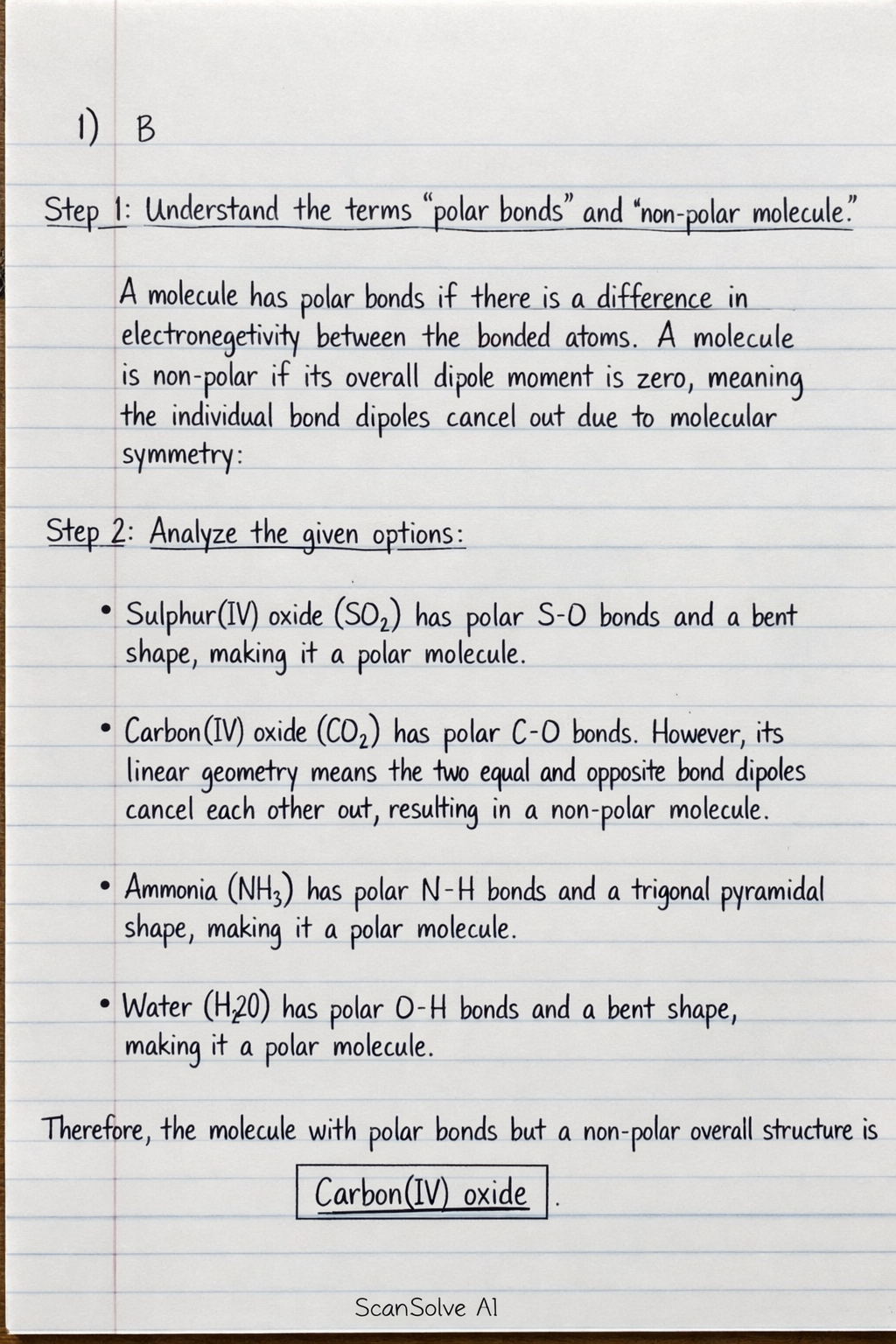
Which of the following molecules possesses polar bonds but is non-polar?
Chemistry
ScanSolve AI Answer
Step-by-step solution
8 stepshere are the answers to the questions:
- B
Understand the terms "polar bonds" and "non-polar molecule".
A molecule has polar bonds if there is a difference in electronegativity between the bonded atoms. A molecule is non-polar if its overall dipole moment is zero, meaning the individual bond dipoles cancel out due to molecular symmetry.Analyze the given options.
* Sulphur(IV) oxide ($SO_2$) has polar S-O bonds and a bent shape, making it a polar molecule. * Carbon(IV) oxide ($CO_2$) has polar C-O bonds. However, its linear geometry means the two equal and opposite bond dipoles cancel each other out, resulting in a non-polar molecule. * Ammonia ($NH_3$) has polar N-H bonds and a trigonal pyramidal shape, making it a polar molecule. * Water ($H_2O$) has polar O-H bonds and a bent shape, making it a polar molecule. Therefore, the molecule with polar bonds but a non-polar overall structure is $\boxed{\text{Carbon(IV) oxide}}$.2. B
Recall the definition of an alkyl group.
An alkyl group is a functional group derived from an alkane by removing one hydrogen atom.Recall the general formula for an alkane.
The general formula for an alkane is $C_nH_{2n+2}$.Derive the general formula for an alkyl group.
By removing one hydrogen atom from an alkane, the general formula for an alkyl group becomes $C_nH_{2n+1}$. The general formula of an alkyl group is $\boxed{C_nH_{2n+1}}$.3. A
Analyze the given chemical equation.
The equation is $MgCl_2 + 2H_2O \rightarrow Mg(OH)_2 + 2HCl$. In this reaction, a salt ($MgCl_2$) reacts with water ($H_2O$) to produce a base ($Mg(OH)_2$) and an acid ($HCl$).Define the reaction types in the options.
* **Hydrolysis** is a chemical reaction in which water reacts with a substance to break it down into two or more new substances. * **Hydration** is the process of adding water molecules to a substance, often forming a hydrate, without necessarily breaking the original compound. * **Neutralization** is the reaction between an acid and a base to form a salt and water. * **Ionization** is the process by which an atom or a molecule acquires a negative or positive charge by gaining or losing electrons, or by the dissociation of a molecule into ions.Match the reaction to the definition.
The reaction of $MgCl_2$ with water to form $Mg(OH)_2$ and $HCl$ is a classic example of a salt undergoing hydrolysis.

The reaction represented by the equation is $\boxed{\text{hydrolysis}}$.
Was this helpful?
Still stuck on this one?
Ask a follow-up, and the answer starts from this question.
Got a different question?Ask your own question
More Chemistry Questions
Handwritten Step-by-Step Solution
Get this as a handwritten image on WhatsApp — like a tutor wrote it for you.
Try on WhatsApp