
We read your photo as:
Pls explain what polar and non polar covalent meas
ScanSolve AI Answer
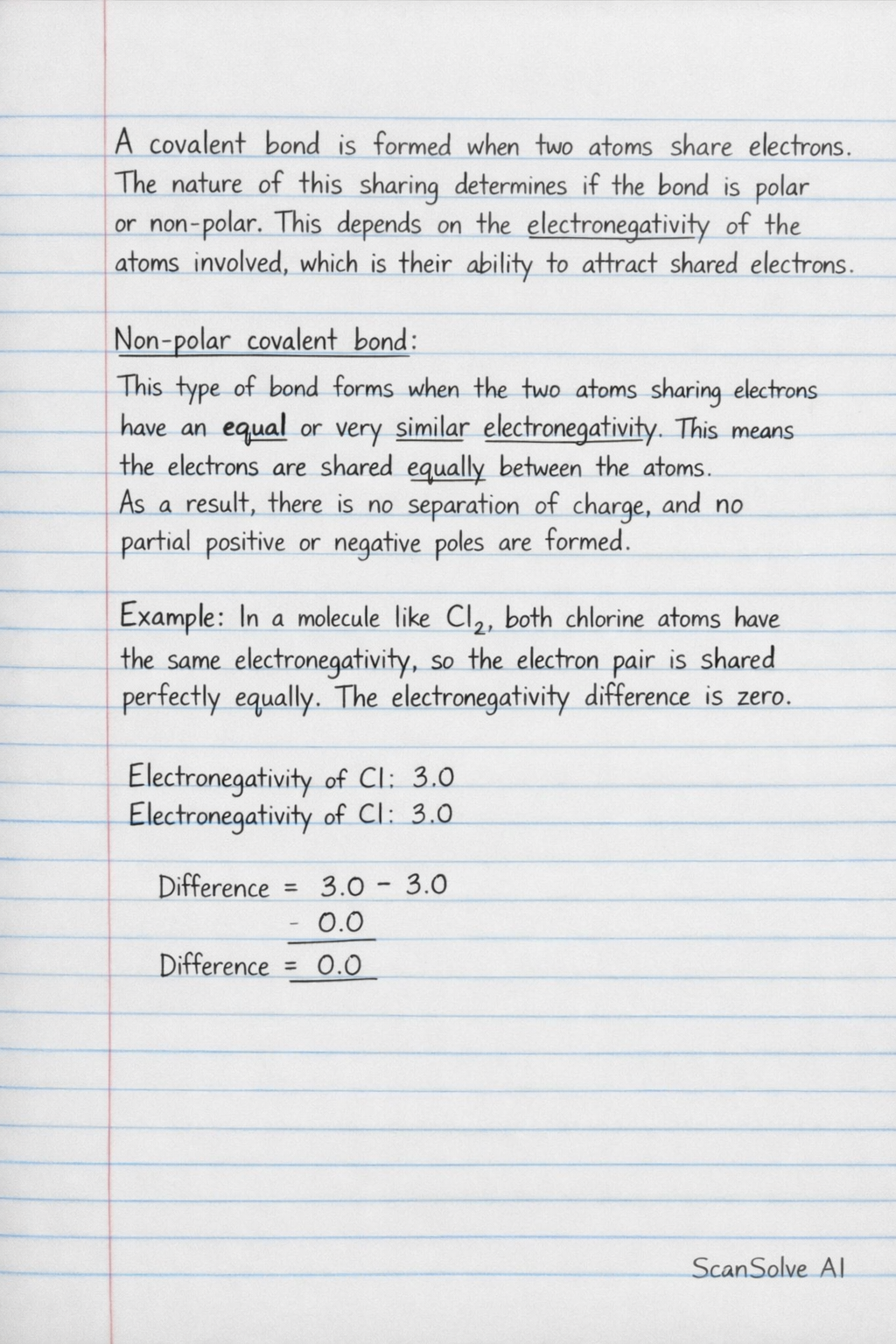
A covalent bond is formed when two atoms share electrons. The nature of this sharing determines if the bond is polar or non-polar. This depends on the electronegativity of the atoms involved, which is their ability to attract shared electrons.
-
Non-polar covalent bond: This type of bond forms when the two atoms sharing electrons have an equal or very similar electronegativity. This means the electrons are shared equally between the atoms. As a result, there is no separation of charge, and no partial positive or negative poles are formed.
- Example: In a molecule like , both chlorine atoms have the same electronegativity, so the electron pair is shared perfectly equally. The electronegativity difference is zero.
-
Polar covalent bond: This type of bond forms when the two atoms sharing electrons have a significant difference in their electronegativity. The atom with higher electronegativity will attract the shared electrons more strongly, pulling them closer to itself. This creates a partial negative charge () on the more electronegative atom and a partial positive charge () on the less electronegative atom, forming a dipole.
- Example: In a molecule like , chlorine is more electronegative than hydrogen. The shared electrons spend more time closer to the chlorine atom, giving chlorine a partial negative charge () and hydrogen a partial positive charge ().
In summary:
- Non-polar covalent: Equal sharing of electrons, zero or very small electronegativity difference.
- Polar covalent: Unequal sharing of electrons, significant electronegativity difference.
Still stuck on this one?
Ask a follow-up, and the answer starts from this question.
More Chemistry Questions
Handwritten Step-by-Step Solution
Get this as a handwritten image on WhatsApp — like a tutor wrote it for you.
Try on WhatsApp