
We read your photo as:
Which ONE of the bonds between the atoms is most polar?
ScanSolve AI Answer
Answer
1.1 To determine the most polar bond, we compare the electronegativity difference between the bonded atoms. A larger difference indicates a more polar bond.
- Electronegativity values: C , H , O , Cl .
- C-C:
- C-H:
- C-O:
- C-Cl: The largest electronegativity difference is for the C-O bond.
The correct option is C.
1.2 When magnesium chloride () dissolves in water, it dissociates into ions and ions. Water () is a polar molecule, meaning it has a permanent dipole. The attractive force between an ion () and a polar molecule (water) is called an ion-dipole force.
The correct option is B.
1.3 Hydrogen bonding occurs when a hydrogen atom is bonded to a highly electronegative atom (like N, O, or F) that also possesses at least one lone pair of electrons.
- Statement (i) "be large in size" is incorrect. The atoms involved in hydrogen bonding (N, O, F) are relatively small.
- Statement (ii) "be highly electronegative" is correct. High electronegativity creates a significant partial positive charge on the hydrogen and a partial negative charge on the electronegative atom, which is essential for hydrogen bonding.
- Statement (iii) "have at least one lone pair of electrons" is correct. The lone pair on the electronegative atom is crucial for forming the attractive interaction with the partially positive hydrogen atom of another molecule.
Therefore, statements (ii) and (iii) are true. Based on typical multiple-choice options, the correct answer would be the option that includes both (ii) and (iii).
The correct option is C (ii) and (iii).
Try one yourself
A new problem that tests the same skill.
Still stuck on this one?
Ask a follow-up, and the answer starts from this question.
More Physics Questions
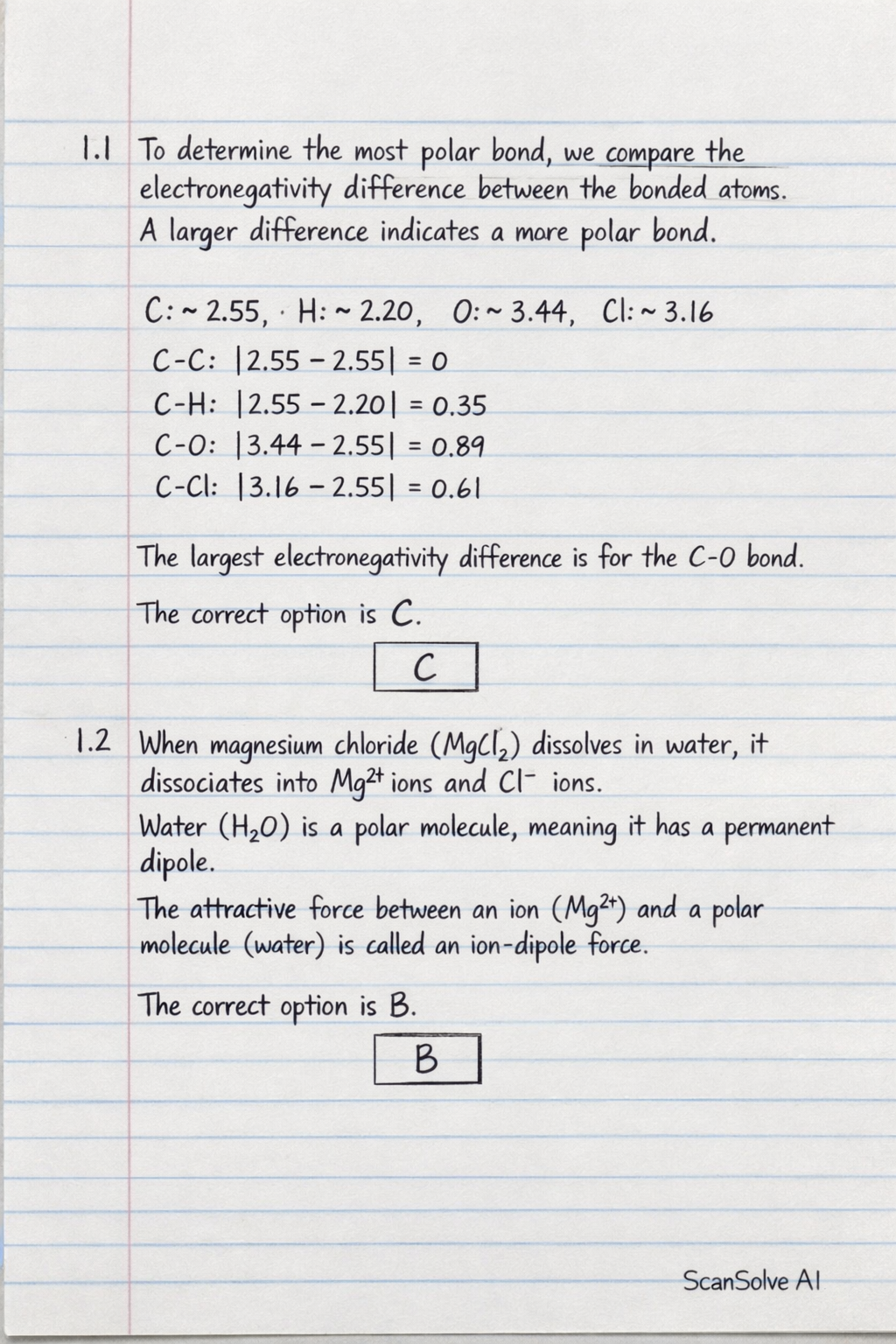
Handwritten Step-by-Step Solution
Get this as a handwritten image on WhatsApp — like a tutor wrote it for you.
Try on WhatsApp