
We read your photo as:
Which molecule has a central atom with no lone pairs?
ScanSolve AI Answer
Answer
Here are the solutions to the chemistry quiz questions:
2. Which molecule has a central atom with no lone pairs?
- A) : Nitrogen has one lone pair.
- B) : Oxygen has two lone pairs.
- C) : Carbon has no lone pairs.
- D) : Sulfur has one lone pair.
- The correct option is C.
23. Resonance in nitrate ion () results in:
- The nitrate ion has one double bond and two single bonds that are delocalized through resonance, resulting in three equivalent bonds.
- The correct option is B.
24. Molecular geometry of is:
- Methane () has a central carbon atom bonded to four hydrogen atoms with no lone pairs, leading to a tetrahedral geometry.
- The correct option is A.
25. Molecular geometry of is:
- Ammonia () has a central nitrogen atom bonded to three hydrogen atoms and one lone pair, resulting in a trigonal pyramidal geometry.
- The correct option is B.
26. Electron geometry around O in is:
- Water () has a central oxygen atom with two bonding pairs and two lone pairs, giving it a tetrahedral electron geometry.
- The correct option is D.
27. Molecular geometry of is:
- Carbon dioxide () has a central carbon atom double-bonded to two oxygen atoms with no lone pairs, resulting in a linear geometry.
- The correct option is A.
28. Electron geometry around B in is:
- Boron trifluoride () has a central boron atom bonded to three fluorine atoms with no lone pairs, giving it a trigonal planar electron geometry.
- The correct option is A.
29. Molecular geometry of is:
- Phosphorus pentafluoride () has a central phosphorus atom bonded to five fluorine atoms with no lone pairs, resulting in a trigonal bipyramidal geometry.
- The correct option is A.
30. Which molecule is nonpolar?
- is linear, and its polar C=O bonds cancel out due to symmetry, making the molecule nonpolar.
- The correct option is C.
31. Which molecule is polar?
- has a bent geometry with polar S-O bonds and a lone pair on sulfur, resulting in a net dipole moment, making it polar.
- The correct option is C.
32. geometry is:
- Sulfur dioxide () has a central sulfur atom with two bonding pairs and one lone pair, resulting in a bent molecular geometry.
- The correct option is B.
33. HCN polarity is:
- Hydrogen cyanide (HCN) has a linear structure with a highly polar C≡N bond and a slightly polar C-H bond. The dipoles do not cancel, making it polar.
- The correct option is B.
34. polarity is:
- Methanol () contains polar C-O and O-H bonds and has an asymmetric structure, resulting in a net dipole moment, making it polar.
- The correct option is B.
35. Which molecule has delocalized electrons?
- Ozone () exhibits resonance, which means it has delocalized electrons.
- The correct option is B.
36. Which molecule is trigonal pyramidal?
- Ammonia () has a central nitrogen atom with three bonding pairs and one lone pair, giving it a trigonal pyramidal geometry.
- The correct option is B.
37. Which molecule is linear?
- Carbon dioxide () has a linear molecular geometry.
- The correct option is B.
38. Which molecule is nonpolar due to symmetry?
- Carbon tetrachloride () has a tetrahedral geometry. Although the C-Cl bonds are polar, the symmetrical arrangement causes the bond dipoles to
Try one yourself
A new problem that tests the same skill.
Still stuck on this one?
Ask a follow-up, and the answer starts from this question.
More Chemistry Questions
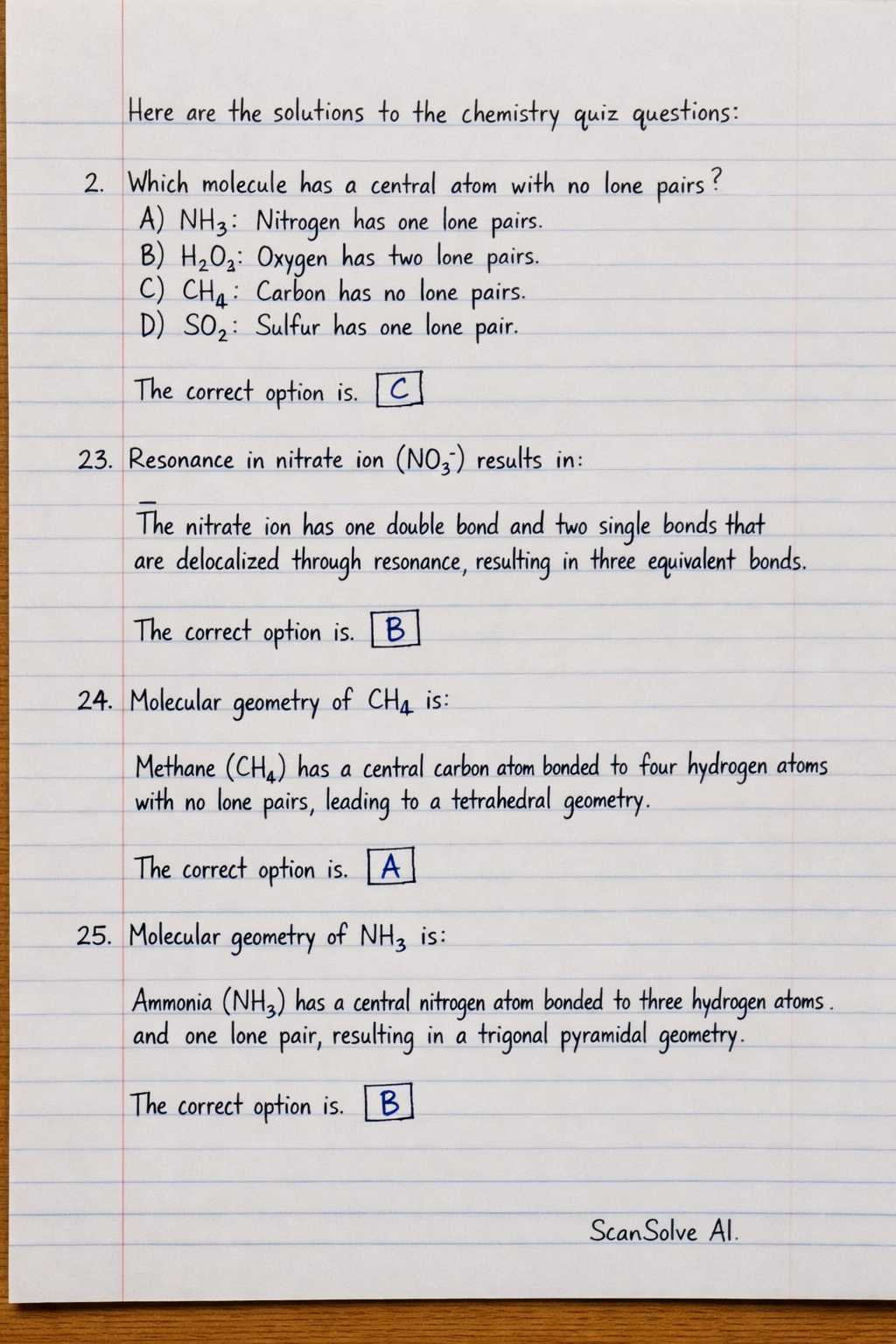
Handwritten Step-by-Step Solution
Get this as a handwritten image on WhatsApp — like a tutor wrote it for you.
Try on WhatsApp