
We read your photo as:
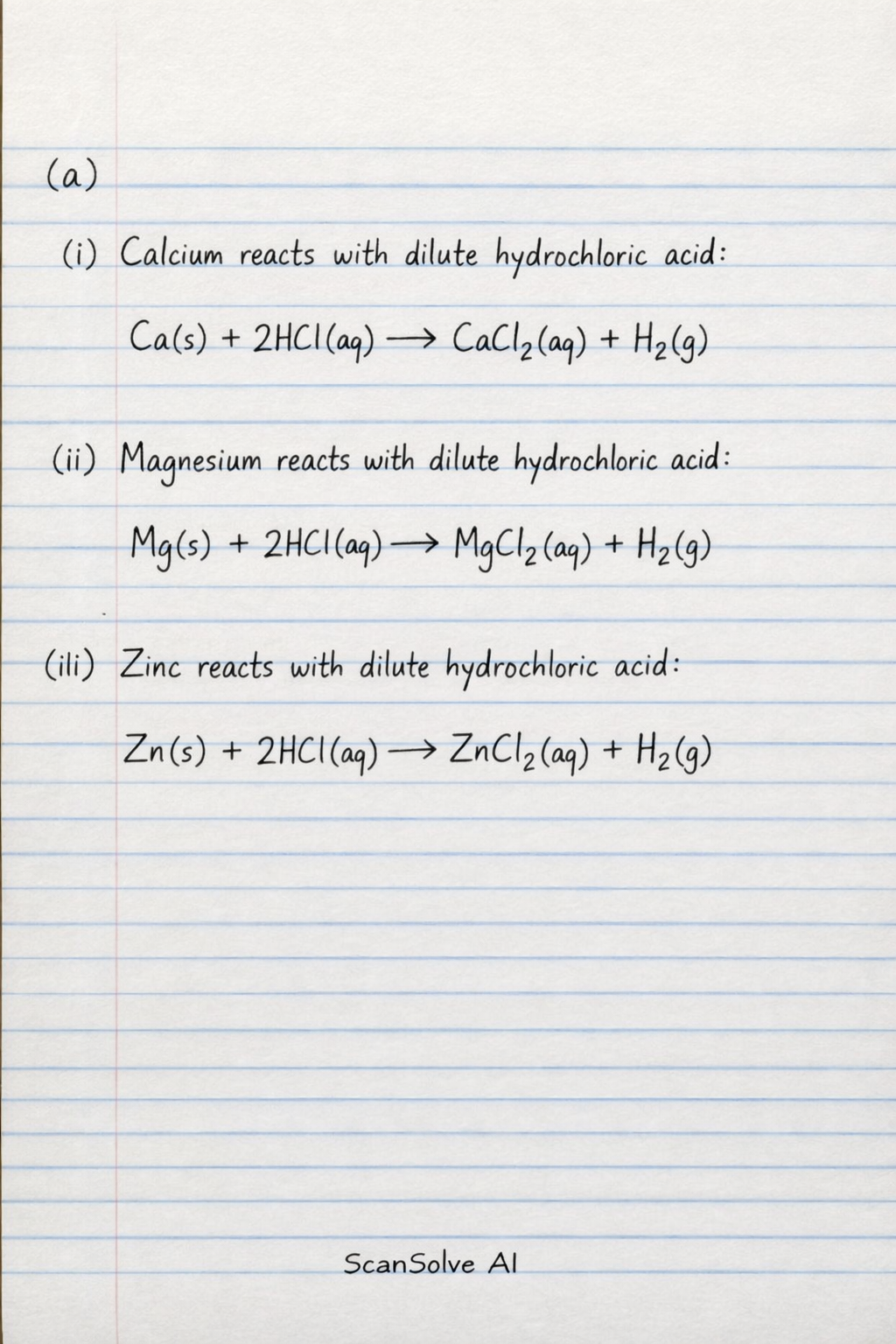
Calcium reacts with dilute hydrochloric acid:
Chemistry
ScanSolve AI Answer
(a)
- (i) Calcium reacts with dilute hydrochloric acid:
- (ii) Magnesium reacts with dilute hydrochloric acid:
- (iii) Zinc reacts with dilute hydrochloric acid:
(b)
- (i) Circuit symbols:
- (α) Capacitor:
- (β) Diode:
- (γ) Resistor:
\text{—}\text{/\/\/\}\text{—}
- (ii) To reverse bias the p-n junction diode, the positive terminal of the battery must be connected to the cathode (the line side) and the negative terminal to the anode (the triangle side). (The square represents the battery, with the longer line being the positive terminal. The diode is reversed compared to the original image, or the battery polarity is reversed.)
(c)
Two functions of potassium in crops are:
- It regulates water balance within the plant, influencing stomatal opening and closing.
- It activates enzymes essential for protein synthesis, sugar transport, and overall plant metabolism.
Was this helpful?
Still stuck on this one?
Ask a follow-up, and the answer starts from this question.
Got a different question?Ask your own question
More Chemistry Questions
QDetermine the relative reactivity of calcium and magnesium by observing their reactions with dilute…QExplain the observations of the reaction between calcium carbonate and hydrochloric acid.Q200 g of calcium carbonate completely reacted with dilute HCL in 2 minute.What is the rate of…QTo answer questions (d) and (e) regarding calcium carbonate, I need the balanced chemical equation…QCalculate the moles of calcium carbonate remaining after reacting with 0.2 moles of HCl.
Handwritten Step-by-Step Solution
Get this as a handwritten image on WhatsApp — like a tutor wrote it for you.
Try on WhatsApp