
We read your photo as:
Calculate the moles of calcium carbonate remaining after reacting with 0.2 moles of HCl.
ScanSolve AI Answer
Answer
Step-by-step solution
5 stepsCalculate the molar mass of calcium carbonate ().
The atomic masses are: Ca = 40.08 g/mol, C = 12.01 g/mol, O = 16.00 g/mol.
Calculate the initial moles of calcium carbonate.
Determine the moles of calcium carbonate that react with 0.2 moles of hydrochloric acid ().
The balanced chemical equation is:
From the stoichiometry, 1 mole of reacts with 2 moles of .
Therefore, the moles of required to react with 0.2 moles of are:Identify the limiting reactant and calculate the moles of calcium carbonate remaining.
Initial moles of
Moles of that will react =
Since the initial moles of () are greater than the moles of that will react (), is the limiting reactant, and some will remain.Convert the remaining moles of calcium carbonate to mass.
Rounding to three significant figures:
The amount of calcium carbonate that would remain is .
Try one yourself
A new problem that tests the same skill.
Still stuck on this one?
Ask a follow-up, and the answer starts from this question.
More Chemistry Questions
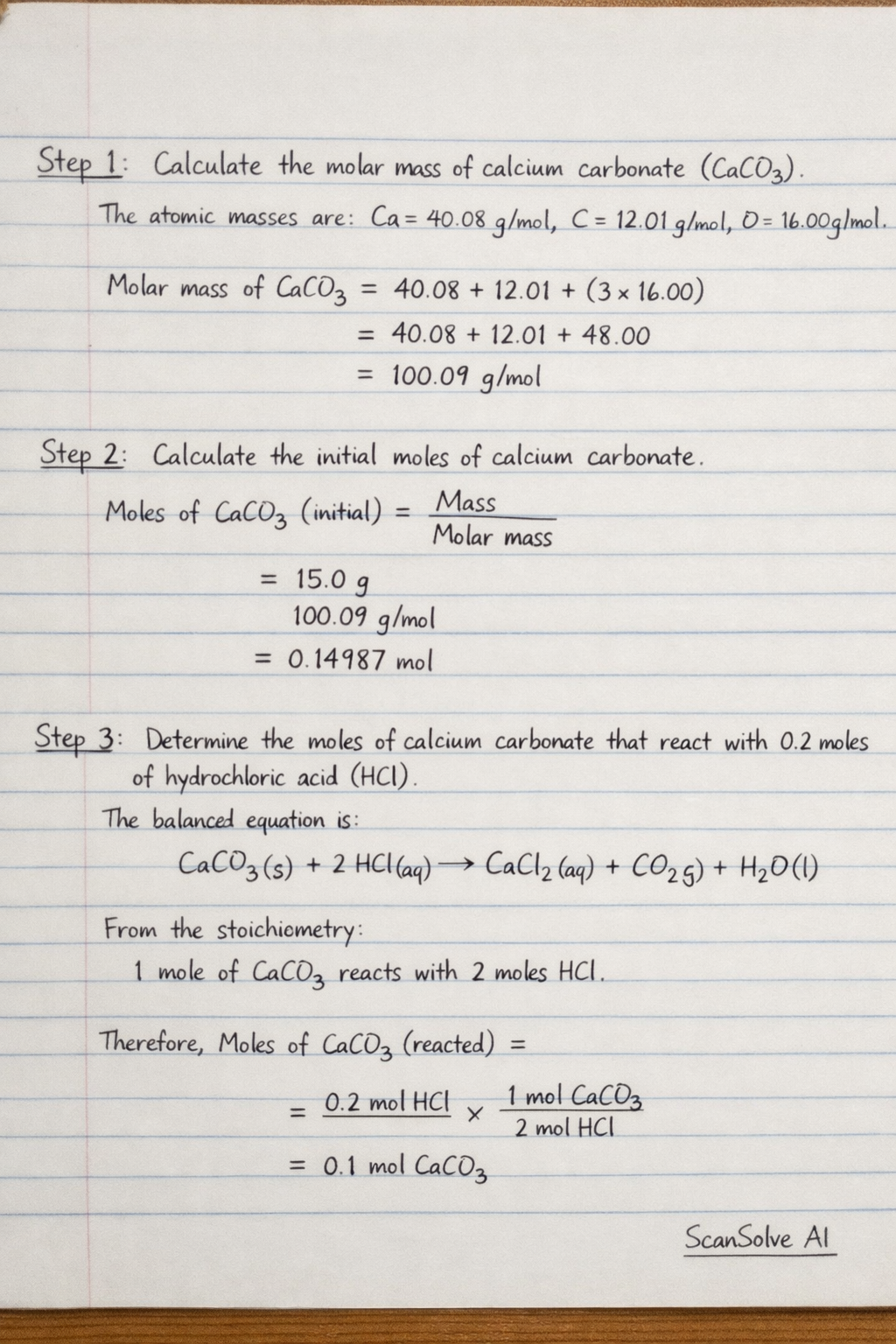
Handwritten Step-by-Step Solution
Get this as a handwritten image on WhatsApp — like a tutor wrote it for you.
Try on WhatsApp