
We read your photo as:
Determine the relative reactivity of calcium and magnesium by observing their reactions with dilute hydrochloric acid.
ScanSolve AI Answer
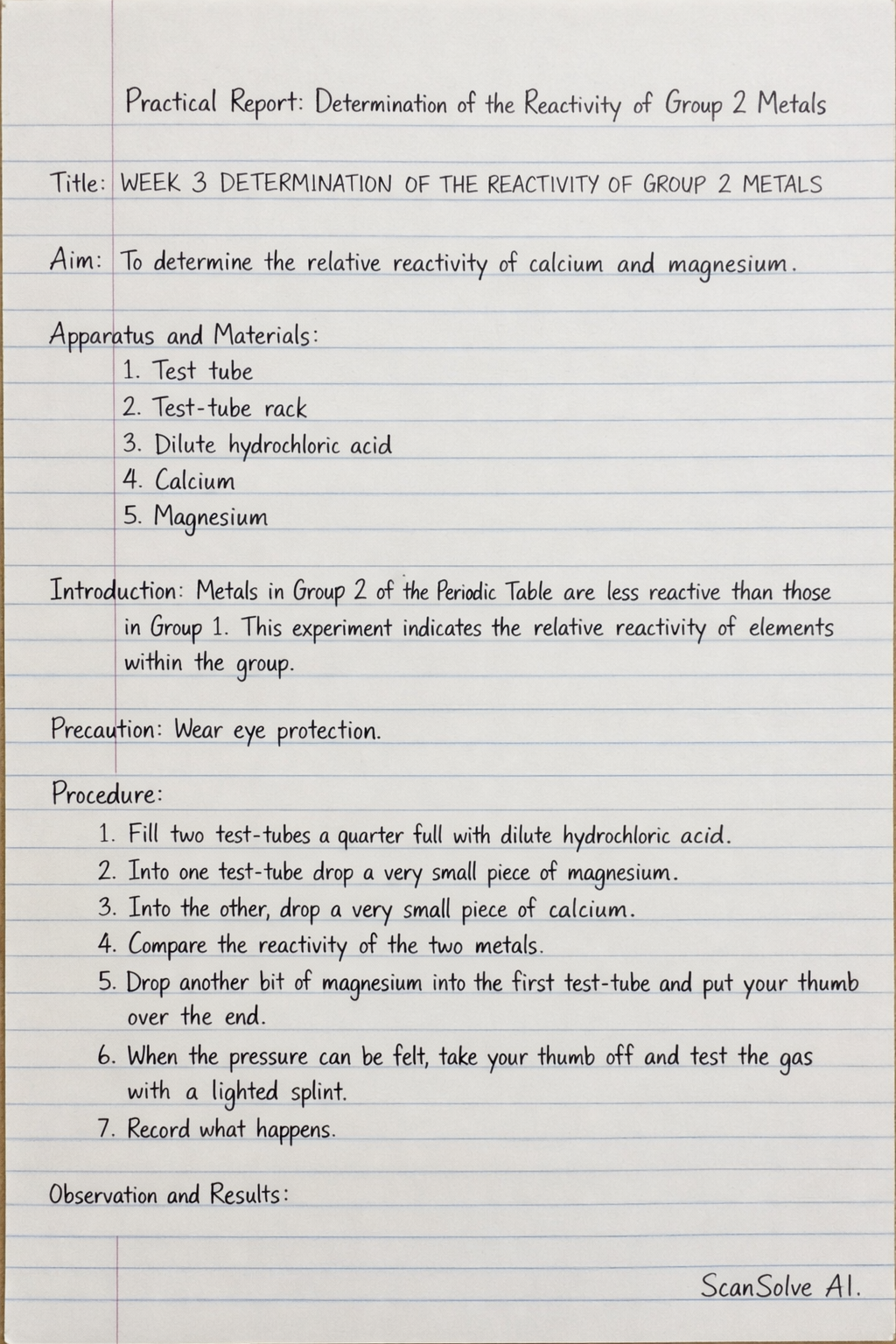
Practical Report: Determination of the Reactivity of Group 2 Metals
Title: WEEK 3 DETERMINATION OF THE REACTIVITY OF GROUP 2 METALS
Aim: To determine the relative reactivity of calcium and magnesium.
Apparatus and Materials:
- Test tube
- Test-tube rack
- Dilute hydrochloric acid
- Calcium
- Magnesium
Introduction:
Metals in Group 2 of the Periodic Table are less reactive than those in Group 1. This experiment indicates the relative reactivity of elements within the group.
Precaution:
Wear eye protection.
Procedure:
- Fill two test-tubes a quarter full with dilute hydrochloric acid.
- Into one test-tube drop a very small piece of magnesium.
- Into the other, drop a very small piece of calcium.
- Compare the reactivity of the two metals.
- Drop another bit of magnesium into the first test-tube and put your thumb over the end.
- When the pressure can be felt, take your thumb off and test the gas with a lighted splint.
- Record what happens.
Observation and Results:
| Observation Point | Magnesium + Dilute HCl | Calcium + Dilute HCl |
|---|---|---|
| Initial reaction | Slow bubbling, magnesium slowly dissolves. | Vigorous bubbling, calcium dissolves rapidly. |
| Heat change | Slight temperature increase. | Significant temperature increase. |
| Gas test (Mg) | Gas collected produces a 'pop' sound with a lighted splint. | (Not tested in procedure, but would also be hydrogen) |
Questions:
1. Which is the more reactive, magnesium or calcium?
Calcium is more reactive than magnesium.
2. Write word equations for these reactions.
- Magnesium + Hydrochloric acid Magnesium chloride + Hydrogen
- Calcium + Hydrochloric acid Calcium chloride + Hydrogen
3. Write formula equations for these reactions.
- For Magnesium:
- For Calcium:
Still stuck on this one?
Ask a follow-up, and the answer starts from this question.
More Chemistry Questions
Handwritten Step-by-Step Solution
Get this as a handwritten image on WhatsApp — like a tutor wrote it for you.
Try on WhatsApp