
We read your photo as:
Please provide the answers to the following questions concerning reproductive anatomy and embryology: 135. Appendix testis from: b) Paramesonephric duct...
ScanSolve AI Answer
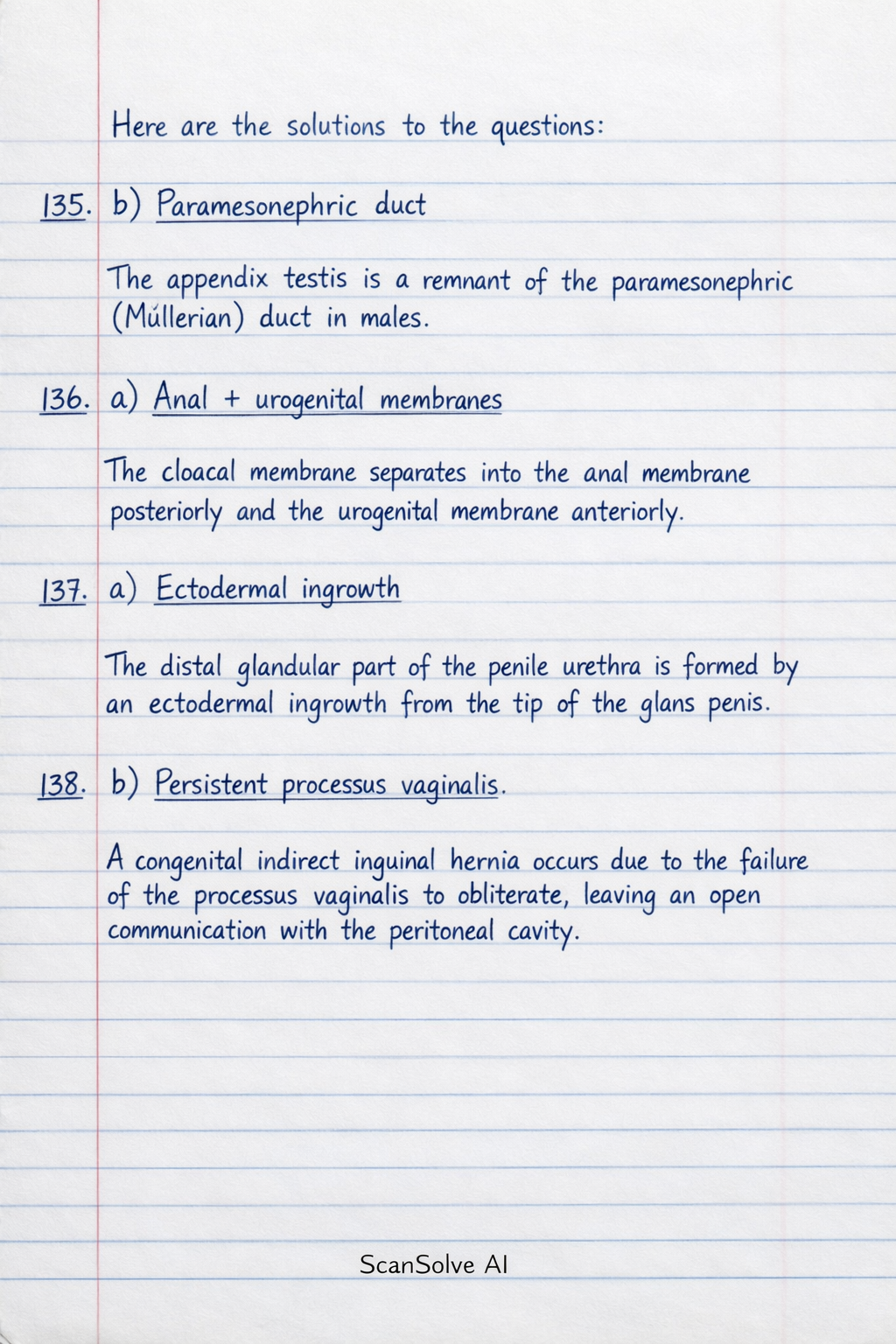
Here are the solutions to the questions:
135. Appendix testis from:
b) Paramesonephric duct
The appendix testis is a remnant of the paramesonephric (Müllerian) duct in males.
136. Cloacal membrane separates into:
a) Anal + urogenital membranes
The cloacal membrane separates into the anal membrane posteriorly and the urogenital membrane anteriorly.
137. Penile urethra distal glandular part from:
a) Ectodermal ingrowth
The distal glandular part of the penile urethra is formed by an ectodermal ingrowth from the tip of the glans penis.
138. Congenital indirect hernia due to:
b) Persistent processus vaginalis
A congenital indirect inguinal hernia occurs due to the failure of the processus vaginalis to obliterate, leaving an open communication with the peritoneal cavity.
139. Androgen insensitivity syndrome features:
c) Undescended testes
Individuals with androgen insensitivity syndrome are genetically male (XY) but are phenotypically female. They have testes (which are often undescended) that produce testosterone, but their cells are unresponsive to androgens.
140. Urachus remnant anomaly:
b) Patent urachus
A patent urachus is an anomaly where the urachus, a remnant of the allantois, fails to close completely, maintaining a connection between the bladder and the umbilicus.
141. Sertoli cells form:
b) Blood-testis barrier
Sertoli cells form tight junctions with each other, creating the blood-testis barrier, which protects developing germ cells from the immune system.
142. Leydig cells secrete:
b) Testosterone
Leydig cells, located in the interstitial tissue of the testes, are responsible for secreting the male hormone testosterone.
143. Spermatogonia lie on:
c) Basal lamina
Spermatogonia are the most immature germ cells and are located on the basal lamina (basement membrane) of the seminiferous tubules.
144. Epididymal epithelium:
b) Pseudostratified columnar with stereocilia
The epididymis is lined by pseudostratified columnar epithelium with stereocilia, which are involved in absorption and secretion.
145. Vas mucosa epithelium:
b) Pseudostratified columnar
The mucosa of the vas deferens is lined by pseudostratified columnar epithelium.
146. Prostate glands embedded in:
b) Fibromuscular stroma
The prostate glands are embedded within a dense fibromuscular stroma composed of smooth muscle and connective tissue.
147. Prostatic concretions are:
b) Corpora amylacea
Prostatic concretions are also known as corpora amylacea, which are calcified glycoprotein bodies found in the prostatic acini.
148. Seminal vesicle wall rich in:
b) Smooth muscle
The wall of the seminal vesicle is rich in smooth muscle, which contracts during ejaculation to expel its fluid contents.
149. Bulbourethral glands type:
b) Mucous
The bulbourethral glands (Cowper's glands) are mucous glands that secrete a clear, viscous fluid.
Still stuck on this one?
Ask a follow-up, and the answer starts from this question.
More Biology Questions
Handwritten Step-by-Step Solution
Get this as a handwritten image on WhatsApp — like a tutor wrote it for you.
Try on WhatsApp