
We read your photo as:
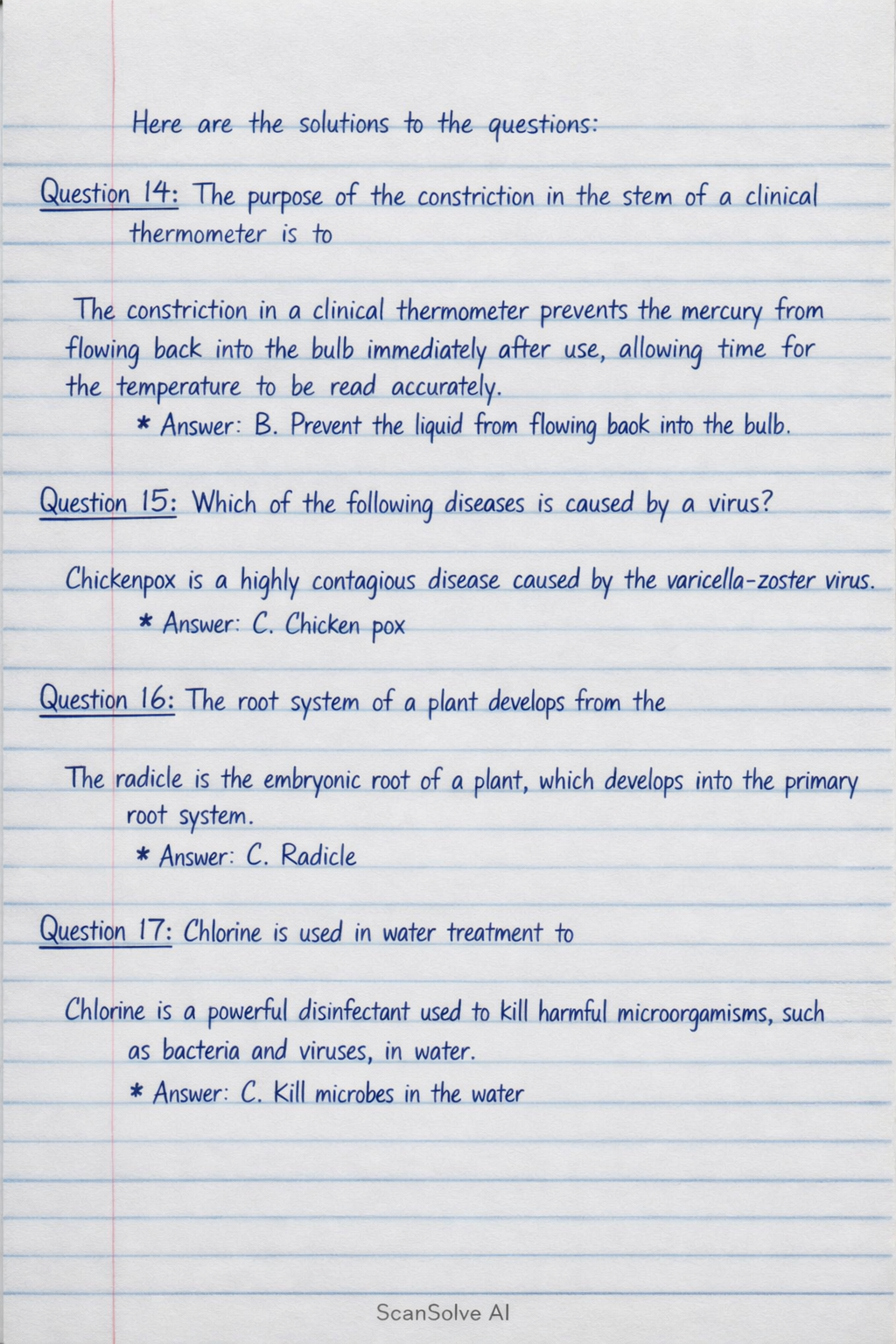
Question 14: The purpose of the constriction in the stem of a clinical thermometer is to
ScanSolve AI Answer
Answers
3 partsStep-by-step solution
9 stepsHere are the solutions to the questions:
Part 14
The purpose of the constriction in the stem of a clinical thermometer is to
The constriction in a clinical thermometer prevents the mercury from flowing back into the bulb immediately after use, allowing time for the temperature to be read accurately.
- Answer: B. Prevent the liquid from flowing back into the bulb
Part 15
Which of the following diseases is caused by a virus?
Chickenpox is a highly contagious disease caused by the varicella-zoster virus.
- Answer: C. Chicken pox
Part 16
The root system of a plant develops from the
The radicle is the embryonic root of a plant, which develops into the primary root system.
- Answer: C. Radicle
Part 17
Chlorine is used in water treatment to
Chlorine is a powerful disinfectant used to kill harmful microorganisms, such as bacteria and viruses, in water.
- Answer: C. Kill microbes in the water
Part 18
Carbon monoxide is poisonous to humans when inhaled because it
Carbon monoxide binds to hemoglobin in red blood cells much more readily than oxygen, forming carboxyhemoglobin and preventing oxygen transport to the body's tissues.
- Answer: D. Blocks the path of oxygen with the blood
Part 19
A person suffering from constipation should takes in enough
Roughage (dietary fiber) adds bulk to stool and helps it pass through the digestive system, preventing constipation.
- Answer: B. Roughages
Part 20
Calculate the current passing through an electric kettle that operates at and has an effective resistance of .
Identify the given values and the formula.
We are given voltage and resistance . We need to find the current .
Ohm's Law states .Rearrange the formula to solve for current.
Substitute the values and calculate the current.
- Answer: A.
Part 21
Inorganic components of soil includes the following except
Humus is decomposed organic matter, making it an organic component of soil, unlike mineral ions, soil water, and soil air which are inorganic.
- Answer: C. Humus
Part 22
A chemical test for water in the laboratory is its ability to
Anhydrous copper (II) sulfate is a white solid that turns blue in the presence of water, making it a common chemical test for water.
- Answer: D. Turns white anhydrous copper (II) sulphate blue
Part 23
A fruit with sticky covering is likely to be dispersed by
Fruits with sticky coverings are adapted to attach to the fur or feathers of animals, which then carry them to new locations for dispersal.
- Answer: B. Mammals
Part 24
How many moles of HCl are there in of HCl?
Determine the molar mass of HCl.
Molar mass of H
Molar mass of Cl
Molar mass of HClUse the formula for moles.
Substitute the given mass and molar mass to calculate the moles.
- Answer: C.
Part 25
The density of a substance is . Calculate its volume, if it has a mass of .
Identify the given values and the formula.
We are given density and mass . We need to find the volume .
The formula for density is .Rearrange the formula to solve for volume.
Substitute the values and calculate the volume.
- Answer: A.
Part 26
Exhaled air may readily put off a burning candle because it contains a high level of
Exhaled air has a significantly higher concentration of carbon dioxide and water vapor compared to inhaled air. Carbon dioxide is a non-combustible gas that smothers the flame, and water vapor helps to cool it, both contributing to extinguishing the candle.
- Answer: C. Carbon dioxide and Water vapour
Try one yourself
A new problem that tests the same skill.
Still stuck on this one?
Ask a follow-up, and the answer starts from this question.
More Biology Questions
Handwritten Step-by-Step Solution
Get this as a handwritten image on WhatsApp — like a tutor wrote it for you.
Try on WhatsApp