
We read your photo as:
Explain reflex action and its mechanism using the example of touching a hot object.
ScanSolve AI Answer
Step-by-step solution
6 stepsHere's an explanation of Reflex Action based on your notes:
Reflex Action
A reflex action is a quick, automatic response to an external stimulus. This response occurs without conscious thought or planning.
Examples of Reflex Action:
- Knee jerk when the knee cap of a crossed leg is tapped.
- Blinking of eyes when foreign bodies appear in front of them.
- Salivating at the smell of food.
- Sneezing, coughing, swallowing.
- Quick withdrawal of a hand from a hot object.
Reflex Arc
A reflex arc is the pathway followed by impulses from the sense organ to the effector during a reflex action. It involves neurons and the spinal cord.
Mechanism (e.g., touching a hot object):
When a hand touches a hot object (e.g., a saucepan), pain receptors in the skin are stimulated.
These receptors generate nerve impulses which are transmitted by a sensory neuron to the spinal cord.
In the spinal cord, these impulses are transmitted to a relay neuron (interneuron).
The relay neuron then transmits the impulses to a motor neuron across another synapse.
The motor neuron transmits the impulses from the spinal cord to the biceps muscle of the arm.
The biceps muscles are stimulated to contract, while the triceps relax.
This causes the arm to bend at the elbow, and the hand is withdrawn from the hot object.
Still stuck on this one?
Ask a follow-up, and the answer starts from this question.
More Biology Questions
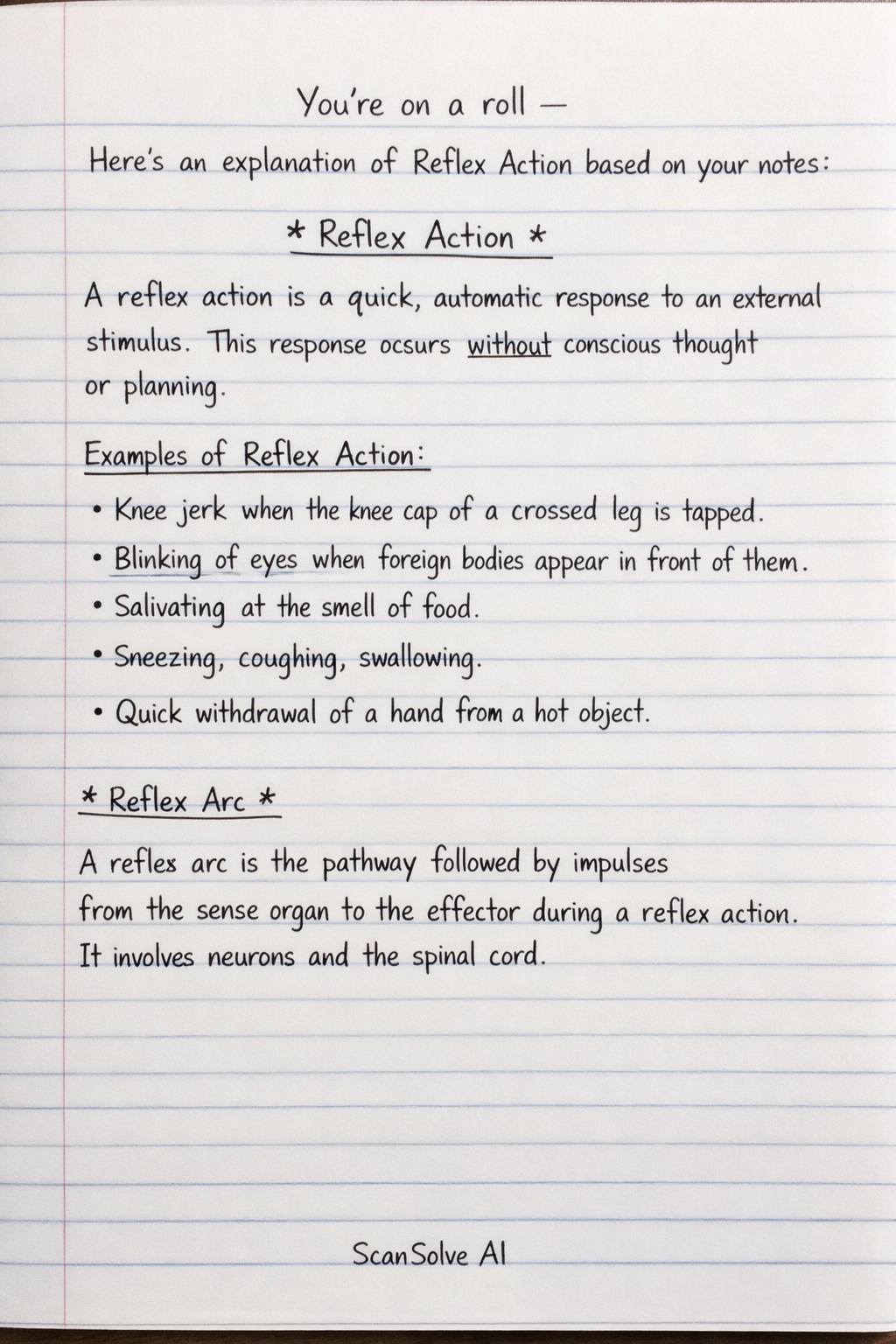
Handwritten Step-by-Step Solution
Get this as a handwritten image on WhatsApp — like a tutor wrote it for you.
Try on WhatsApp