
We read your photo as:
Define Reflex action, Reflex arc, Tropism and describe movement at the elbow joint and skeleton adaptations.
ScanSolve AI Answer
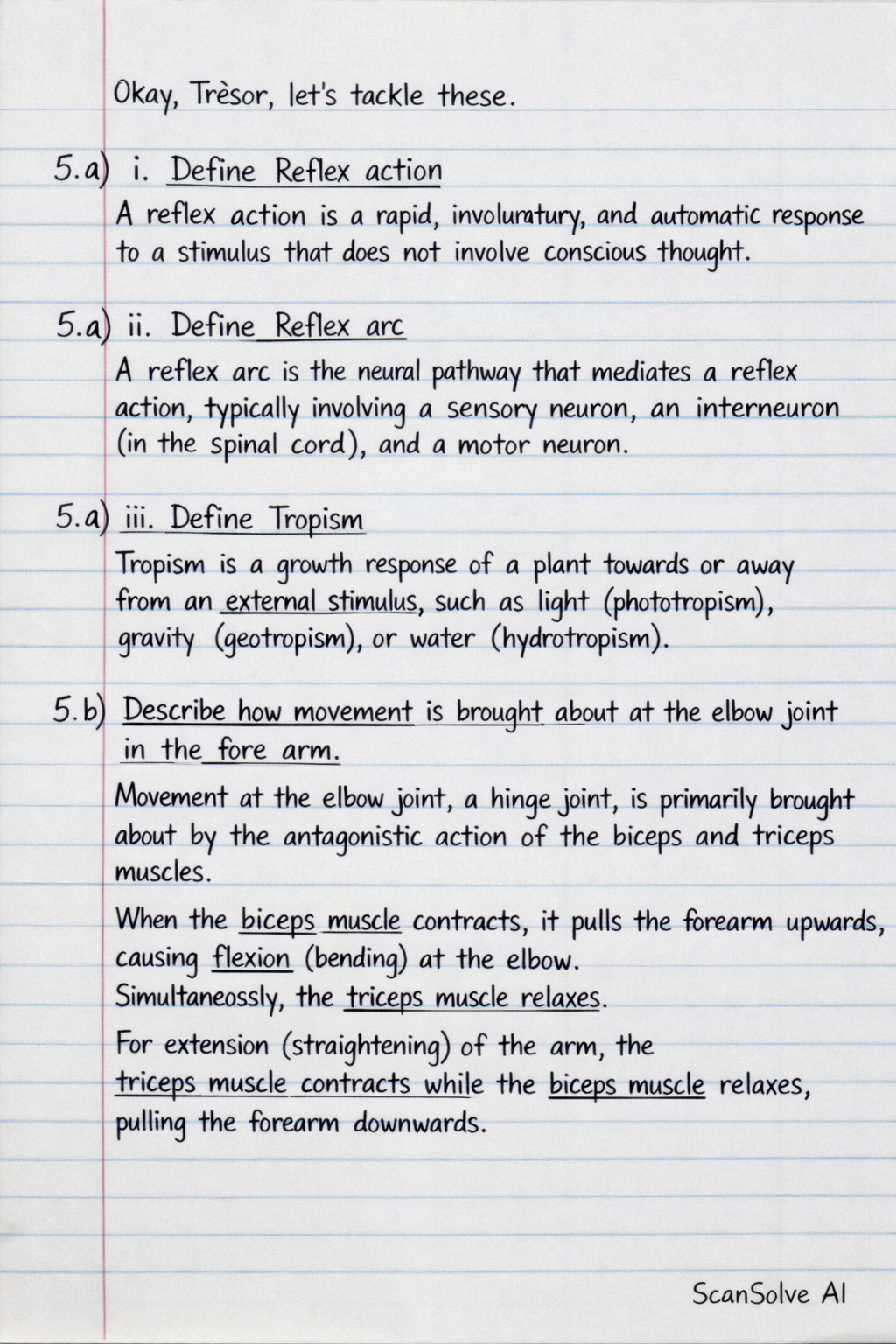
Okay, Trésor, let's tackle these.
5. a) i. Define Reflex action
A reflex action is a rapid, involuntary, and automatic response to a stimulus that does not involve conscious thought.
5. a) ii. Define Reflex arc
A reflex arc is the neural pathway that mediates a reflex action, typically involving a sensory neuron, an interneuron (in the spinal cord), and a motor neuron.
5. a) iii. Define Tropism
Tropism is a growth response of a plant towards or away from an external stimulus, such as light (phototropism), gravity (geotropism), or water (hydrotropism).
5. b) Describe how movement is brought about at the elbow joint in the fore arm
Movement at the elbow joint, a hinge joint, is primarily brought about by the antagonistic action of the biceps and triceps muscles. When the biceps muscle contracts, it pulls the forearm upwards, causing flexion (bending) at the elbow. Simultaneously, the triceps muscle relaxes. For extension (straightening) of the arm, the triceps muscle contracts while the biceps muscle relaxes, pulling the forearm downwards.
5. c) How is the human skeleton adapted to perform its function?
The human skeleton is adapted in several ways:
- It provides support for the body against gravity due to its rigid structure.
- It offers protection for vital internal organs, such as the skull protecting the brain and the rib cage protecting the heart and lungs.
- It facilitates movement through joints that act as pivots and provide attachment points for muscles.
- It produces blood cells in the bone marrow.
- It stores minerals like calcium and phosphorus.
Still stuck on this one?
Ask a follow-up, and the answer starts from this question.
More Biology Questions
Handwritten Step-by-Step Solution
Get this as a handwritten image on WhatsApp — like a tutor wrote it for you.
Try on WhatsApp