
We read your photo as:
Describe the relationship between photosynthesis and respiration, and the factors affecting their rates.
ScanSolve AI Answer
Step-by-step solution
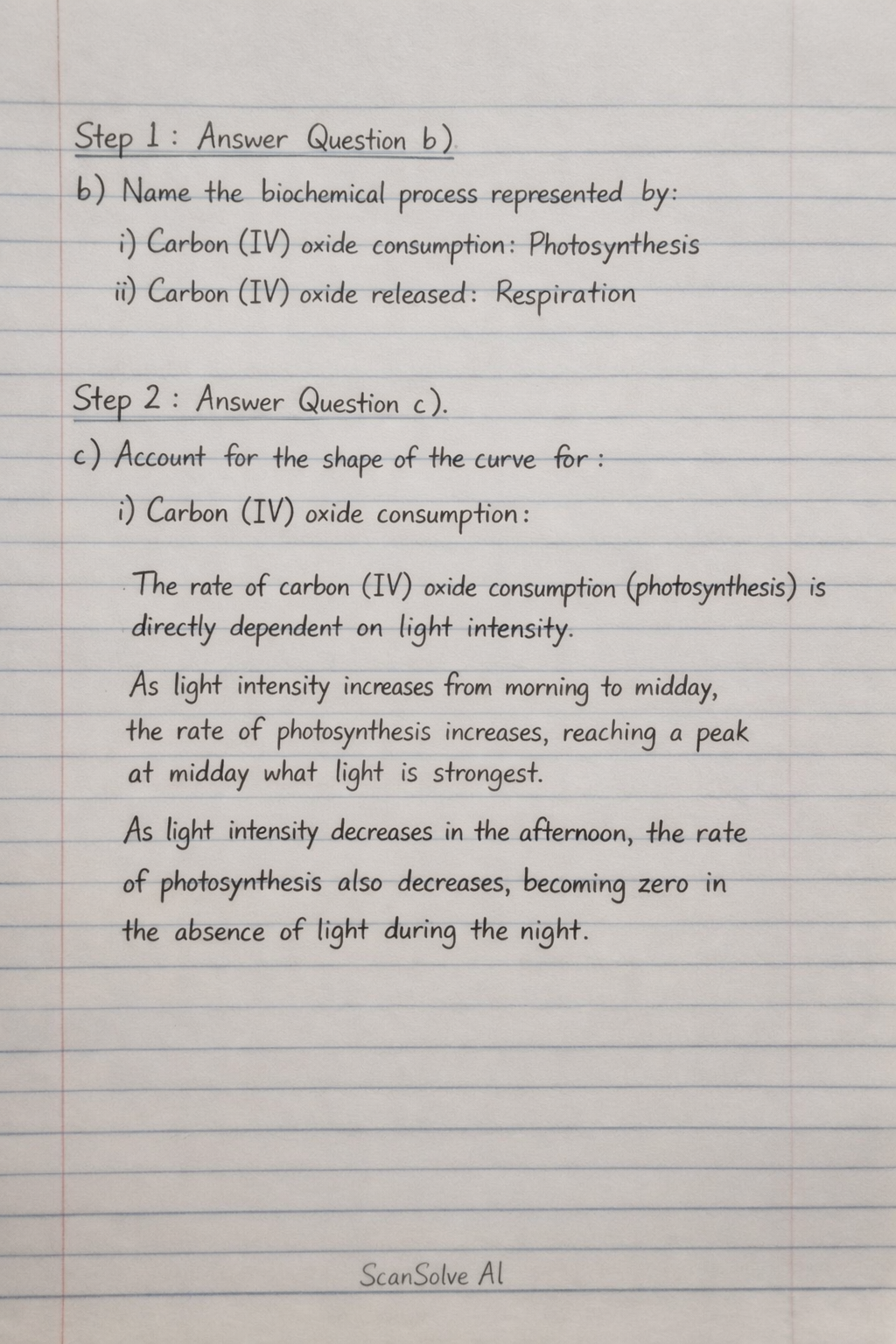
3 stepsStep 1: Answer Question b).
Part b(i)
Carbon (IV) oxide consumption: *Photosynthesis
Name the biochemical process represented by
Part b(ii)· 1 step
Carbon (IV) oxide released: *Respiration
Answer Question c).
Part c· 1 step
Account for the shape of the curve for
*i) Carbon (IV) oxide consumption: The rate of carbon (IV) oxide consumption (photosynthesis) is directly dependent on **light intensity**. As light intensity increases from morning to midday, the rate of photosynthesis increases, reaching a peak at midday when light is strongest. As light intensity decreases in the afternoon, the rate of photosynthesis also decreases, becoming zero in the absence of light during the night.
*ii) Carbon (IV) oxide released: The release of carbon (IV) oxide is due to **respiration**, which occurs continuously throughout the day and night. During the night, with no photosynthesis, all CO2 produced by respiration is released. During the day, the CO2 produced by respiration is **reused** by photosynthesis, so the net release of CO2 decreases, and at high light intensities, there is a net consumption of CO2. The curve shows a higher net release at night and lower net release (or even net consumption) during the day.
Answer Question d).
Part d· 1 step
*i) What is meant by the term compensation point? The **compensation point** is the light intensity (or time of day) at which the rate of photosynthesis exactly equals the rate of respiration. At this point, there is no net exchange of carbon (IV) oxide between the plant and its environment.
*ii) From the graph state the time of the day when the plant attains compensation point: The compensation points occur when the rate of CO2 consumption equals the rate of CO2 release. Based on the data from the previous graph, this occurs approximately at **9:00 am** and **5:00 pm**.
Answer Question e).
*e) Explain how temperature affects the rate of CO2 consumption in a plant: Carbon (IV) oxide consumption in a plant is primarily due to photosynthesis, which is an enzyme-catalyzed process. At low temperatures, enzyme activity is low, so the rate of CO2 consumption is low. As temperature increases, enzyme activity generally increases, leading to a higher rate of CO2 consumption up to an optimal temperature. Beyond this optimal temperature, the enzymes involved in photosynthesis begin to denature, causing a rapid decrease in the rate of CO2 consumption.
Still stuck on this one?
Ask a follow-up, and the answer starts from this question.
More Biology Questions
Handwritten Step-by-Step Solution
Get this as a handwritten image on WhatsApp — like a tutor wrote it for you.
Try on WhatsApp