
We read your photo as:
Renal threshold for glucose is decreased in A. Diabetes mellitus B. Insulinoma C. Renal glycosuria D. Alimentary glycosuria
ScanSolve AI Answer
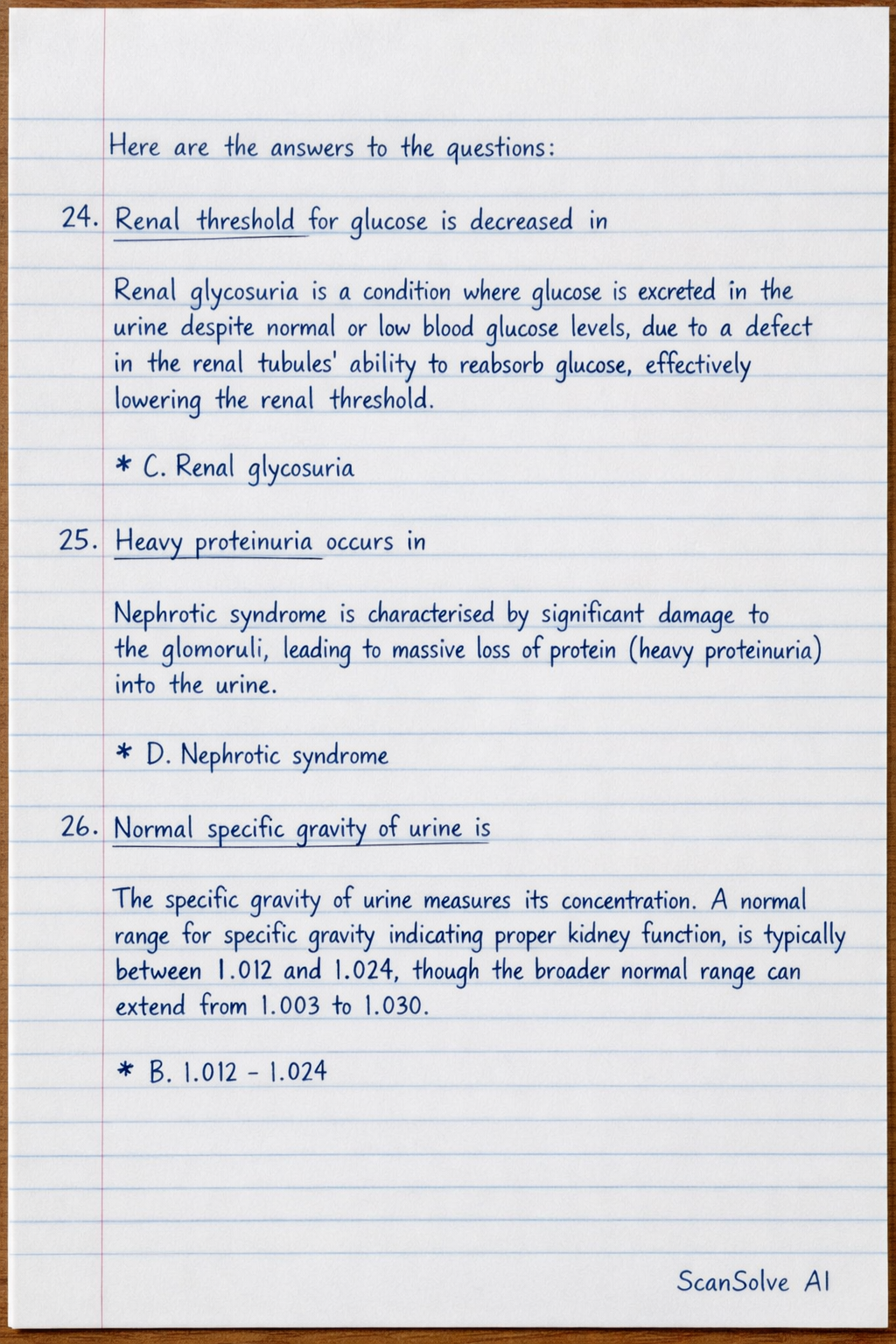
Here are the answers to the questions:
24. Renal threshold for glucose is decreased in
Renal glycosuria is a condition where glucose is excreted in the urine despite normal or low blood glucose levels, due to a defect in the renal tubules' ability to reabsorb glucose, effectively lowering the renal threshold.
- C. Renal glycosuria
25. Heavy proteinuria occurs in
Nephrotic syndrome is characterized by significant damage to the glomeruli, leading to massive loss of protein (heavy proteinuria) into the urine.
- D. Nephrotic syndrome
26. Normal specific gravity of urine is
The specific gravity of urine measures its concentration. A normal range for specific gravity, indicating proper kidney function, is typically between 1.012 and 1.024, though the broader normal range can extend from 1.003 to 1.030.
- B. 1.012-1.024
27. Polyuria can occur in
In diabetes mellitus, high blood glucose levels exceed the renal threshold, leading to glucose in the urine. This glucose acts as an osmotic diuretic, drawing water into the urine and causing excessive urination (polyuria).
- A. Diabetes mellitus
28. The general formula for polysaccharide is
Polysaccharides are formed by linking many monosaccharide units, typically hexoses like glucose. During this process, a molecule of water () is removed for each glycosidic bond formed. Starting with a hexose unit (), the removal of results in a repeating unit of .
- B.
29. The number of isomers of glucose is
Glucose has 4 chiral carbon atoms. The maximum number of stereoisomers for a molecule with chiral centers is . For glucose, , so the number of isomers is .
- D. 16
30. The tissues with the highest total glycogen content are
The liver and skeletal muscles are the primary sites for glycogen storage in the body. Liver glycogen helps maintain blood glucose homeostasis, while muscle glycogen provides energy for muscle contraction.
- C. Liver and muscle
31. All proteins contain the
Proteins are polymers made up of amino acids. While there are many amino acids in nature, the vast majority of proteins in living organisms are constructed from a standard set of 20 common amino acids.
- A. Same 20 amino acids
Still stuck on this one?
Ask a follow-up, and the answer starts from this question.
More Biology Questions
Handwritten Step-by-Step Solution
Get this as a handwritten image on WhatsApp — like a tutor wrote it for you.
Try on WhatsApp