
We read your photo as:
Describe the role of catalase in breaking down hydrogen peroxide and what happens when it is denatured. Include how to set up a controlled experiment.
ScanSolve AI Answer
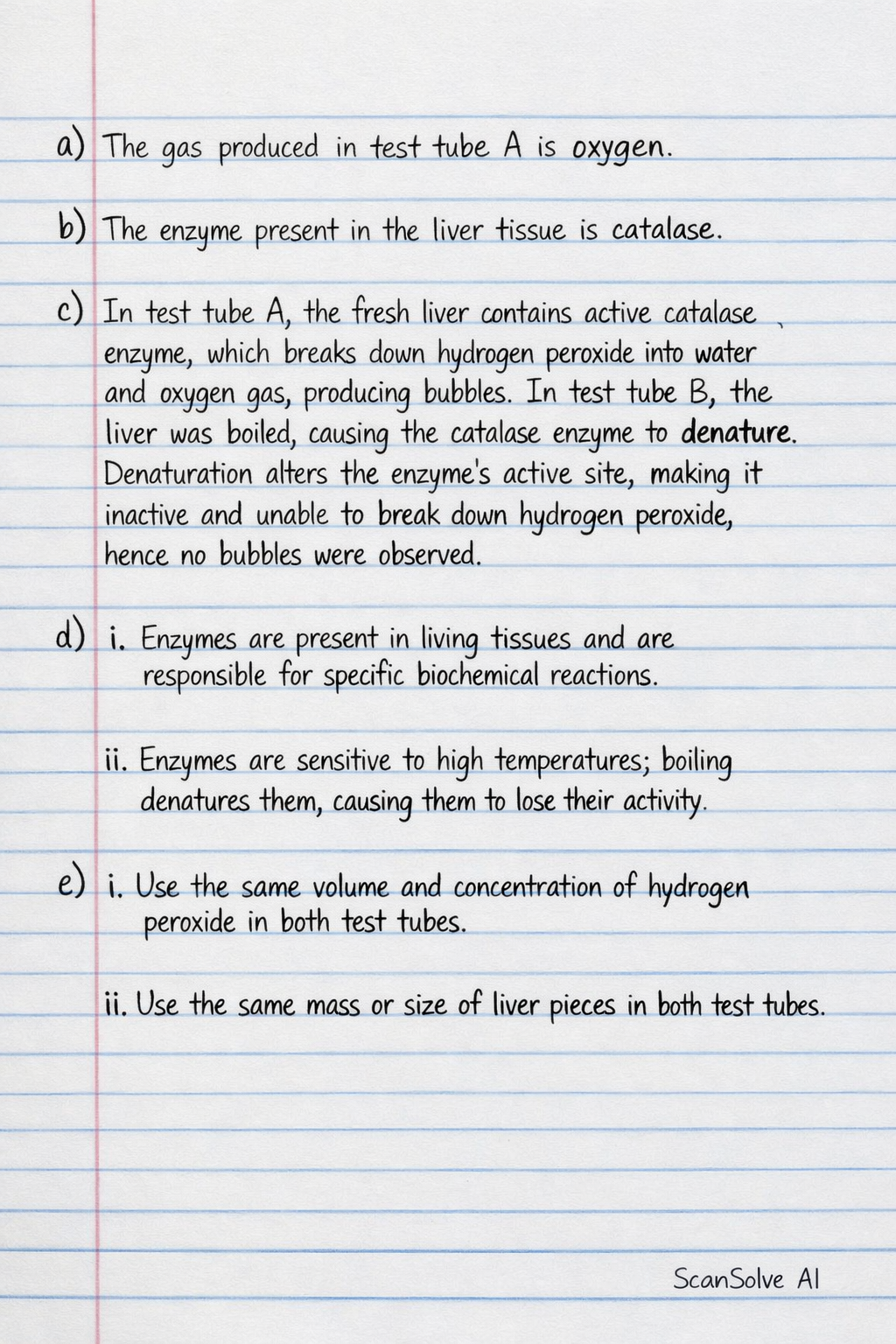
a) The gas produced in test tube A is oxygen.
b) The enzyme present in the liver tissue is catalase.
c) In test tube A, the fresh liver contains active catalase enzyme, which breaks down hydrogen peroxide into water and oxygen gas, producing bubbles. In test tube B, the liver was boiled, causing the catalase enzyme to denature. Denaturation alters the enzyme's active site, making it inactive and unable to break down hydrogen peroxide, hence no bubbles were observed.
d)
i. Enzymes are present in living tissues and are responsible for specific biochemical reactions.
ii. Enzymes are sensitive to high temperatures; boiling denatures them, causing them to lose their activity.
e)
i. Use the same volume and concentration of hydrogen peroxide in both test tubes.
ii. Use the same mass or size of liver pieces in both test tubes.
Still stuck on this one?
Ask a follow-up, and the answer starts from this question.
More Biology Questions
Handwritten Step-by-Step Solution
Get this as a handwritten image on WhatsApp — like a tutor wrote it for you.
Try on WhatsApp