
We read your photo as:
Explain the role of temperature, pH, and trophic levels in ecosystem energy flow, and the role of decomposers.
Biology
ScanSolve AI Answer
Here are the answers to your questions:
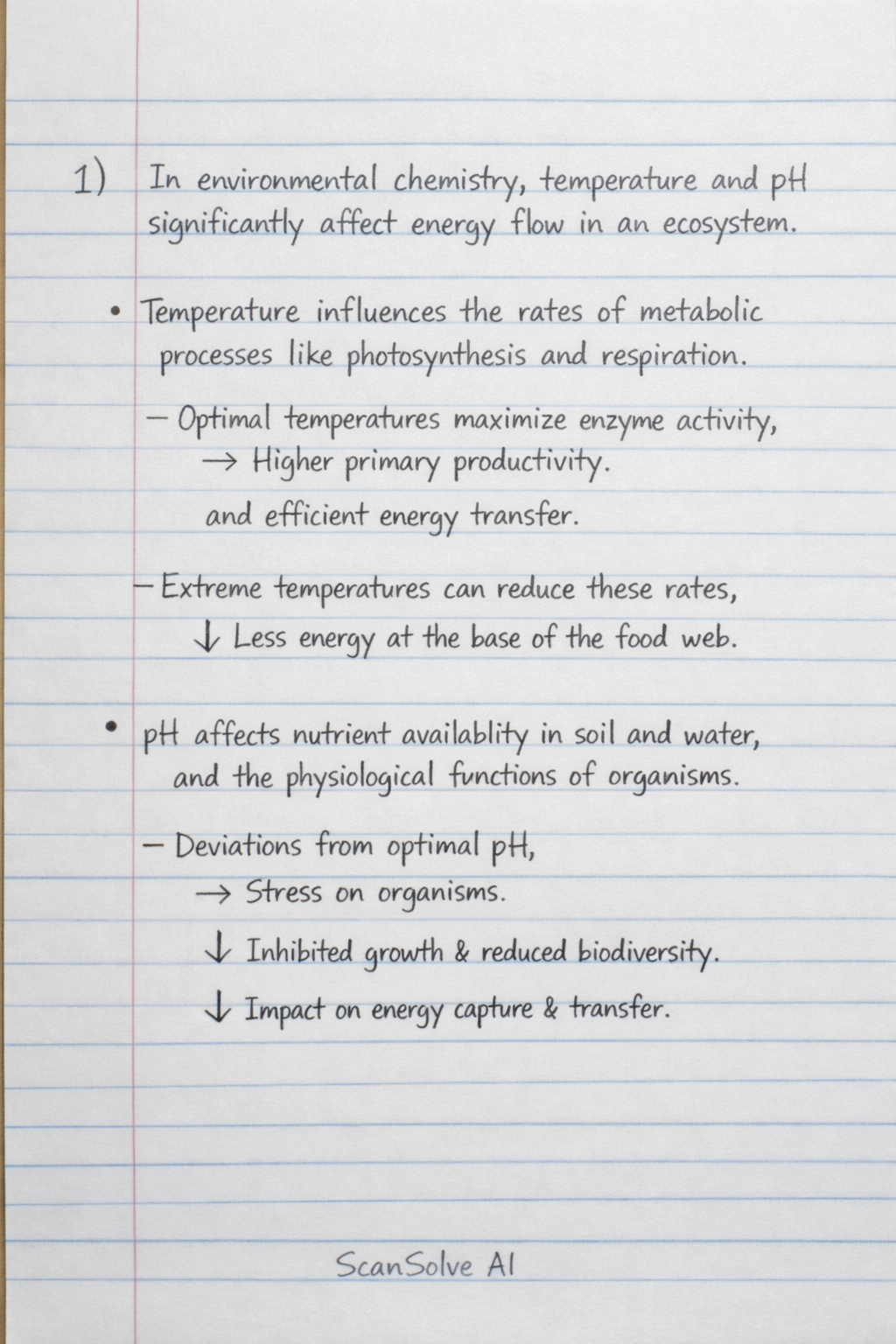
1) In environmental chemistry, temperature and pH significantly affect energy flow in an ecosystem.
- Temperature influences the rates of metabolic processes like photosynthesis and respiration. Optimal temperatures maximize enzyme activity, leading to higher primary productivity and efficient energy transfer. Extreme temperatures can reduce these rates, decreasing the energy available at the base of the food web.
- pH affects nutrient availability in soil and water, and the physiological functions of organisms. Deviations from optimal pH can stress organisms, inhibit growth, and reduce biodiversity, thereby impacting the overall energy capture and transfer within the ecosystem.
2) There are fewer carnivores compared to herbivores in most ecosystems due to the loss of energy at each trophic level transfer.
- According to the 10% rule, only about 10% of the energy from one trophic level is transferred to the next; the rest is lost as heat during metabolic processes or remains unconsumed.
- Since carnivores feed on herbivores (or other carnivores), they are at higher trophic levels, meaning less energy is available to support their populations. This energy limitation results in fewer individuals at higher trophic levels.
3) Decomposers contribute significantly to energy cycling and ecosystem stability.
- In energy cycling, decomposers (like bacteria and fungi) break down dead organic matter, releasing nutrients back into the soil or water. While they release energy as heat during decomposition, their primary role is to make essential nutrients available for primary producers, thus sustaining the base of the food web.
- For ecosystem stability, this nutrient recycling ensures a continuous supply of raw materials for producers, preventing nutrient depletion and the accumulation of dead biomass. This continuous cycle supports the productivity and health of the entire ecosystem.
4) Conserving primary producers is crucial for maintaining ecosystem energy balance.
- Primary producers (e.g., plants, algae) are the foundation of nearly all food webs, converting solar energy into chemical energy through photosynthesis. This energy forms the initial energy source for all other trophic levels.
- Their conservation ensures a stable and sufficient energy supply for herbivores, which in turn support carnivores. A decline in primary producers would lead to a collapse of the food web, disrupting the entire ecosystem's energy flow and balance.
Was this helpful?
Still stuck on this one?
Ask a follow-up, and the answer starts from this question.
Got a different question?Ask your own question
More Biology Questions
QDescribe the roles of producers and consumers in a pond ecosystem, and explain energy transfer…QHow does energy flow in an ecosystemQDescribe the roles of primary producers and consumers in an ecosystem, explaining energy transfer…QDescribe the roles of the biotic components of an ecosystem in maintaining ecological stability…QExplain the role of primary producers and energy transfer in an ecosystem, and discuss unique…
Browse by topic:Ecology
Handwritten Step-by-Step Solution
Get this as a handwritten image on WhatsApp — like a tutor wrote it for you.
Try on WhatsApp