

This biology question covers important biological concepts and processes. The step-by-step explanation below helps you understand the underlying mechanisms and reasoning.
ScanSolve AI Answer
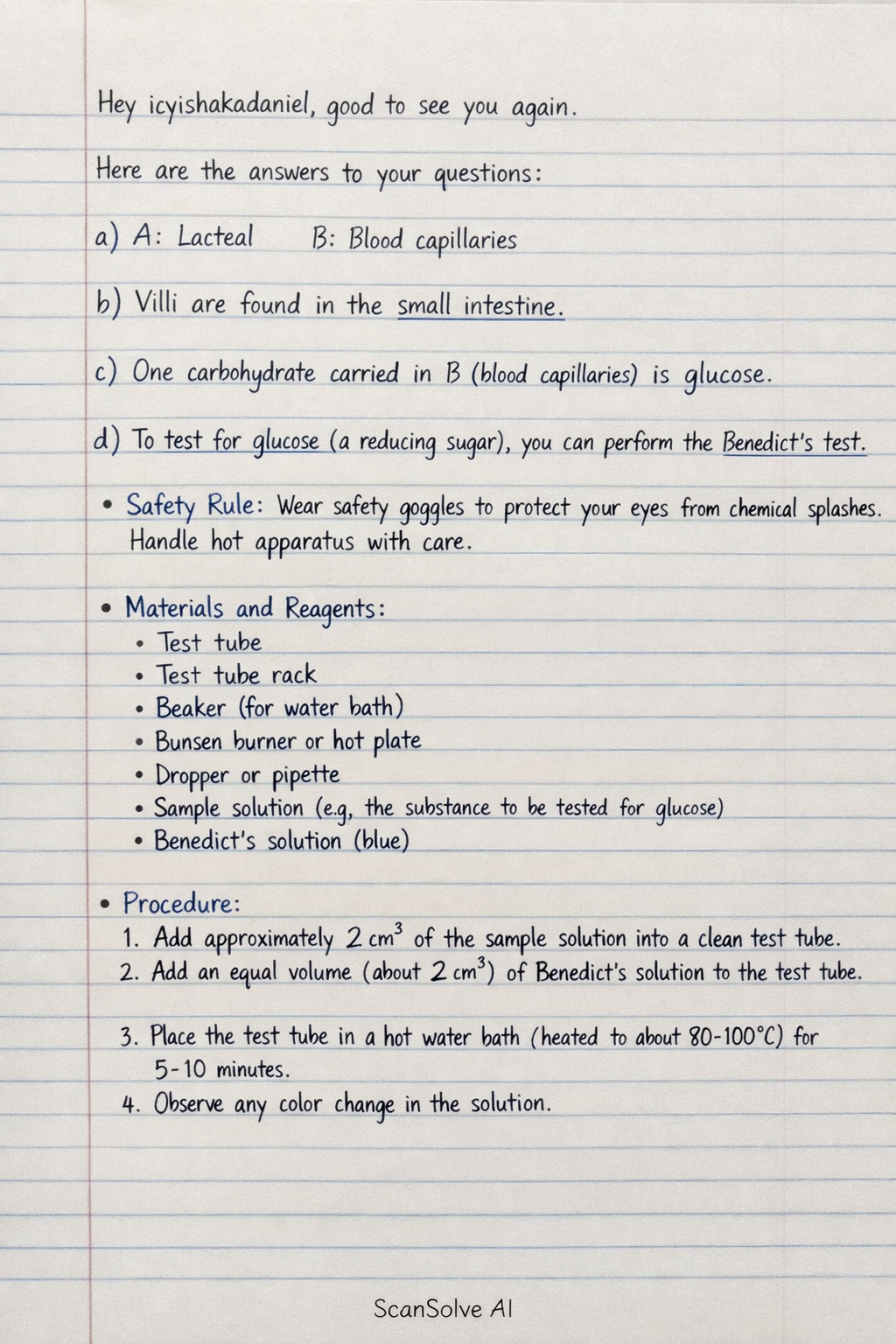
Hey icyishakadaniel, good to see you again. Here are the answers to your questions: a) A: Lacteal B: Blood capillaries b) Villi are found in the small intestine. c) One carbohydrate carried in B (blood capillaries) is glucose. d) To test for glucose (a reducing sugar), you can perform the Benedict's test. • Safety Rule: Wear safety goggles to protect your eyes from chemical splashes. Handle hot apparatus with care. • Materials and Reagents: Test tube Test tube rack Beaker (for water bath) Bunsen burner or hot plate Dropper or pipette Sample solution (e.g., the substance to be tested for glucose) Benedict's solution (blue) • Procedure: 1. Add approximately 2\,cm^3 of the sample solution into a clean test tube. 2. Add an equal volume (about 2\,cm^3) of Benedict's solution to the test tube. 3. Place the test tube in a hot water bath (heated to about 80-100^) for 5-10 minutes. 4. Observe any color change in the solution. • Conclusion: If the solution changes color from blue to green, yellow, orange, or a brick-red precipitate forms, then reducing sugars (like glucose) are present. If the solution remains blue, then no reducing sugars are present. • Deduction: The formation of a brick-red precipitate* indicates a high concentration of reducing sugar. A green or yellow* color indicates a low concentration of reducing sugar. The Benedict's test specifically detects reducing sugars, which include monosaccharides (like glucose) and some disaccharides. What's next? 📸