
We read your photo as:
Select a specific endangered mammal species from Ghana or West Africa. Describe its external morphological features and explain how each is adapted to its natural habitat.
ScanSolve AI Answer
Here are the answers to the remaining parts of your biology questions, focusing on the White-bellied Pangolin:
d)
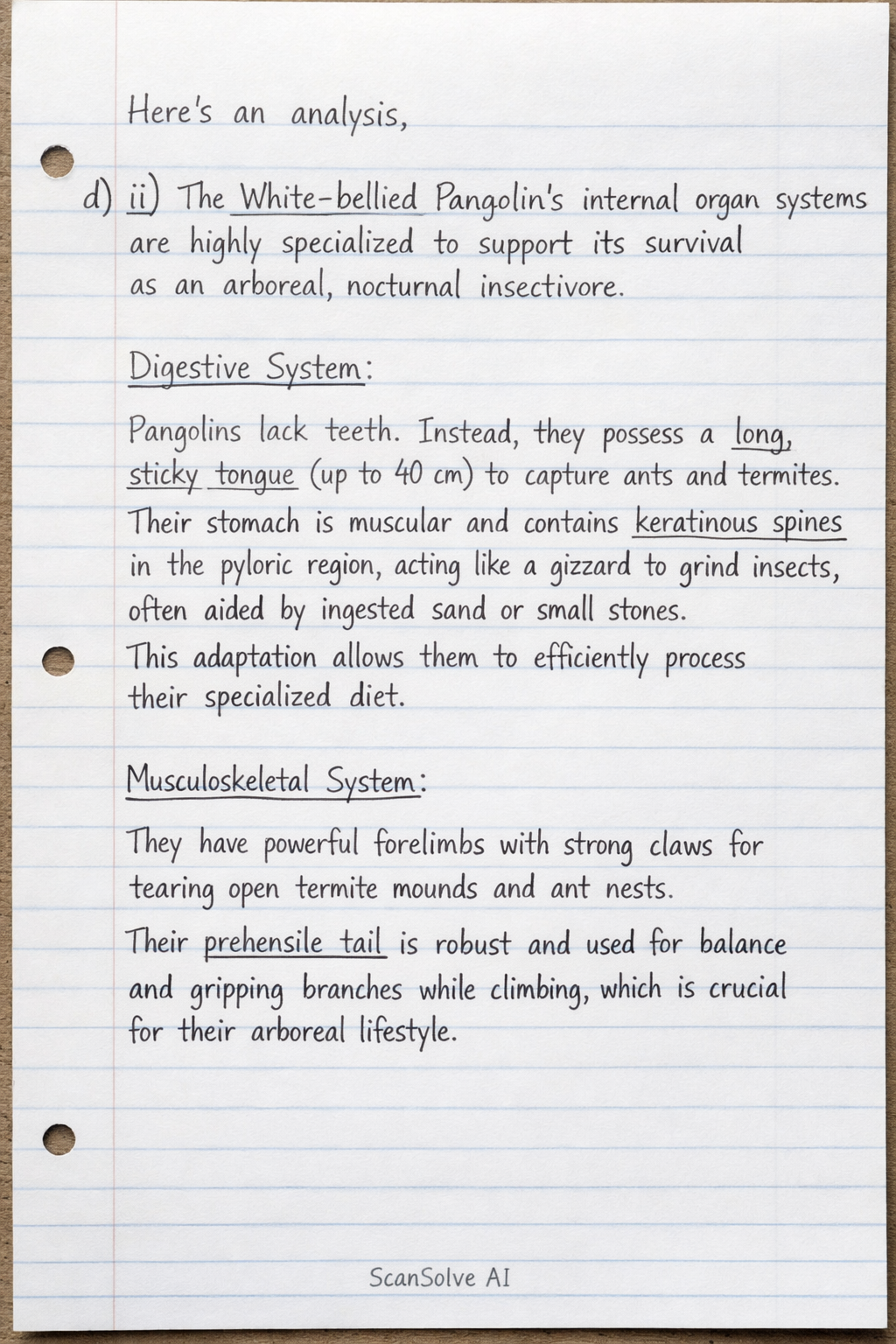
ii) The White-bellied Pangolin's internal organ systems are highly specialized to support its survival as an arboreal, nocturnal insectivore.
- Digestive System: Pangolins lack teeth. Instead, they possess a long, sticky tongue (up to 40 cm) to capture ants and termites. Their stomach is muscular and contains keratinous spines in the pyloric region, acting like a gizzard to grind insects, often aided by ingested sand or small stones. This adaptation allows them to efficiently process their specialized diet.
- Musculoskeletal System: They have powerful forelimbs with strong claws for tearing open termite mounds and ant nests. Their prehensile tail is robust and used for balance and gripping branches while climbing, which is crucial for their arboreal lifestyle.
- Nervous System: While their eyesight is poor, their olfactory system (sense of smell) is highly developed, enabling them to locate hidden insect nests in the dark. This compensates for their nocturnal habits and specialized diet. These systems work together: the keen sense of smell (nervous system) guides them to prey, powerful claws (musculoskeletal) open the nests, the long tongue (musculoskeletal/digestive) collects the insects, and the specialized stomach (digestive) processes them, all supporting their unique ecological niche.
iii) Climate change and habitat loss pose significant threats to the White-bellied Pangolin's morphological and physiological adaptations.
- Impact on Morphological Adaptations: Habitat loss, primarily deforestation, directly removes the trees essential for their arboreal lifestyle and the use of their prehensile tail. This forces them to spend more time on the ground, increasing their vulnerability to predators and poachers. Their scales, while protective, offer no defense against habitat destruction.
- Impact on Physiological Adaptations: Climate change can alter rainfall patterns and temperatures, directly affecting the populations and distribution of their primary food sources (ants and termites). A decline in these insect populations would lead to food scarcity, impacting the pangolin's metabolism and reproductive success. Extreme temperatures could also stress their thermoregulation, as their nocturnal activity is partly an adaptation to avoid daytime heat. Disruption of their specific ecological niche due to these changes can lead to malnutrition, reduced breeding, and increased mortality.
iv) Understanding mammalian morphology and physiology is essential for effective wildlife conservation because it provides the foundational knowledge needed to develop targeted and successful strategies.
- Morphology (study of form and structure) helps conservationists understand a species' specific habitat requirements (e.g., the need for trees for arboreal pangolins), how they interact with their environment (e.g., claws for digging), and their vulnerabilities (e.g., slow movement on the ground). This informs habitat protection, anti-poaching efforts, and rescue protocols.
- Physiology (study of function) reveals how a species survives and reproduces (e.g., specialized digestion for specific diets, thermoregulation, reproductive cycles). This knowledge is crucial for assessing the impact of environmental changes (like climate change or pollution), designing effective captive breeding programs (e.g., appropriate diets, environmental conditions), and managing diseases in wild populations. Together, morphology and physiology allow conservationists to identify critical threats, predict species responses to environmental changes, and implement evidence-based interventions that address the unique biological needs of each endangered mammal, thereby maximizing conservation success.
Still stuck on this one?
Ask a follow-up, and the answer starts from this question.
More Biology Questions
Handwritten Step-by-Step Solution
Get this as a handwritten image on WhatsApp — like a tutor wrote it for you.
Try on WhatsApp