
We read your photo as:
List the numbers which satisfy each of the following conditions. i. x < 8 if x is the first three divisible numbers of 8. ii. 21 <= x <= 28 if x is a whole number
ScanSolve AI Answer
Step-by-step solution
17 steps(continued from previous interaction)
a) Evaluate .
Simplify the expression inside the parentheses.
Substitute the simplified value back into the expression and perform multiplication.
Perform addition/subtraction from left to right for the constant terms.
Perform the division.
Simplify the fraction.
The simplified expression is .
b) Identify irrational numbers from the following list of numbers: .
Analyze each number to determine if it is rational or irrational.
- . This is an integer, so it is a rational number.
- 0.54. This is a terminating decimal, so it is a rational number.
- 1.7264. This is a terminating decimal, so it is a rational number.
- 27.1238.... The ellipsis indicates that the decimal continues indefinitely without a repeating pattern. This is a non-terminating, non-repeating decimal, so it is an irrational number.
- . This is a fraction of two integers, so it is a rational number.
- . The cube root of 5 is not an integer or a simple fraction. Its decimal representation is non-terminating and non-repeating. This is an irrational number.
List the irrational numbers.
The irrational numbers from the list are .
- a) List the numbers which satisfy each of the following conditions: i. if is the first three divisible numbers of 8.
Identify the numbers that 8 is divisible by (factors of 8).
The factors of 8 are $1, 2, 4, 8$.
Identify the first three of these factors.
The first three factors are $1, 2, 4$.
Check if these numbers satisfy the condition .
, , . All satisfy the condition.
The numbers are .ii. if is a whole number.
Identify whole numbers.
Whole numbers are $0, 1, 2, 3, ...$.
List the whole numbers that are greater than or equal to 21 and less than or equal to 28.
The numbers are .
b) If , then . Insert inequality sign ( or ) in the box to make a statement true.
Assumption: There is a typo in the question, and the expression should be to allow for a comparison based on the given information. If the 'b' is intentional, the question cannot be answered without a relationship between 'a' and 'b' or 'd'.Simplify the expressions on both sides of the box.
Left side:
Right side:Compare the two simplified expressions.
We need to compare and .
Subtract from both sides of the comparison.
vs
6 vs 3Determine the inequality sign.
Since 6 is greater than 3, the inequality sign is .
So, .
The inequality sign to insert is .- Careful study the following figure and answer the questions that follows. i. The figure above represents the arrangement of number systems.
ii. Name the category of numbers represented by letter A to F.
A: Natural Numbers (or Counting Numbers)
B: Whole Numbers
C: Integers
D: Rational Numbers
E: Irrational Numbers
F: Real Numbersiii. How can you differentiate the category of numbers labeled by letter D and those labeled by letter E?
Rational numbers (D) can be expressed as a fraction $\frac{p}{
Still stuck on this one?
Ask a follow-up, and the answer starts from this question.
More Mathematics Questions
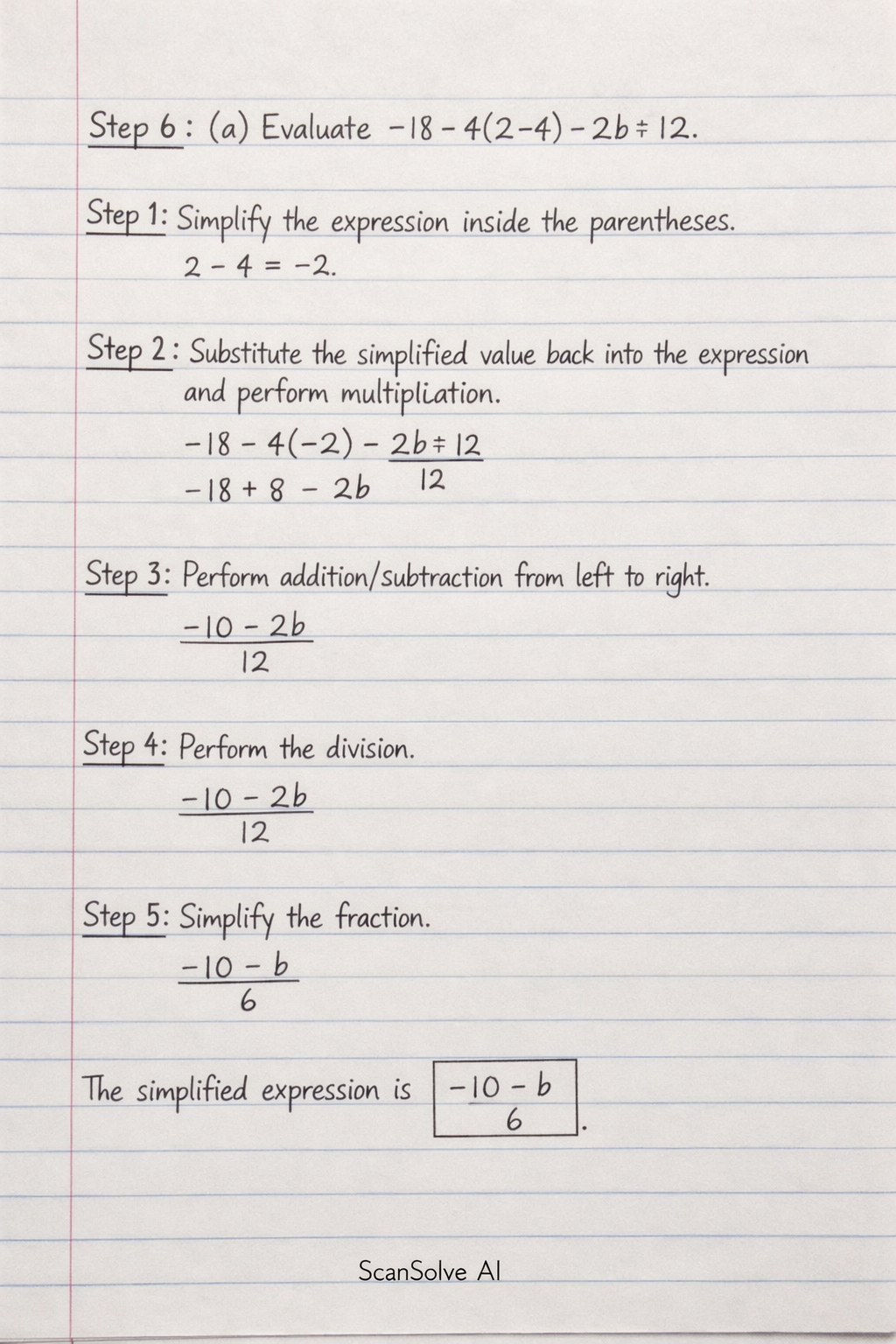
Handwritten Step-by-Step Solution
Get this as a handwritten image on WhatsApp — like a tutor wrote it for you.
Try on WhatsApp