
We read your photo as:
If one angle in a triangle is 80° and another is 60°, what is the measure of the third angle?
ScanSolve AI Answer
Step-by-step solution
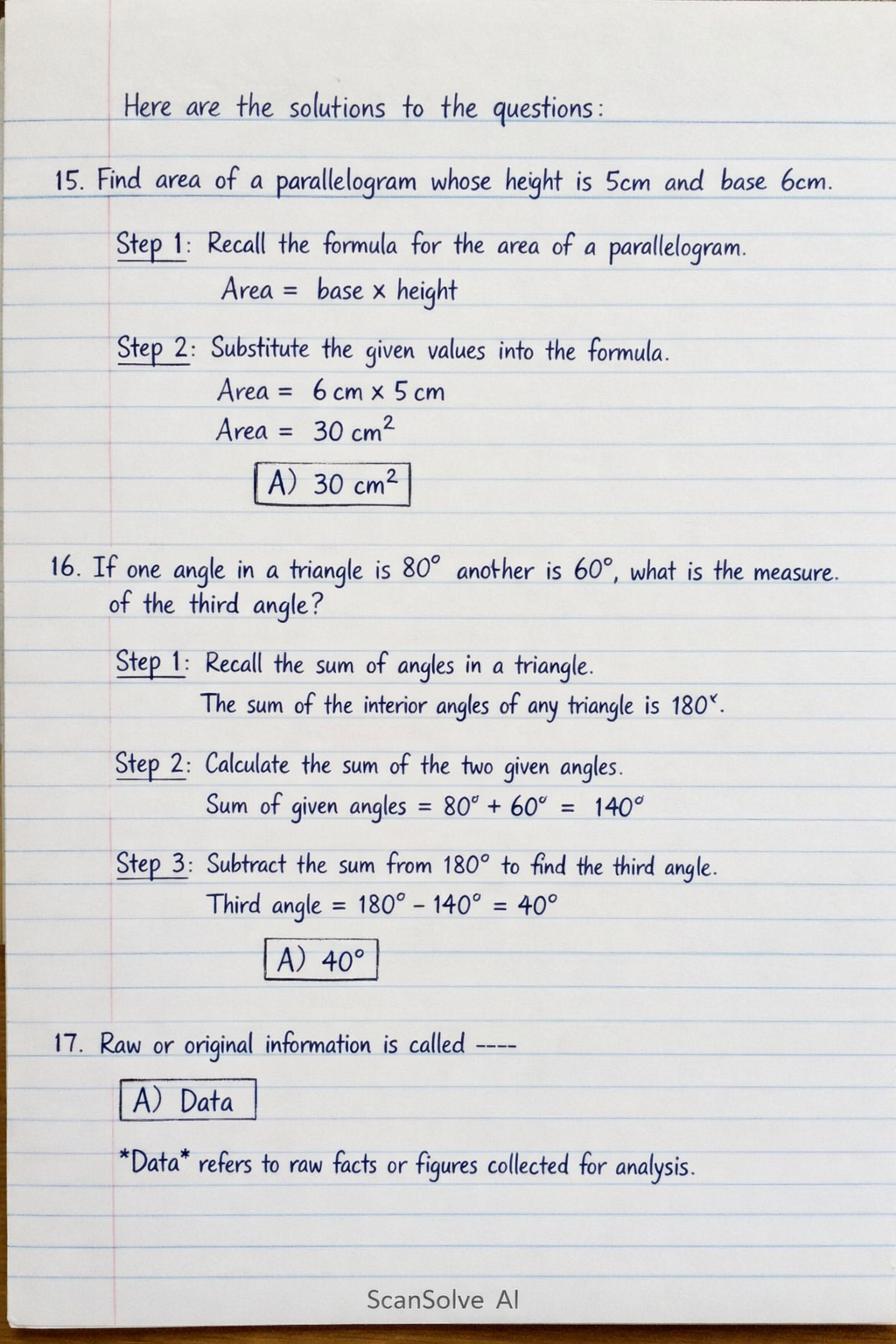
13 stepsHere are the solutions to the questions:
15. Find area of a parallelogram whose height is 5cm and base 6cm.
Recall the formula for the area of a parallelogram.
The area of a parallelogram is given by the formula:
Substitute the given values into the formula.
- (A)
16. If one angle in a triangle is and another is , what is the measure of the third angle?
Recall the sum of angles in a triangle.
The sum of the interior angles of any triangle is .
Calculate the sum of the two given angles.
Subtract the sum from to find the third angle.
- (A)
17. Raw or original information is called-----
- (A) Data Data refers to raw facts or figures collected for analysis.
18. An angle measured in a clockwise direction from north is known as
- (B) Bearing A bearing is an angle measured clockwise from the North direction.
19. Angle that is more than but less than is called what?
- (B) Obtuse angle An obtuse angle is an angle that measures greater than but less than .
20. What is the sum of angles at a point?
- (A) The sum of angles around a central point is always .
21. A triangular base prism has base 3cm and height 4cm. If the total height is 5cm. Calculate the volume.
Calculate the area of the triangular base.
Assuming the base and height of the triangle are perpendicular, the area of the triangle is:
Calculate the volume of the prism.
The volume of a prism is the area of its base multiplied by its total height.
- (A)
22. A trapezium has parallel sides of 8 cm and 12 cm, with a height of 5 cm. What is its area?
Recall the formula for the area of a trapezium.
The area of a trapezium is given by:
where and are the lengths of the parallel sides, and is the height.
Substitute the given values into the formula.
- (A)
23. What is the size of each angle in an equilateral triangle?
Recall the properties of an equilateral triangle.
An equilateral triangle has three equal sides and three equal angles.
Calculate the measure of each angle.
Since the sum of angles in a triangle is , each angle in an equilateral triangle is:
- (C)
24. A triangle with two sides and base angles equal is called...
- (B) Isosceles triangle An isosceles triangle is a triangle that has two sides of equal length, and the angles opposite these sides (base angles) are also equal.
25. The volume of a cube is . What is the length of each edge?
Recall the formula for the volume of a cube.
The volume of a cube is given by:
where is the length of an edge.
Substitute the given volume and solve for .
To find , take the cube root of both sides:
- (A)
26. What is true about alternate angles when two parallel lines are cut by a transversal?
- (A) They are equal When two parallel lines are intersected by a transversal, the alternate interior angles and alternate exterior angles are equal.
27. What does a balanced scale demonstrate in solving equations?
- (B) Subtraction A balanced scale demonstrates the principle of equality in equations. When solving equations, any operation (like addition, subtraction, multiplication, or division) performed on one side must also be performed on the other side to maintain the balance (equality). Subtraction, for example, can be demonstrated by removing equal weights from both sides of the scale.
Still stuck on this one?
Ask a follow-up, and the answer starts from this question.
More Mathematics Questions
Handwritten Step-by-Step Solution
Get this as a handwritten image on WhatsApp — like a tutor wrote it for you.
Try on WhatsApp