

This biology question covers important biological concepts and processes. The step-by-step explanation below helps you understand the underlying mechanisms and reasoning.
ScanSolve AI Answer
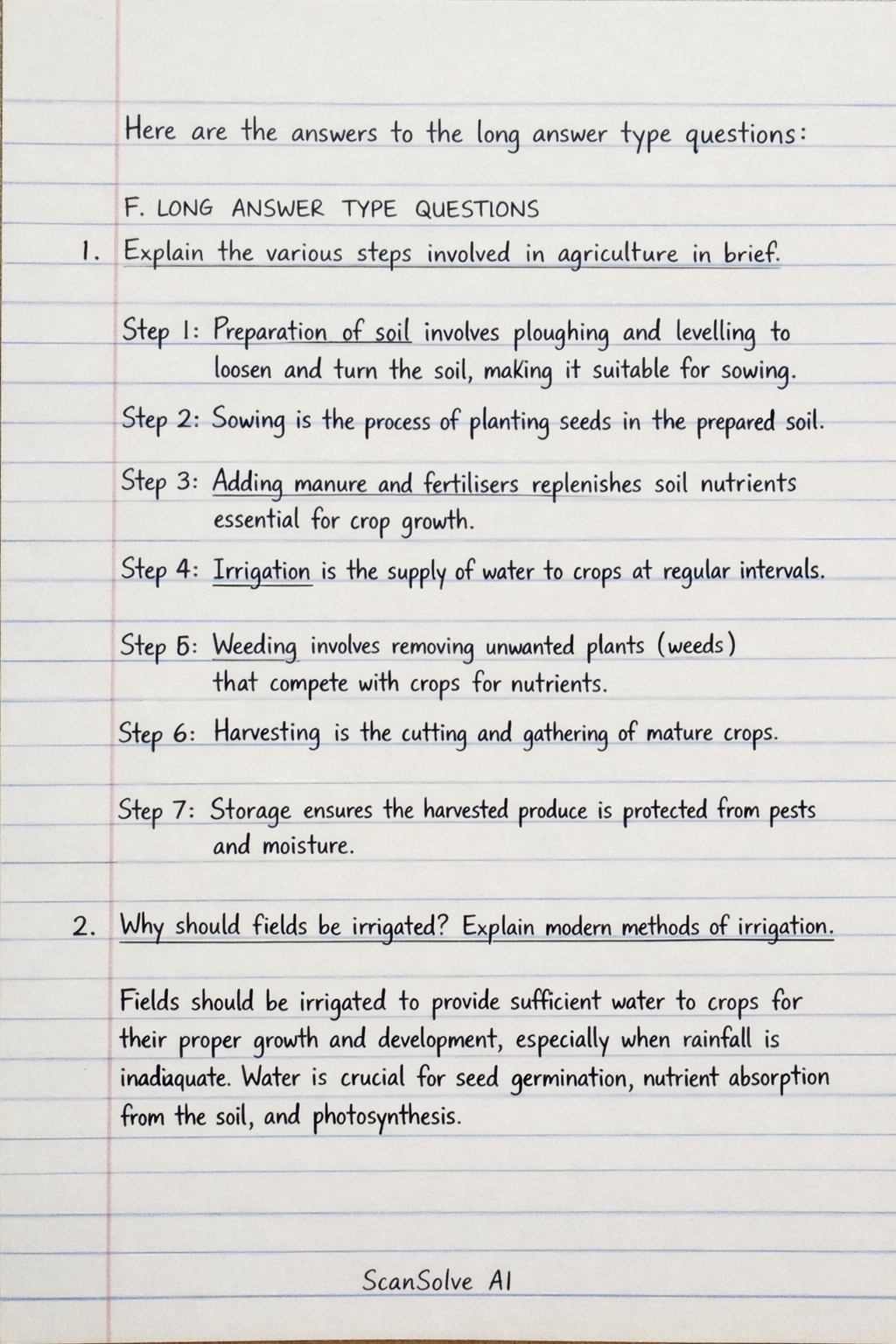
Here are the answers to the long answer type questions: F. LONG ANSWER TYPE QUESTIONS 1. Explain the various steps involved in agriculture in brief. Step 1: Preparation of soil involves ploughing and levelling to loosen and turn the soil, making it suitable for sowing. Step 2: Sowing is the process of planting seeds in the prepared soil. Step 3: Adding manure and fertilisers replenishes soil nutrients essential for crop growth. Step 4: Irrigation is the supply of water to crops at regular intervals. Step 5: Weeding involves removing unwanted plants (weeds) that compete with crops for nutrients. Step 6: Harvesting is the cutting and gathering of mature crops. Step 7: Storage ensures the harvested produce is protected from pests and moisture. 2. Why should fields be irrigated? Explain modern methods of irrigation. Fields should be irrigated to provide sufficient water to crops for their proper growth and development, especially when rainfall is inadequate. Water is crucial for seed germination, nutrient absorption from the soil, and photosynthesis. Modern methods of irrigation include: • Sprinkler system: This method uses perpendicular pipes with rotating nozzles on top, joined to the main pipeline at regular intervals. Water is allowed to flow through the main pipe under pressure, escaping from the rotating nozzles and sprinkling over the crop as if it were raining. It is ideal for uneven land and sandy soil. • Drip system: In this system, water falls drop by drop directly at the position of the roots. This is a very efficient method as water is not wasted at all, making it suitable for areas with water scarcity. 3. Explain the natural methods by which lost nutrients in the soil are put back. Natural methods to replenish lost nutrients in the soil include: • Crop rotation: This involves growing different crops alternately on the same field. For example, leguminous plants (like pulses) can be grown after cereal crops. Leguminous plants have nitrogen-fixing bacteria in their root nodules, which convert atmospheric nitrogen into usable forms, thus enriching the soil with nitrogen. • Fallowing: Leaving the field uncultivated for a season or more allows the soil to naturally regain its fertility and nutrient content. • Adding manure: Manure, which is decomposed organic matter from animal excreta and plant waste, naturally enriches the soil with nutrients and improves its structure and water-holding capacity. 4. What is animal husbandry? Describe food products that we get from animals. Animal husbandry is the scientific management of livestock, which includes feeding, breeding, and disease control, for food and other useful products. Food products obtained from animals include: • Milk: Obtained from animals like cows, buffaloes, and goats. It is used directly or processed into dairy products such as cheese, butter, and yogurt. • Eggs: Primarily from poultry birds like hens and ducks. • Meat: Sourced from various animals such as chicken, goat, sheep, and fish. • Honey: Produced by honeybees. 5. How does a manure differ from a fertiliser? Here's how manure differs from a fertiliser: • Manure is a natural organic substance obtained from the decomposition of animal waste and plant residues. It provides a lot of humus to the soil, improving its texture and water retention capacity. Manure is relatively less rich in specific plant nutrients and does not cause water pollution. • Fertiliser is a man-made inorganic chemical compound. It does not provide humus to the soil but is very rich in specific plant nutrients like nitrogen, phosphorus, and potassium (NPK). Excessive use of fertilisers can lead to water pollution. Send me the next one 📸