

This biology question covers important biological concepts and processes. The step-by-step explanation below helps you understand the underlying mechanisms and reasoning.
ScanSolve AI Answer
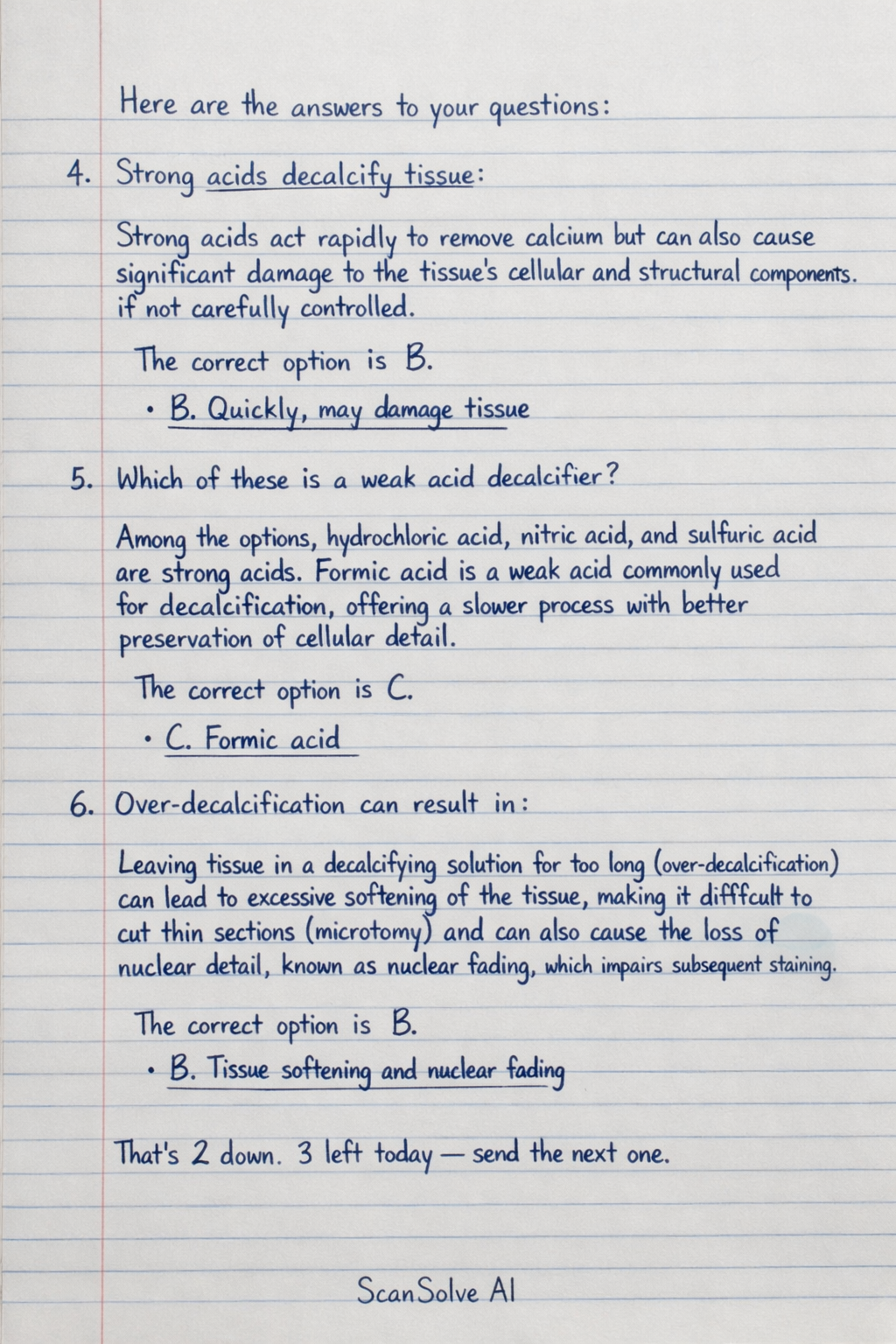
Here are the answers to your questions: 4. Strong acids decalcify tissue: Strong acids act rapidly to remove calcium but can also cause significant damage to the tissue's cellular and structural components if not carefully controlled. The correct option is B. B. Quickly, may damage tissue 5. Which of these is a weak acid decalcifier? Among the options, hydrochloric acid, nitric acid, and sulfuric acid are strong acids. Formic acid is a weak acid commonly used for decalcification, offering a slower process with better preservation of cellular detail. The correct option is C. C. Formic acid 6. Over-decalcification can result in: Leaving tissue in a decalcifying solution for too long (over-decalcification) can lead to excessive softening of the tissue, making it difficult to cut thin sections (microtomy), and can also cause the loss of nuclear detail, known as nuclear fading, which impairs subsequent staining. The correct option is B. B. Tissue softening and nuclear fading That's 2 down. 3 left today — send the next one.