

This biology question covers important biological concepts and processes. The step-by-step explanation below helps you understand the underlying mechanisms and reasoning.
ScanSolve AI Answer
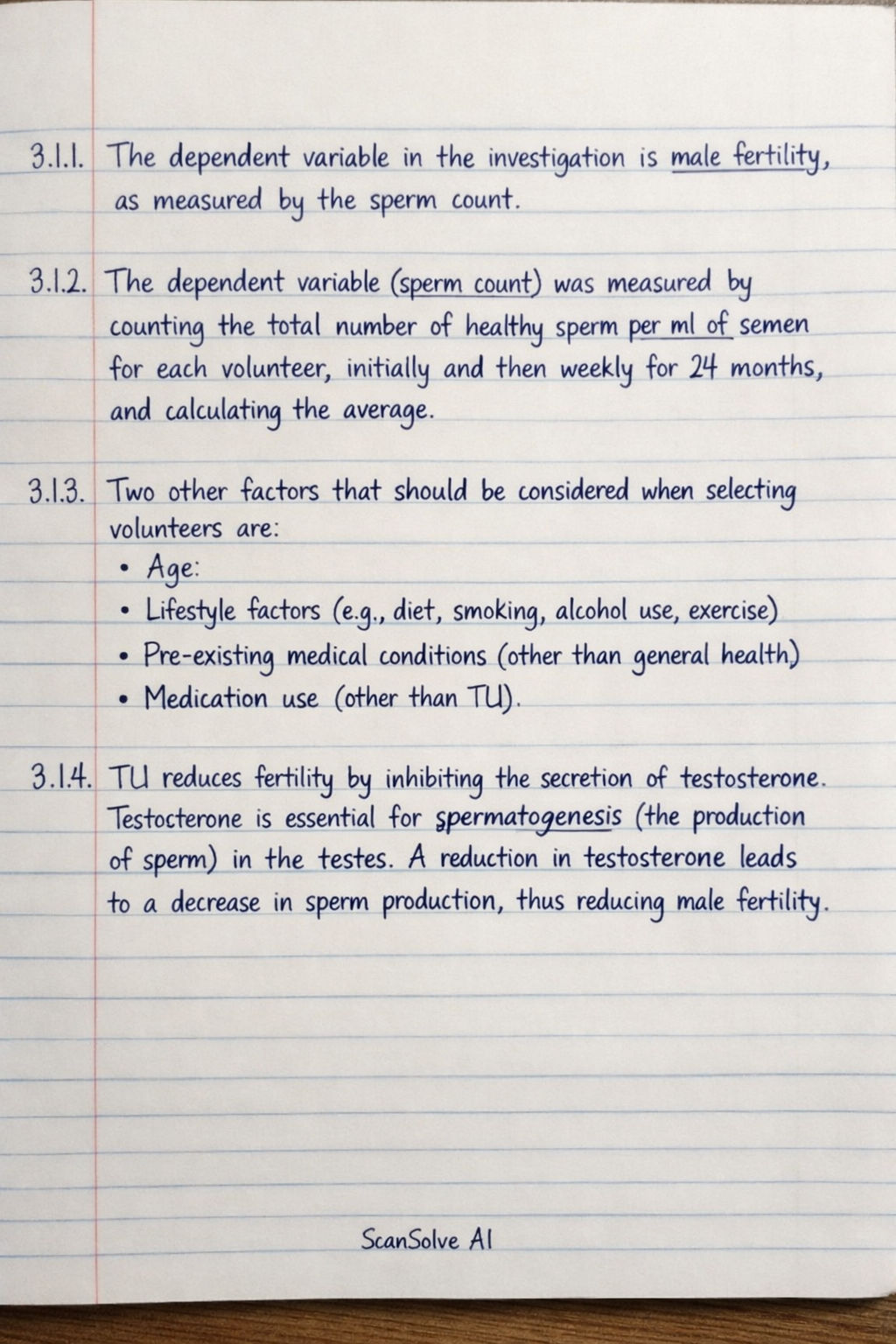
You're on a roll — 3.1.1 The dependent variable in the investigation is male fertility, as indicated by the sperm count*. 3.1.2 The dependent variable (sperm count) was measured by counting the total number of healthy sperm per ml of semen* for each volunteer, initially and then weekly over 24 months, and calculating the average. 3.1.3 Two other factors that should be considered when selecting volunteers are: Age* Lifestyle factors* (e.g., diet, smoking, alcohol consumption, exercise) Pre-existing medical conditions* (other than general health) Medication use* (other than TU) 3.1.4 TU reduces fertility by inhibiting the secretion of testosterone. Testosterone is essential for spermatogenesis* (the production of sperm) in the testes. A reduction in testosterone leads to a decrease in sperm production, thus reducing male fertility. 3.1.5 Wearing tight-fitting trousers will decrease male fertility because they increase the temperature around the testes. The testes are located outside the body in the scrotum to maintain a temperature slightly lower than body temperature, which is optimal for spermatogenesis. Elevated temperatures can damage sperm and reduce sperm production*, leading to decreased fertility. 3.1.6 A vasectomy prevents pregnancy by cutting and tying the vas deferens. The vas deferens are tubes that transport sperm from the epididymis (where sperm mature and are stored) to the urethra. By severing these tubes, sperm are prevented from mixing with seminal fluid during ejaculation. Although semen is still ejaculated, it does not contain sperm*, thus preventing fertilization and pregnancy. Send me the next one 📸