
We read your photo as:
What are the answers to the following Biology questions: 1. a) State any two disorders in a hemophilic person. b) Explain how the gene of hemophilia arise in population. c) Explain how steady flow of
ScanSolve AI Answer
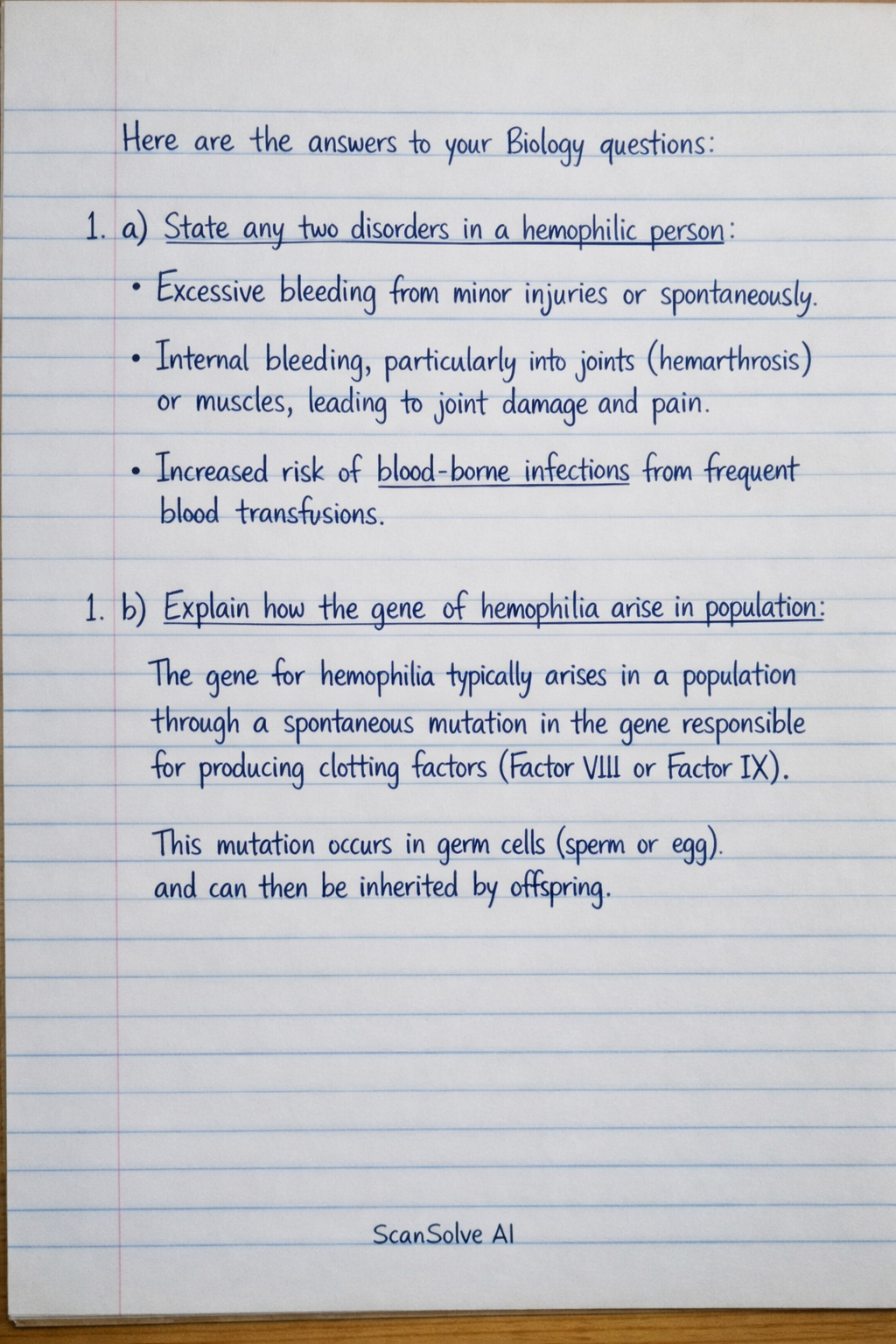
Here are the answers to your Biology questions:
1. a) State any two disorders in a hemophilic person.
- Excessive bleeding from minor injuries or spontaneously.
- Internal bleeding, particularly into joints (hemarthrosis) or muscles, leading to joint damage and pain.
- Increased risk of blood-borne infections from frequent blood transfusions.
1. b) Explain how the gene of hemophilia arise in population.
The gene for hemophilia typically arises in a population through a spontaneous mutation in the gene responsible for producing clotting factors (Factor VIII or Factor IX). This mutation occurs in germ cells (sperm or egg) and can then be inherited by offspring.
1. c) Explain how steady flow of carbon dioxide between air and the mesophyll is maintained in a leaf during the night.
During the night, plants do not photosynthesize but continue to respire. Respiration in the mesophyll cells produces carbon dioxide, increasing its concentration inside the leaf. This creates a concentration gradient between the higher CO concentration in the mesophyll and the lower CO concentration in the surrounding atmosphere. As a result, carbon dioxide continuously diffuses out of the leaf through the stomata, maintaining a steady flow.
2. a) Name any one hormone involved in osmoregulation.
Antidiuretic Hormone (ADH) or Vasopressin.
2. b) Explain why blood of a patient and dialysis fluid move in opposite directions in a dialysis machine.
Blood and dialysis fluid move in opposite directions (counter-current flow) in a dialysis machine to maintain a steep concentration gradient for waste products (like urea and excess salts) throughout the entire length of the exchange surface. This maximizes the efficiency of diffusion, allowing for continuous and effective removal of wastes from the blood into the dialysis fluid.
3. a) State any two functions of large intestines in the alimentary canal.
- Absorption of water and electrolytes.
- Formation and storage of feces.
- Housing beneficial gut bacteria that produce vitamins (e.g., Vitamin K).
3. b) Explain how an injury to the medulla might cause death.
The medulla oblongata controls vital involuntary functions such as breathing (respiratory rate and depth) and heart rate. An injury to the medulla can disrupt these critical functions, leading to the cessation of breathing or cardiac arrest, which results in death.
Still stuck on this one?
Ask a follow-up, and the answer starts from this question.
More Biology Questions
Handwritten Step-by-Step Solution
Get this as a handwritten image on WhatsApp — like a tutor wrote it for you.
Try on WhatsApp