
We read your photo as:
What is the axillary vein and its relation to the subclavian vein during a subclavian vein puncture?
ScanSolve AI Answer
The axillary vein is a large vein that drains blood from the upper limb. It begins at the lower border of the teres major muscle as a continuation of the basilic vein. It then becomes the subclavian vein at the lateral border of the first rib.
During a subclavian vein puncture, a needle is inserted to access the subclavian vein, typically for central venous catheter placement. The axillary vein is relevant because it is a direct anatomical continuation of the subclavian vein. Therefore, when attempting to cannulate the subclavian vein, especially if the needle is advanced too far laterally or if the entry point is more distal, the needle may inadvertently enter the axillary vein. Understanding this anatomical relationship is crucial for successful cannulation and to avoid complications during the procedure.
Still stuck on this one?
Ask a follow-up, and the answer starts from this question.
More Biology Questions
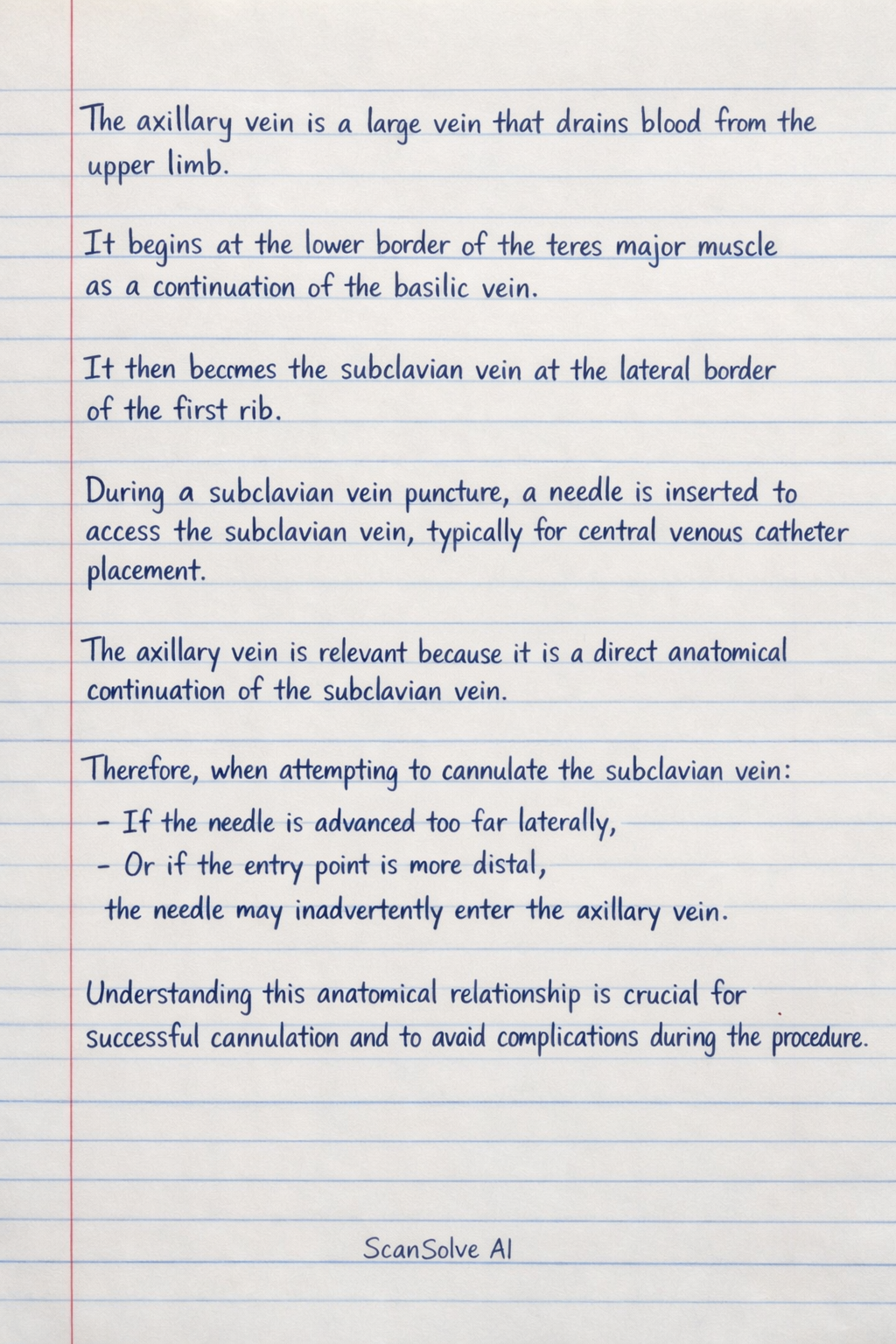
Handwritten Step-by-Step Solution
Get this as a handwritten image on WhatsApp — like a tutor wrote it for you.
Try on WhatsApp