
We read your photo as:
What are the definitions of mass number and atomic number, and why should passengers wear seatbelts?
ScanSolve AI Answer
Answer
Step-by-step solution
6 stepsHere are the solutions to all the questions:
1 (a) (i) Define each of the following terms:
- (α) mass number: The total number of protons and neutrons in the nucleus of an atom.
- (β) atomic number: The number of protons in the nucleus of an atom, which determines its chemical element.
1 (a) (ii) An atom has eleven electrons. Draw an electronic configuration for it.
The electronic configuration for an atom with eleven electrons is:
1 (b) Name four blood vessels associated with the human heart.
- Aorta
- Pulmonary artery
- Vena cava (superior or inferior)
- Pulmonary vein
1 (c) Explain each of the following as applied to animal production.
Part i
Culling: The process of removing undesirable or unproductive animals from a herd or flock to improve the overall quality and efficiency of the remaining stock.
Part ii
Castration: The surgical removal of the testicles of male animals, primarily to prevent breeding, control aggression, or improve meat quality.
Part iii
Debeaking: The partial removal of a bird's beak, typically done to prevent feather pecking, cannibalism, and egg eating in poultry.
1 (d) Explain why it is advisable for passengers on board a moving vehicle to put on their seatbelts throughout the journey.
It is advisable for passengers to wear seatbelts due to inertia. In the event of a sudden stop or collision, the seatbelt restrains the passenger, preventing them from being thrown forward and hitting the dashboard, windshield, or other occupants, thereby reducing the risk of severe injury or death.
2 (a) (i) Distinguish between grafting and budding.
- Grafting is a horticultural technique where two plant parts (a scion and a rootstock) are joined together to grow as a single plant.
- Budding is a specific type of grafting where a single bud, rather than a larger scion, is used as the upper part to be joined to the rootstock.
2 (a) (ii) Give three reasons for grafting and budding.
- To propagate desirable varieties that do not root easily from cuttings.
- To impart disease resistance or pest resistance from the rootstock to the scion.
- To enable faster fruiting or flowering compared to growing from seed.
2 (b) Determine the mass of HCl needed to prepare 500cm of 0.100M HCl solution. [H = 1, Cl = 35.5]
Calculate the molar mass of HCl.
Molar mass of HCl () = Atomic mass of H + Atomic mass of Cl
Convert the volume from cm to dm.
Volume () =
Calculate the number of moles () of HCl needed.
Calculate the mass () of HCl needed.
2 (c) State five characteristics of images formed in a plane mirror.
- Virtual (cannot be projected onto a screen)
- Erect (upright)
- Laterally inverted (left and right are swapped)
- Same size as the object
- Same distance behind the mirror as the object is in front
2 (d) State five benefits a nation derives from agriculture.
- Food security for its population.
- Employment opportunities for a significant portion of the workforce.
- Generation of foreign exchange through export of agricultural products.
- Provision of raw materials for industries (e.g., textiles, food processing).
- Rural development and poverty reduction in agricultural areas.
3 (a) (i) What is relative density?
Relative density (or specific gravity) is the ratio of the density of a substance to the density of a reference substance, usually water at 4°C. It is a dimensionless quantity.3 (a) (ii) Calculate the relative density of brine, if its density is 1.6 g/cm. (Density of water = 1 g/cm)
State the given densities.
Density of brine =
Density of water =Apply the formula for relative density.
3 (b) Describe, briefly, how urine is formed in humans.
Urine formation occurs in the kidneys through three main processes: glomerular filtration, where blood plasma is filtered in the glomerulus to form a filtrate; tubular reabsorption, where essential substances like water, glucose, and salts are reabsorbed from the filtrate back into the blood in the renal tubules; and tubular secretion, where waste products and excess ions are actively secreted from the blood into the filtrate. The remaining fluid, now concentrated with wastes, becomes urine.3 (c) State five ways by which the fertility of soil can be enhanced.
- Adding organic matter (e.g., compost, manure) to improve soil structure and nutrient retention.
- Practicing crop rotation to prevent nutrient depletion and break pest cycles.
- Using cover crops to protect the soil from erosion and add nitrogen.
- Applying appropriate fertilizers (organic or inorganic) to replenish specific nutrients.
- Controlling soil pH through liming or acidification to optimize nutrient availability.
3 (d) (i) What is hard water?
Hard water is water that contains a high concentration of dissolved mineral ions, primarily calcium (Ca) and magnesium (Mg) ions.3 (d) (ii) Give three disadvantages of hard water.
- Forms scum with soap, reducing its lathering ability and effectiveness.
- Causes limescale buildup in pipes, kettles, and water heaters, reducing efficiency and potentially causing damage.
- Can lead to increased consumption of soap and detergents to achieve cleaning.
4 (a) Describe how igneous rocks are formed.
Igneous rocks are formed from the cooling and solidification of molten rock material. This molten rock, called magma when it is beneath the Earth's surface, or lava when it erupts onto the surface, cools and crystallizes. The rate of cooling determines the crystal size: slow cooling underground forms large crystals (intrusive igneous rocks), while rapid cooling on the surface forms small crystals or glassy textures (extrusive igneous rocks).4 (b) (i) What is meant by the term classification as used in science?
Classification in science refers to the systematic arrangement of organisms or objects into groups or categories based on shared characteristics, similarities, and evolutionary relationships. This helps in organizing knowledge, identifying relationships, and making predictions.
Try one yourself
A new problem that tests the same skill.
Still stuck on this one?
Ask a follow-up, and the answer starts from this question.
More Biology Questions
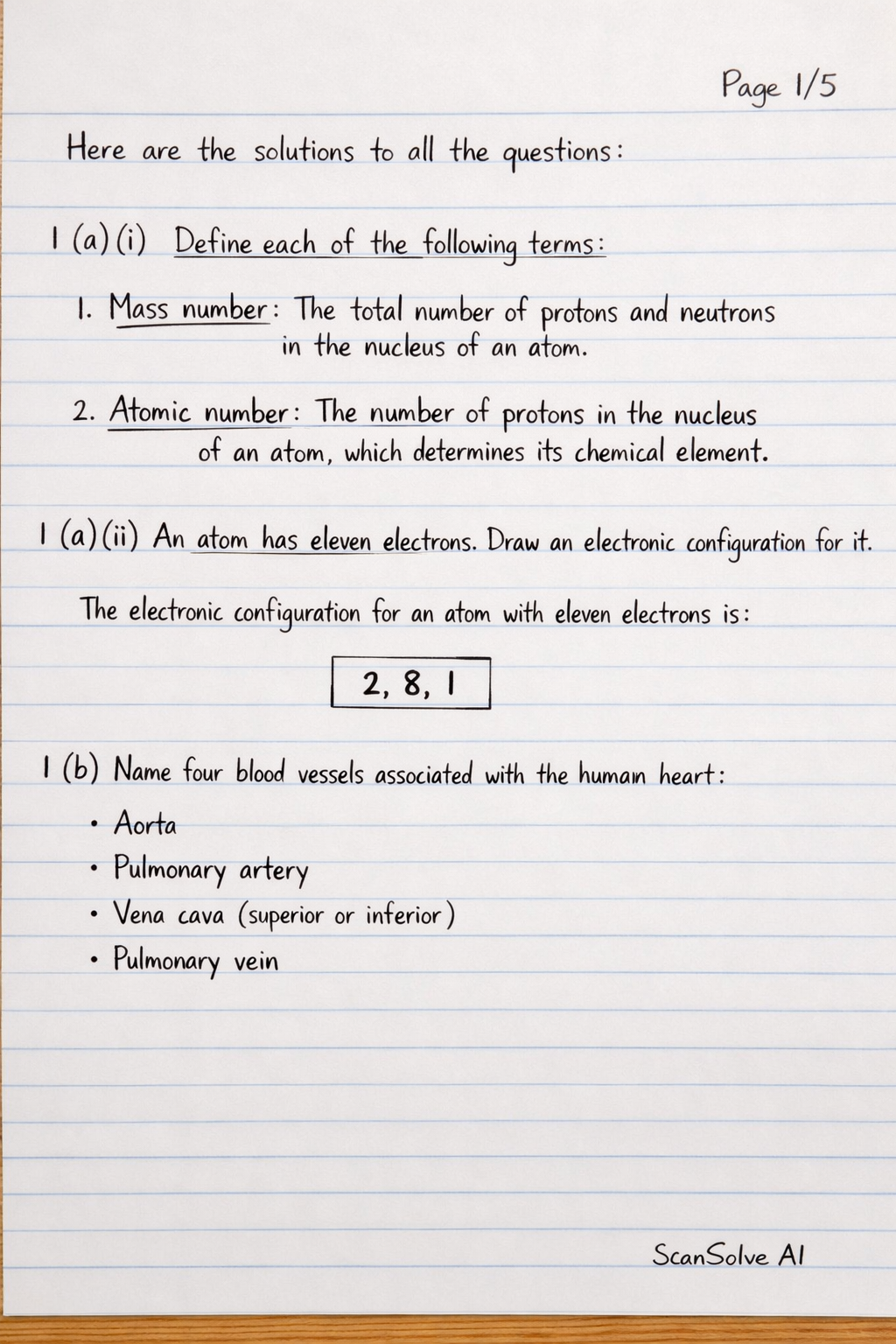
Handwritten Step-by-Step Solution
Get this as a handwritten image on WhatsApp — like a tutor wrote it for you.
Try on WhatsApp