
We read your photo as:
Rutherford's experiment and definitions of atomic number/mass number. Acid/base identification and uses.
ScanSolve AI Answer
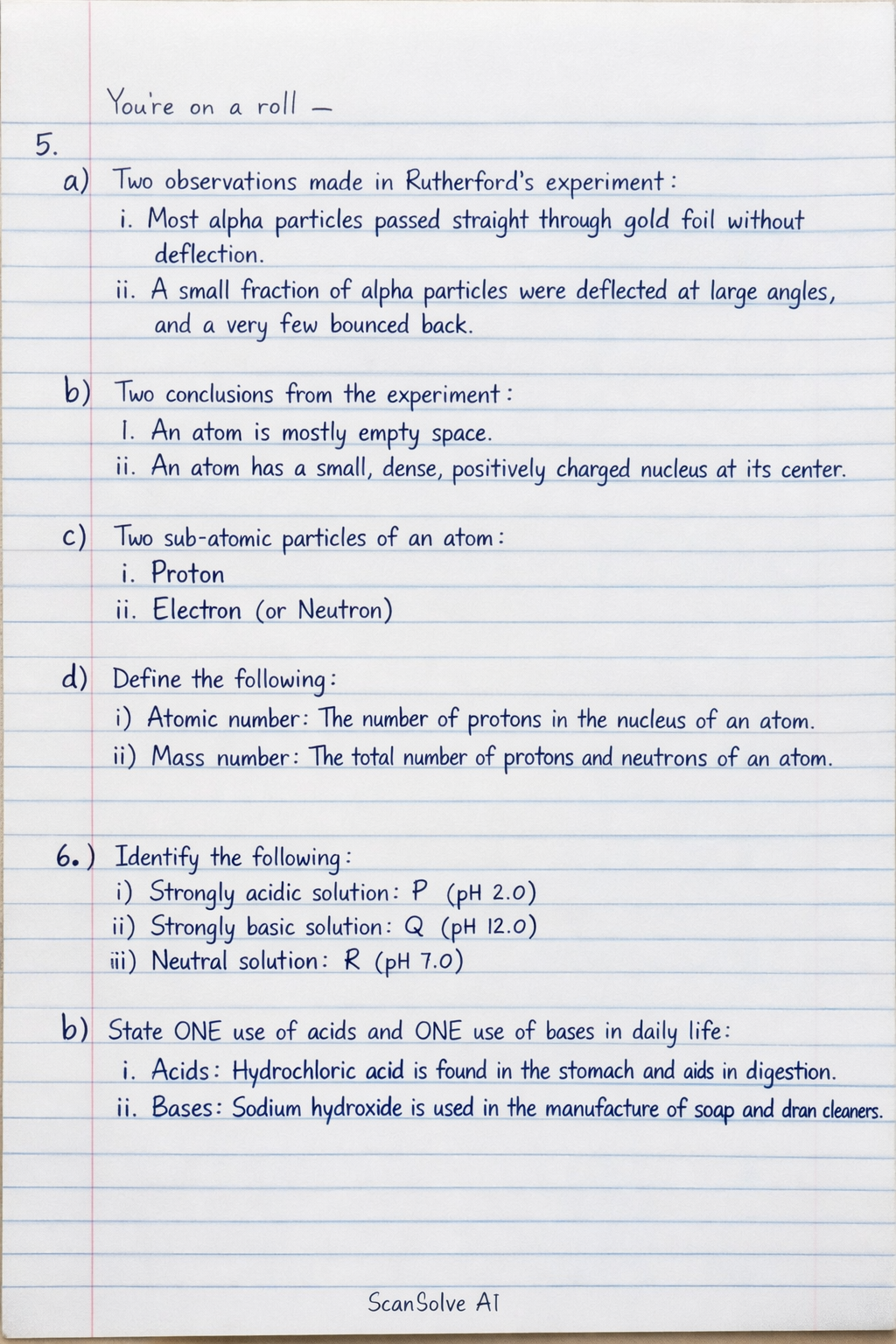
a) Two observations made in Rutherford's experiment:
i. Most alpha particles passed straight through the gold foil without deflection.
ii. A small fraction of alpha particles were deflected at large angles, and a very few bounced back.
b) Two conclusions from the experiment:
i. An atom is mostly empty space.
ii. An atom has a small, dense, positively charged nucleus at its center.
c) Two sub-atomic particles of an atom:
i. Proton
ii. Electron (or Neutron)
d) Define the following:
i) Atomic number: The number of protons in the nucleus of an atom.
ii) Mass number: The total number of protons and neutrons in the nucleus of an atom.
a) Identify the following:
i) Strongly acidic solution: P (pH 2.0)
ii) Strongly basic solution: Q (pH 12.0)
iii) Neutral solution: R (pH 7.0)
b) State ONE use of acids and ONE use of bases in daily life:
i. Acids: Hydrochloric acid is found in the stomach and aids in digestion.
ii. Bases: Sodium hydroxide is used in the manufacture of soap and drain cleaners.
Still stuck on this one?
Ask a follow-up, and the answer starts from this question.
More Physics Questions
Handwritten Step-by-Step Solution
Get this as a handwritten image on WhatsApp — like a tutor wrote it for you.
Try on WhatsApp