
We read your photo as:
What are the effects of alkaline soil on crop growth, and how can acidic and alkaline soils be corrected and tested?
ScanSolve AI Answer
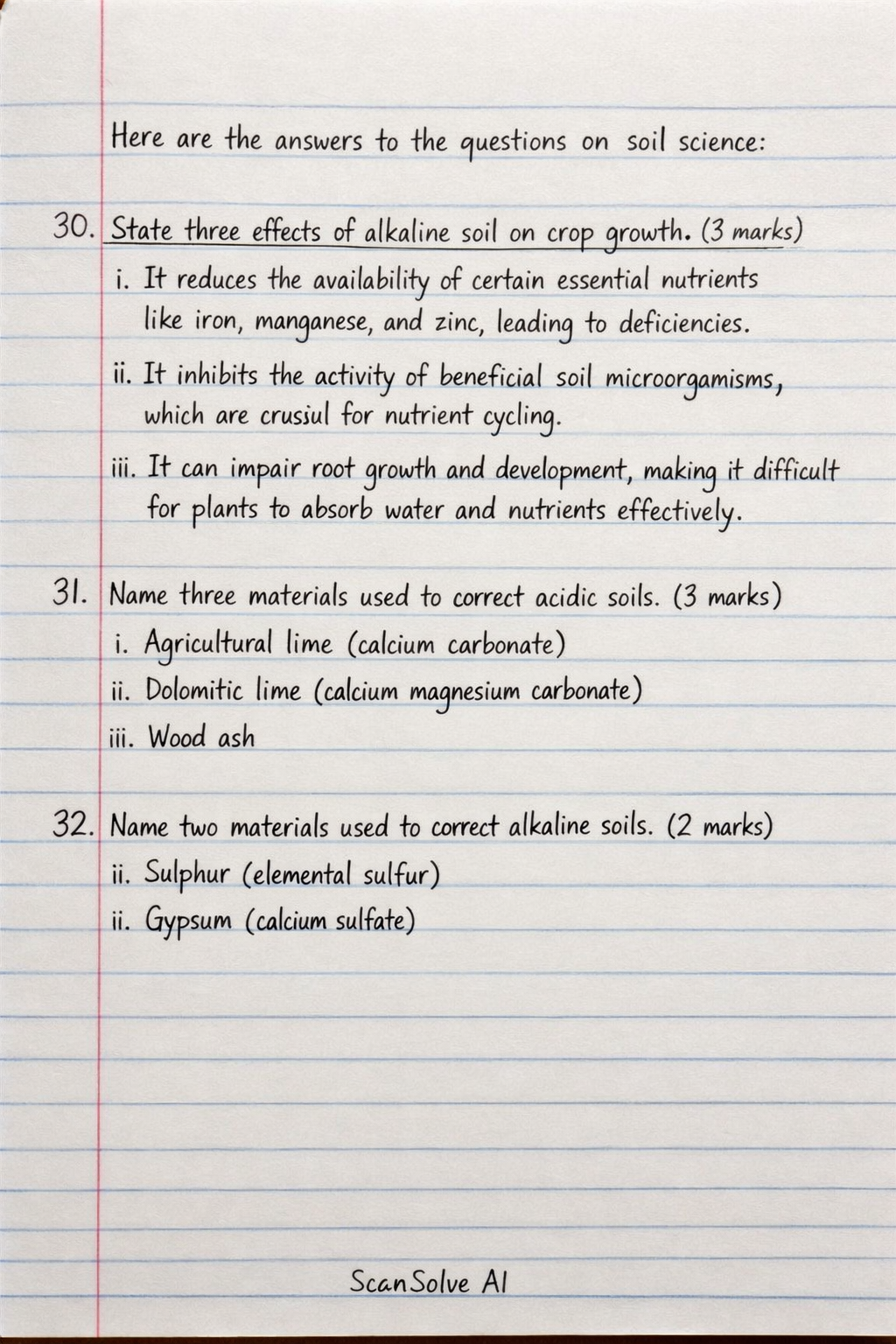
Here are the answers to the questions on soil science:
30. State three effects of alkaline soil on crop growth. (3 marks)
i. It reduces the availability of certain essential nutrients like iron, manganese, and zinc, leading to deficiencies.
ii. It inhibits the activity of beneficial soil microorganisms, which are crucial for nutrient cycling.
iii. It can impair root growth and development, making it difficult for plants to absorb water and nutrients effectively.
31. Name three materials used to correct acidic soils. (3 marks)
i. Agricultural lime (calcium carbonate)
ii. Dolomitic lime (calcium magnesium carbonate)
iii. Wood ash
32. Name two materials used to correct alkaline soils. (2 marks)
i. Sulphur (elemental sulfur)
ii. Gypsum (calcium sulfate)
33. Describe two ways of testing soil pH in a school laboratory. (4 marks)
i. Using a pH meter: A soil sample is mixed with distilled water to form a slurry. The electrodes of a calibrated pH meter are then inserted into the slurry, and the pH reading is taken directly from the meter's display.
ii. Using universal indicator solution or pH paper: A small soil sample is mixed with distilled water. A few drops of universal indicator solution are added, or a strip of pH paper is dipped into the mixture. The resulting color is then compared to a standard pH color chart to determine the soil's pH.
34. Explain what is meant by soil humus. (2 marks)
Soil humus is the stable, dark, amorphous organic matter that remains after the decomposition of plant and animal residues by microorganisms. It is highly resistant to further decomposition and plays a crucial role in soil fertility.
35. State three benefits of humus in crop production. (3 marks)
i. It improves soil structure, making it more friable and enhancing aeration and drainage.
ii. It increases the soil's water-holding capacity, allowing plants to access moisture for longer periods.
iii. It enhances nutrient retention (cation exchange capacity) and provides a slow release of essential nutrients to plants.
36. Name four living organisms found in soil. (4 marks)
i. Bacteria
ii. Fungi
iii. Earthworms
iv. Moles
Still stuck on this one?
Ask a follow-up, and the answer starts from this question.
More Biology Questions
Handwritten Step-by-Step Solution
Get this as a handwritten image on WhatsApp — like a tutor wrote it for you.
Try on WhatsApp