
We read your photo as:
What are the factors affecting the sterilization when using an autoclave and how to determine object size using a microscope?
ScanSolve AI Answer
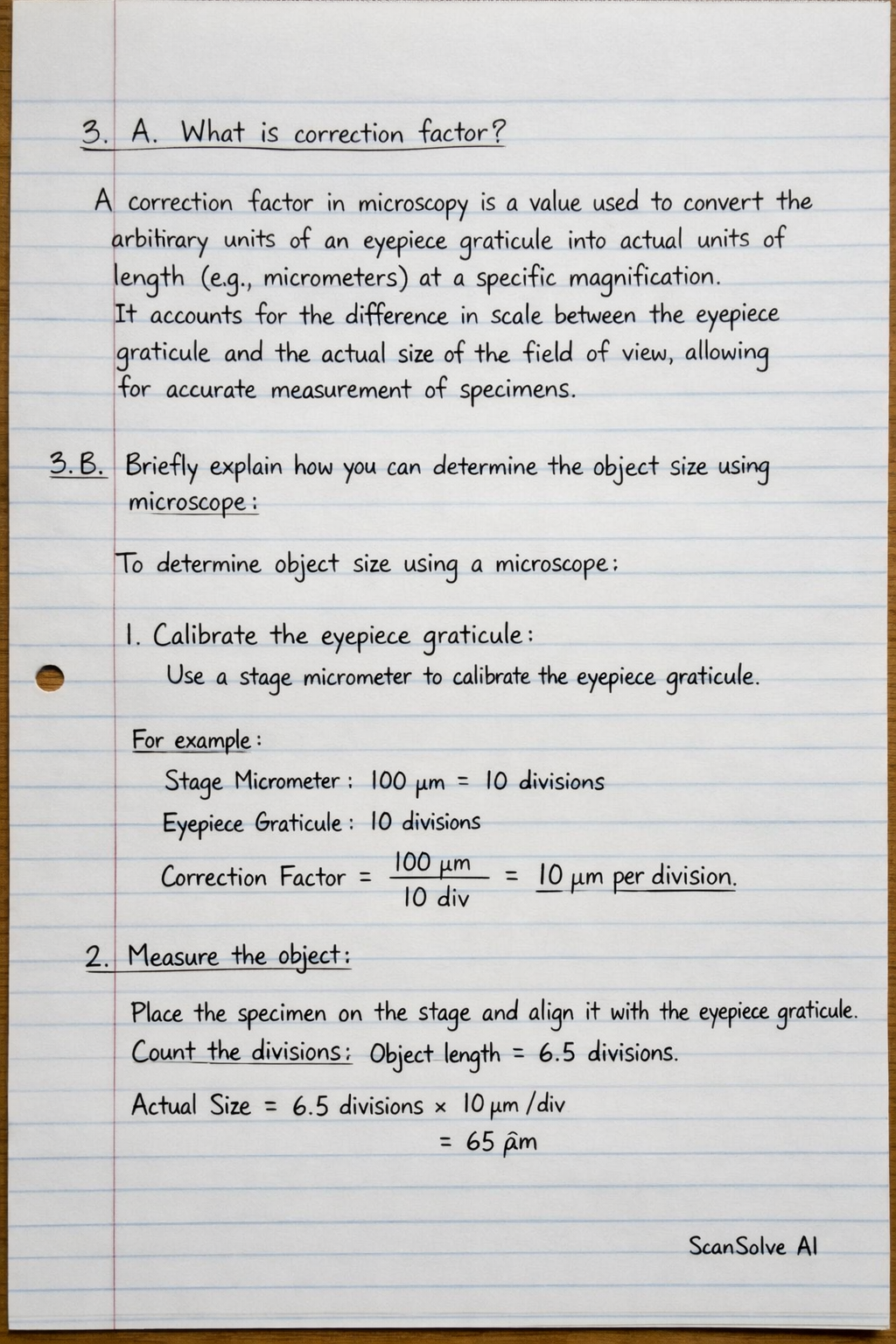
3. A. What is correction factor?
A correction factor in microscopy is a value used to convert the arbitrary units of an eyepiece graticule into actual units of length (e.g., micrometers) at a specific magnification. It accounts for the difference in scale between the eyepiece graticule and the actual size of the field of view, allowing for accurate measurement of specimens.
3. B. Briefly explain how you can determine the object size using microscope;
To determine object size using a microscope:
- Calibrate the eyepiece graticule: Use a stage micrometer (a slide with a precisely measured scale) to calibrate the eyepiece graticule at each objective lens magnification. This determines how many micrometers correspond to one eyepiece graticule unit at that specific magnification.
- Measure the object: Place the specimen on the stage and align it with the eyepiece graticule. Measure the length or width of the object in eyepiece graticule units.
- Calculate actual size: Multiply the measured number of eyepiece graticule units by the calibration factor (micrometers per eyepiece unit) determined in step 1 for that specific magnification.
4. What are the factors affecting the sterilization when using autoclave;
The effectiveness of sterilization using an autoclave is influenced by several factors:
- Temperature: Higher temperatures (typically or ) are more effective at killing microorganisms.
- Time: The duration of exposure to the high temperature and pressure is critical for complete microbial inactivation, ensuring heat penetration to all parts of the load.
- Pressure: Increased pressure raises the boiling point of water, allowing steam to reach the required high temperatures for sterilization.
- Steam quality: Saturated steam (steam containing minimal liquid water droplets) is essential for efficient heat transfer and penetration into materials.
- Loading and packaging: Proper loading ensures steam can circulate freely around all items. Packaging must be permeable to steam but impermeable to microorganisms after sterilization.
- Presence of organic material: Organic matter (e.g., blood, tissue) can protect microorganisms from heat, requiring longer exposure times or thorough cleaning prior to autoclaving.
Still stuck on this one?
Ask a follow-up, and the answer starts from this question.
More Biology Questions
Handwritten Step-by-Step Solution
Get this as a handwritten image on WhatsApp — like a tutor wrote it for you.
Try on WhatsApp