
We read your photo as:
Explain how the information encoded in DNA is used to make protein.
ScanSolve AI Answer
Step-by-step solution
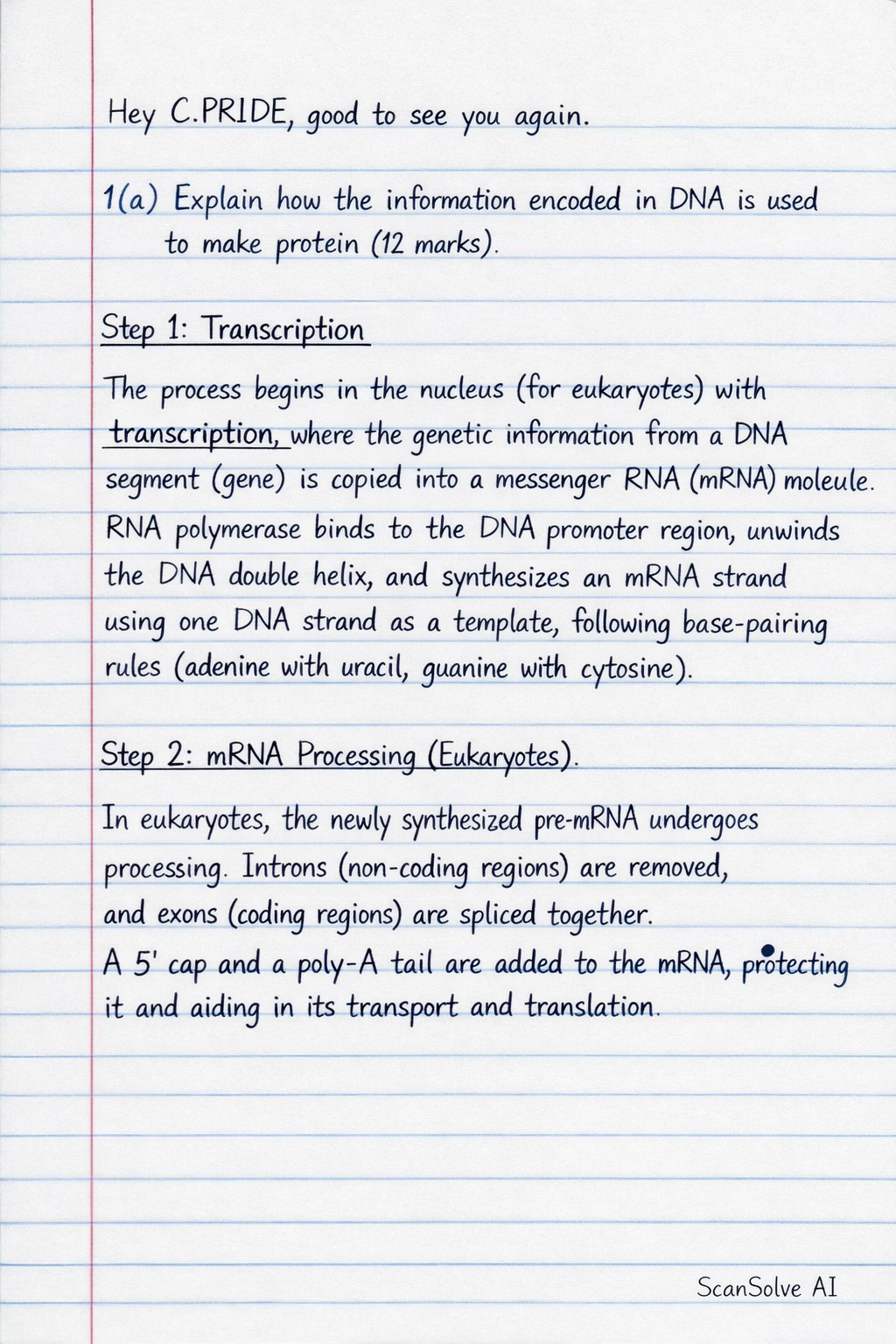
10 steps1(a) Explain how the information encoded in DNA is used to make protein (12 marks)
Transcription
The process begins in the nucleus (for eukaryotes) with transcription, where the genetic information from a DNA segment (gene) is copied into a messenger RNA (mRNA) molecule. RNA polymerase binds to the DNA promoter region, unwinds the DNA double helix, and synthesizes an mRNA strand using one DNA strand as a template, following base-pairing rules (adenine with uracil, guanine with cytosine).
mRNA Processing (Eukaryotes)
In eukaryotes, the newly synthesized pre-mRNA undergoes processing. Introns (non-coding regions) are removed, and exons (coding regions) are spliced together. A 5' cap and a poly-A tail are added to the mRNA, protecting it and aiding in its transport and translation.
Translation Initiation
The mature mRNA molecule then moves out of the nucleus into the cytoplasm and binds to a ribosome. Translation begins when the ribosome scans the mRNA for the start codon (AUG). An initiator transfer RNA (tRNA) molecule, carrying the amino acid methionine, binds to this start codon.
Translation Elongation
The ribosome moves along the mRNA, reading codons (sequences of three nucleotides). For each codon, a specific tRNA molecule, carrying its corresponding amino acid, binds to the codon via its anticodon. The ribosome catalyzes the formation of a peptide bond between the amino acid carried by the incoming tRNA and the growing polypeptide chain.
Translation Termination
Elongation continues until the ribosome encounters a stop codon (UAA, UAG, or UGA) on the mRNA. There are no tRNAs that recognize stop codons. Instead, release factors bind to the stop codon, causing the polypeptide chain to be released from the ribosome.
Protein Folding
The newly synthesized polypeptide chain then folds into a specific three-dimensional structure, often aided by chaperone proteins, to become a functional protein.
1(b) How is the synthesis of proteins regulated by enzyme induction and repression (8 marks)?
Enzyme Induction
Enzyme induction is a mechanism where the presence of a specific substrate (an inducer) increases the synthesis of enzymes required for its metabolism. A classic example is the lac operon in E. coli. In the absence of lactose, a repressor protein binds to the operator region of the operon, blocking RNA polymerase and preventing transcription of genes for lactose metabolism. When lactose is present, it acts as an inducer, binding to the repressor protein. This binding changes the repressor's shape, preventing it from binding to the operator, thus allowing RNA polymerase to transcribe the genes and synthesize the enzymes needed to break down lactose.
Enzyme Repression
Enzyme repression is a mechanism where the presence of an end-product (a corepressor) decreases the synthesis of enzymes involved in its production. An example is the trp operon in E. coli. When tryptophan levels are low, a repressor protein is inactive and cannot bind to the operator, allowing transcription of genes for tryptophan synthesis. However, when tryptophan is abundant, it acts as a corepressor, binding to the repressor protein. This complex then binds to the operator, blocking RNA polymerase and preventing the transcription of genes that produce tryptophan, thus conserving energy.
2(a) With the aid of suitable examples, distinguish between metagenesis and alternation of generations (4 marks)
Alternation of Generations
Alternation of generations describes a life cycle in which there are two distinct multicellular stages: a haploid gametophyte and a diploid sporophyte. The gametophyte produces gametes by mitosis, which fuse to form a zygote that develops into a sporophyte. The sporophyte produces spores by meiosis, which germinate to form new gametophytes. Both stages are typically multicellular and often free-living.
Example: Most plants, such as mosses, ferns, and flowering plants, exhibit alternation of generations.Metagenesis
Metagenesis refers to a life cycle, primarily observed in some animals, where there is an alternation between a sexual reproductive stage and an asexual reproductive stage. This often involves an alternation between two different diploid forms, such as a sessile polyp (asexual) and a free-swimming medusa (sexual). It does not involve an alternation between haploid and diploid multicellular organisms in the same way as alternation of generations.
Example: Many Cnidarians, like jellyfish (Aurelia) and Obelia, display metagenesis, where the polyp stage reproduces asexually by budding, producing medusae that then reproduce sexually.
Still stuck on this one?
Ask a follow-up, and the answer starts from this question.
More Biology Questions
Handwritten Step-by-Step Solution
Get this as a handwritten image on WhatsApp — like a tutor wrote it for you.
Try on WhatsApp