
We read your photo as:
What are the key differences between prokaryotic and eukaryotic cells?
Biology
ScanSolve AI Answer
Here are the differences between prokaryotic and eukaryotic cells:
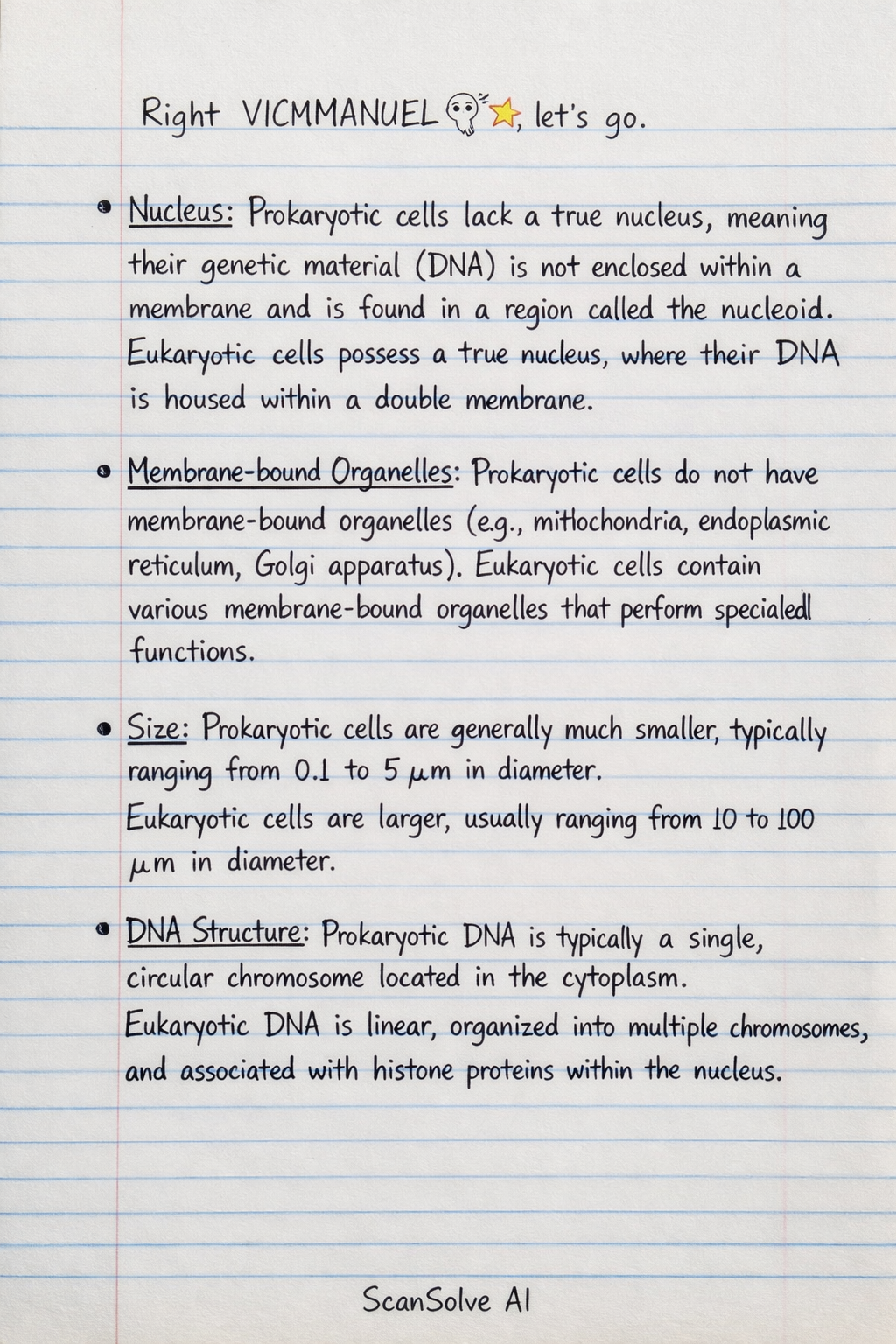
- Nucleus: Prokaryotic cells lack a true nucleus, meaning their genetic material (DNA) is not enclosed within a membrane and is found in a region called the nucleoid. Eukaryotic cells possess a true nucleus, where their DNA is housed within a double membrane.
- Membrane-bound Organelles: Prokaryotic cells do not have membrane-bound organelles (e.g., mitochondria, endoplasmic reticulum, Golgi apparatus). Eukaryotic cells contain various membrane-bound organelles that perform specialized functions.
- Size: Prokaryotic cells are generally much smaller, typically ranging from 0.1 to 5 in diameter. Eukaryotic cells are larger, usually ranging from 10 to 100 in diameter.
- DNA Structure: Prokaryotic DNA is typically a single, circular chromosome located in the cytoplasm. Eukaryotic DNA is linear, organized into multiple chromosomes, and associated with histone proteins within the nucleus.
- Ribosomes: Both cell types have ribosomes, but prokaryotic ribosomes are smaller () compared to eukaryotic ribosomes ().
- Cell Division: Prokaryotic cells reproduce asexually primarily through binary fission. Eukaryotic cells divide by mitosis for somatic cells and meiosis for germ cells.
Was this helpful?
Still stuck on this one?
Ask a follow-up, and the answer starts from this question.
Got a different question?Ask your own question
More Biology Questions
QDescribe prokaryotic and eukaryotic cells with diagrams and differentiate them in tabular form.QWhat are the key structural differences between plant and animal cells?QFeature Prokaryotic Eukaryotic Nucleus No true nucleus True nucleus Nuclear membrane Absent Present…QPlant Cell and Animal Cell, Difference, Structure of Chloroplast, Mitochondria, Nucleus, Ribosome…QTabulate three differences between a plant cell and a animal cell
Browse by topic:Microbiology
Handwritten Step-by-Step Solution
Get this as a handwritten image on WhatsApp — like a tutor wrote it for you.
Try on WhatsApp