
We read your photo as:
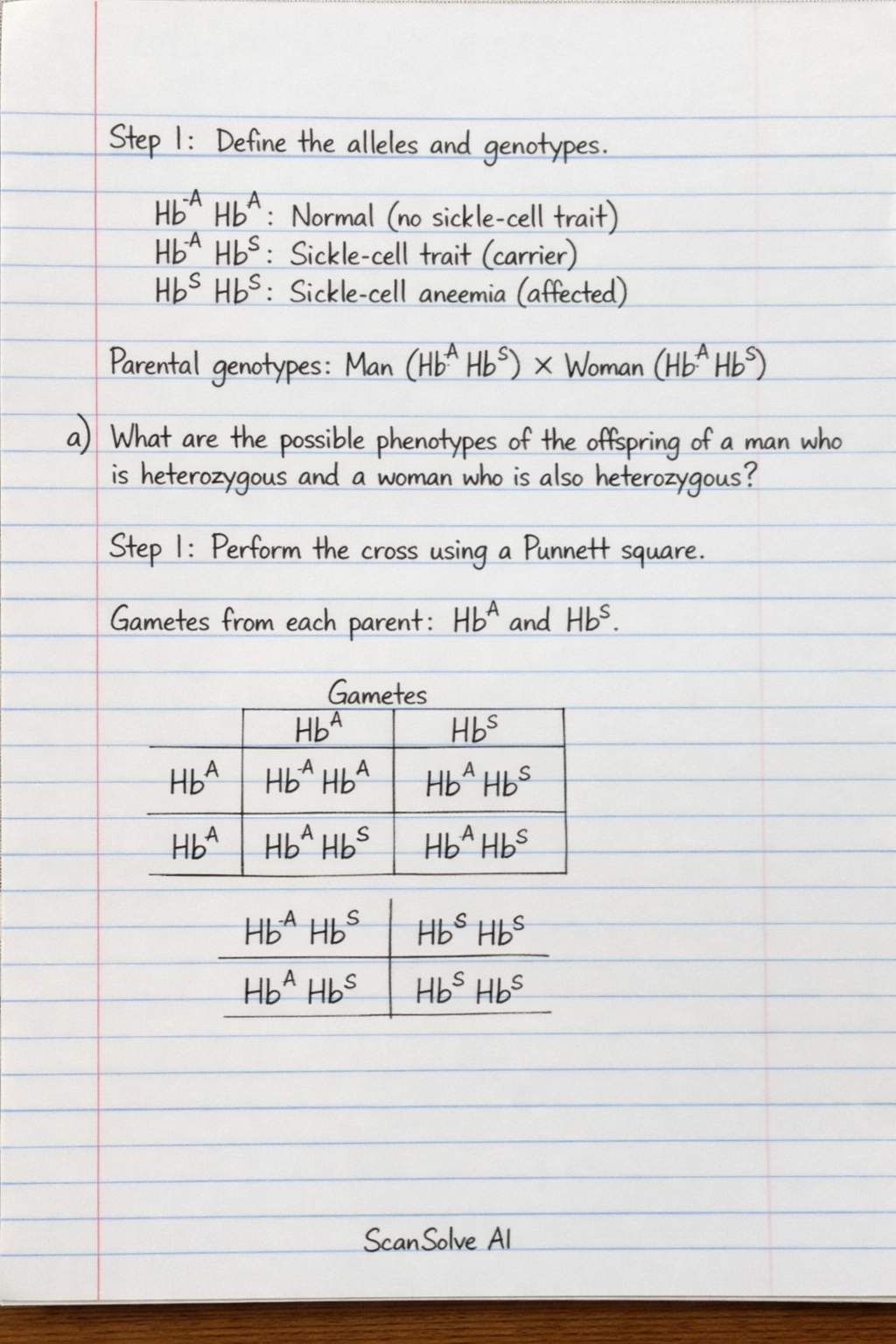
The problem states that normal haemoglobin is Hb^A and abnormal haemoglobin (sickle-cell) is Hb^S. Sickle-cell anaemia is due to a recessive gene, meaning Hb^S is recessive to Hb^A.
ScanSolve AI Answer
Step-by-step solution
3 stepsDefine the alleles and genotypes.
The problem states that normal haemoglobin is Hb and abnormal haemoglobin (sickle-cell) is Hb. Sickle-cell anaemia is due to a recessive gene, meaning Hb is recessive to Hb.
Genotypes and their corresponding phenotypes:
- HbHb: Normal (no sickle-cell trait)
- HbHb: Sickle-cell trait (carrier)
- HbHb: Sickle-cell anaemia (affected)
The cross is between a man who is heterozygous and a woman who is also heterozygous.
Parental genotypes: Man (HbHb) Woman (HbHb)a) What are the possible phenotypes of the offspring of a man who is heterozygous and a woman who is also heterozygous?
Perform the cross using a Punnett square.
Gametes from each parent are Hb and Hb.
Determine the phenotypes from the genotypes.
- HbHb: Normal
- HbHb: Sickle-cell trait
- HbHb: Sickle-cell anaemia
The possible phenotypes of the offspring are:
b) What proportion of the offspring would have been:
b) (i) Sickle-cell anaemia?
Sickle-cell anaemia corresponds to the genotype HbHb.
From the Punnett square, 1 out of 4 offspring has the genotype HbHb.The proportion of offspring with sickle-cell anaemia is:
b) (ii) Sickle-cell trait?
Sickle-cell trait corresponds to the genotype HbHb.
From the Punnett square, 2 out of 4 offspring have the genotype HbHb.The proportion of offspring with sickle-cell trait is:
Still stuck on this one?
Ask a follow-up, and the answer starts from this question.
More Biology Questions
Handwritten Step-by-Step Solution
Get this as a handwritten image on WhatsApp — like a tutor wrote it for you.
Try on WhatsApp