
We read your photo as:
What are the purposes of boiling and cooling the glucose solution, adding an oil layer, and the equation for yeast fermentation?
ScanSolve AI Answer
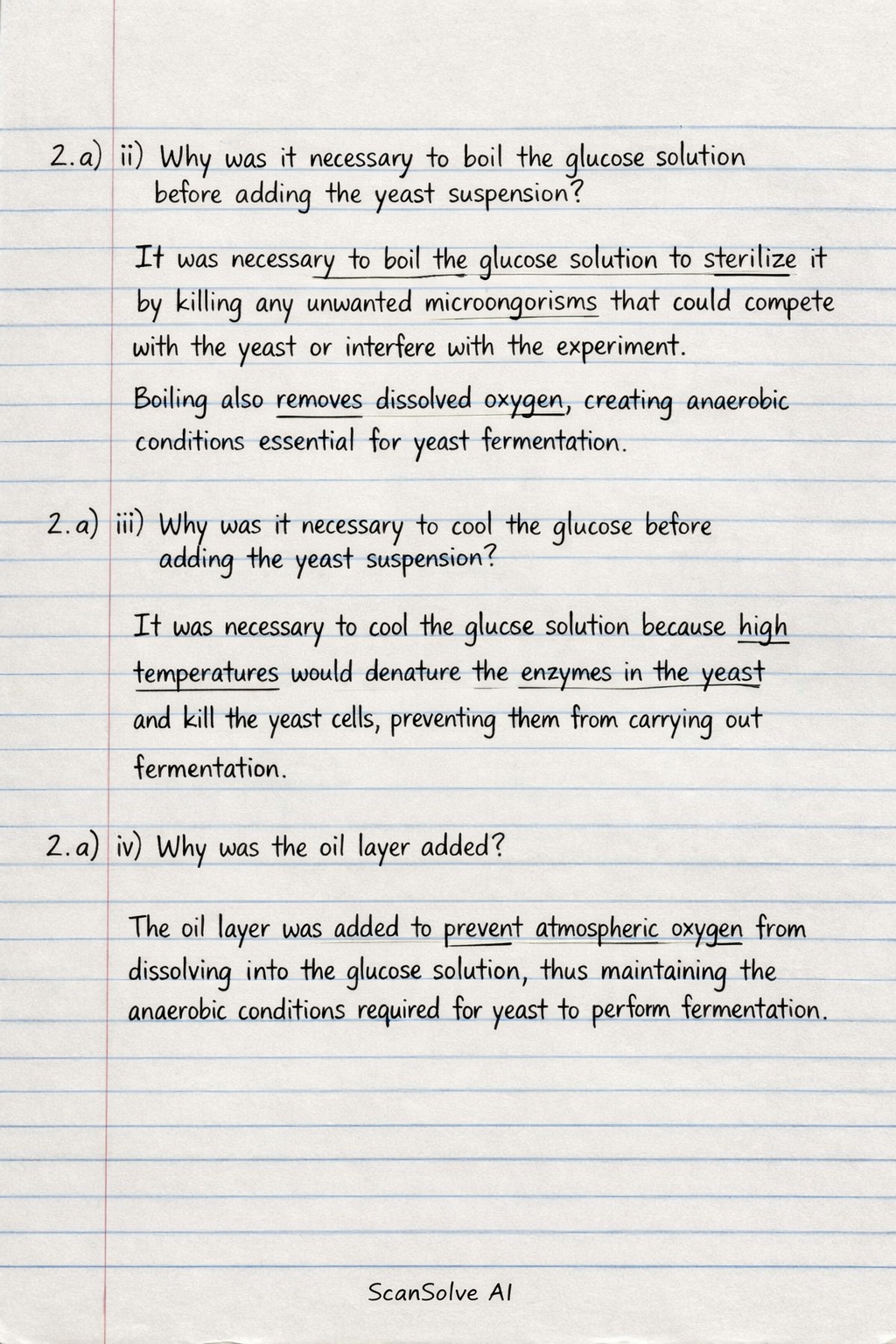
2. a) ii) Why was it necessary to boil the glucose solution before adding the yeast suspension?
- It was necessary to boil the glucose solution to sterilize it by killing any unwanted microorganisms that could compete with the yeast or interfere with the experiment. Boiling also removes dissolved oxygen, creating anaerobic conditions essential for yeast fermentation.
2. a) iii) Why was it necessary to cool the glucose before adding the yeast suspension?
- It was necessary to cool the glucose solution because high temperatures would denature the enzymes in the yeast and kill the yeast cells, preventing them from carrying out fermentation.
2. a) iv) Why was the oil layer added?
- The oil layer was added to prevent atmospheric oxygen from dissolving into the glucose solution, thus maintaining the anaerobic conditions required for yeast to perform fermentation.
2. a) v) Write down the equation for the chemical reaction that took place in the boiling tube.
2. a) vi) State the observations made in the test tube after 45 minutes.
- Bubbles of gas (carbon dioxide) would be seen rising through the solution.
- The solution would appear cloudy due to the growth and activity of the yeast.
3. The diagram below represents a simplified nitrogen cycle.
3. a) Name the group of bacteria represented by:
- A: Nitrogen-fixing bacteria (e.g., Rhizobium, Azotobacter)
- B: Denitrifying bacteria (e.g., Pseudomonas, Thiobacillus denitrificans)
3. a) i) Name the group of organisms represented by C.
- C represents Plants (or Producers).
3. a) ii) Give the reasons for your answer in b (i) above.
- Plants absorb nitrates from the soil (which are derived from atmospheric nitrogen through fixation) and convert them into organic nitrogen compounds like proteins and nucleic acids. Animals then obtain nitrogen by consuming these plants.
3. b) i) Define the term nitrification.
- Nitrification is the biological process where ammonia () or ammonium () is oxidized to nitrite () and then to nitrate () by specific nitrifying bacteria in the soil.
3. b) ii) Explain how excessive use of pesticides will affect nitrification.
- Excessive use of pesticides can kill or inhibit the activity of beneficial nitrifying bacteria (such as Nitrosomonas and Nitrobacter) in the soil. This reduction in bacterial populations will decrease the rate of nitrification, leading to a lower conversion of ammonia to nitrates. Consequently, the availability of nitrates, which are essential for plant growth, will be reduced.
Still stuck on this one?
Ask a follow-up, and the answer starts from this question.
More Biology Questions
Handwritten Step-by-Step Solution
Get this as a handwritten image on WhatsApp — like a tutor wrote it for you.
Try on WhatsApp