
We read your photo as:
The solution describes an experiment investigating the role of carbon dioxide in photosynthesis using two potted plants (A and B), potassium hydroxide, and sodium hydrogen carbonate. It asks about sta
ScanSolve AI Answer
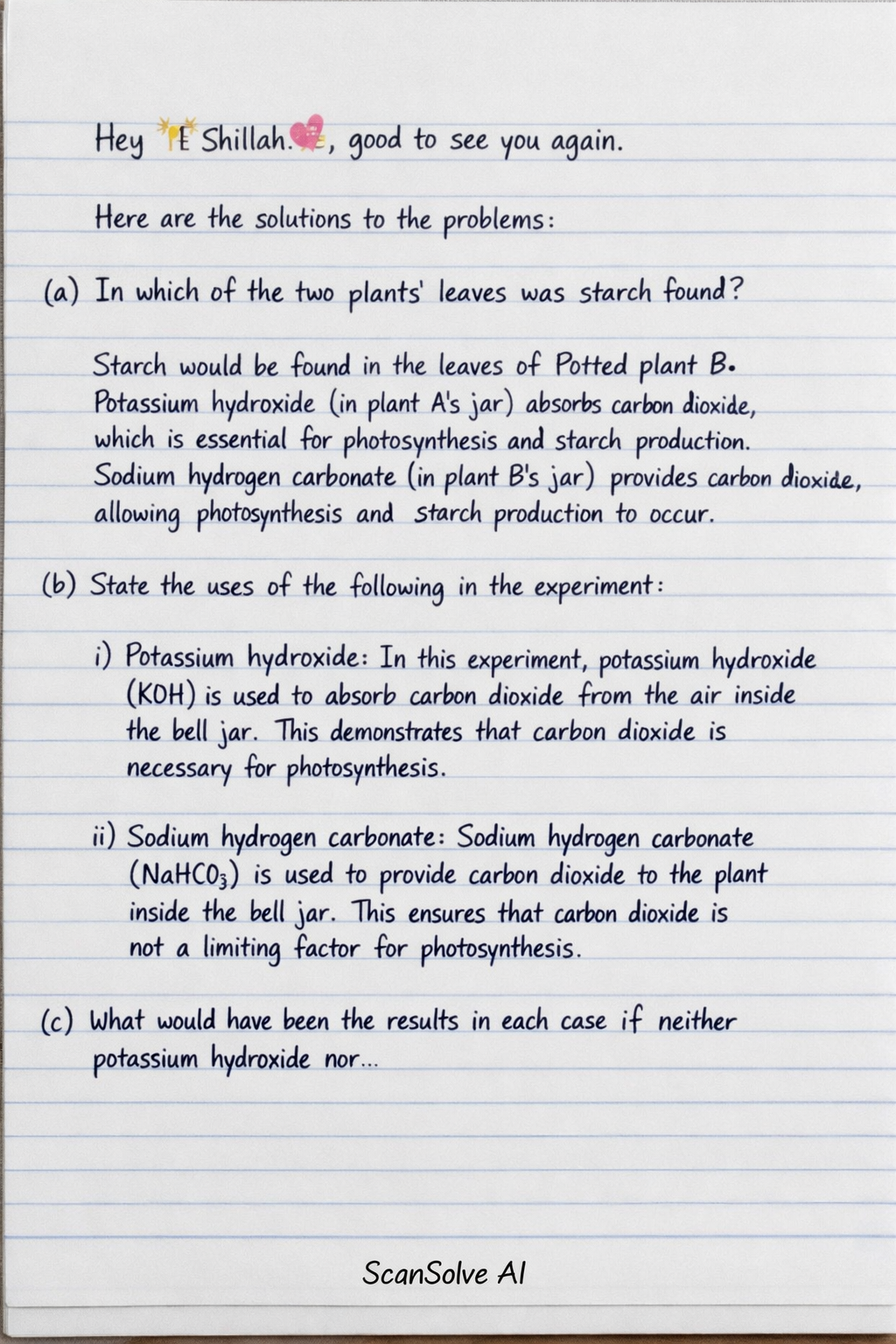
Here are the solutions to the problems:
a) In which of the two plants' leaves was starch found?
Starch would be found in the leaves of Potted plant B. Potassium hydroxide (in plant A's jar) absorbs carbon dioxide, which is essential for photosynthesis and starch production. Sodium hydrogen carbonate (in plant B's jar) provides carbon dioxide, allowing photosynthesis and starch production to occur.
b) State the uses of the following in the experiment:
- i) Potassium hydrogen (hydroxide): In this experiment, potassium hydroxide (KOH) is used to absorb carbon dioxide from the air inside the bell jar. This demonstrates that carbon dioxide is necessary for photosynthesis.
- ii) Sodium hydrogen carbonate: Sodium hydrogen carbonate (NaHCO₃) is used to provide carbon dioxide to the plant inside the bell jar. This ensures that carbon dioxide is not a limiting factor for photosynthesis.
c) What would have been the results in each case if neither potassium hydroxide nor...
The question is cut off, but assuming it asks what would happen if neither chemical was present (i.e., both plants were in bell jars with normal atmospheric air):
If neither potassium hydroxide nor sodium hydrogen carbonate were present, both plants would have access to the atmospheric carbon dioxide inside their bell jars. Therefore, both Potted plant A and Potted plant B would have produced starch in their leaves, assuming sufficient light and water.
Still stuck on this one?
Ask a follow-up, and the answer starts from this question.
More Biology Questions
Handwritten Step-by-Step Solution
Get this as a handwritten image on WhatsApp — like a tutor wrote it for you.
Try on WhatsApp