

This biology question covers important biological concepts and processes. The step-by-step explanation below helps you understand the underlying mechanisms and reasoning.
ScanSolve AI Answer
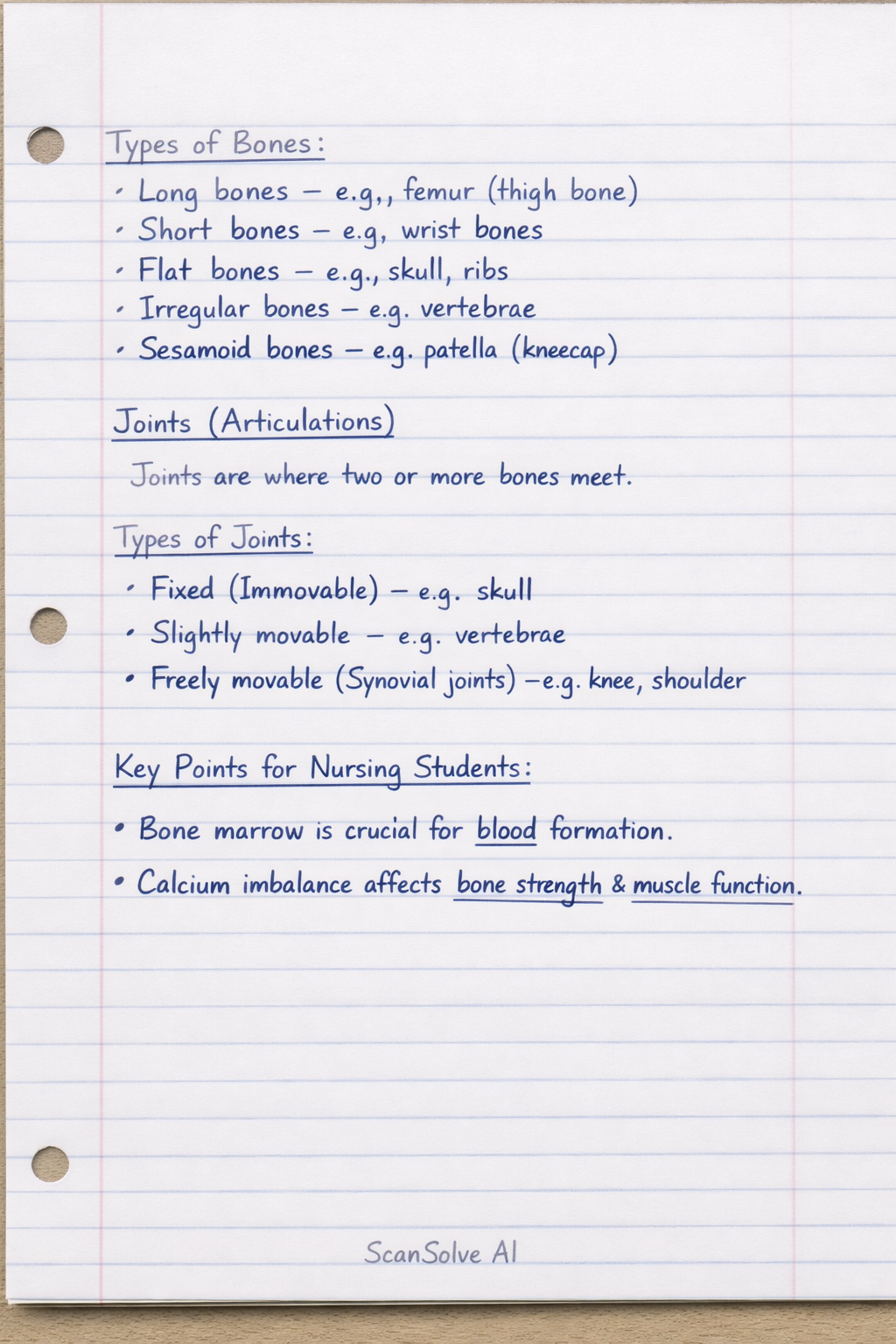
Here is the information from the image: Types of Bones Long bones* – e.g., femur (thigh bone) Short bones* – e.g., wrist bones Flat bones* – e.g., skull, ribs Irregular bones* – e.g., vertebrae Sesamoid bones* – e.g., patella (kneecap) Joints (Articulations) Joints are where two or more bones meet. Types of Joints: Fixed (Immovable)* – e.g., skull Slightly movable* – e.g., vertebrae Freely movable (Synovial joints)* – e.g., knee, shoulder Key Points for Nursing Students Bone marrow is crucial for blood formation*. Calcium imbalance affects bone strength and muscle function*.